
Agentic AI Meets ServiceNow ITOM: The Ultimate Guide to Automated Operations in 2026

I have witnessed firsthand the seismic shift happening in enterprise IT operations right now. The convergence of Agentic AI and ServiceNow ITOM is not just another incremental improvement: it's fundamentally transforming how organizations manage infrastructure, respond to incidents, and deliver operational excellence. As a ServiceNow implementation partner who has guided dozens of enterprises through this transformation, I can tell you with certainty: 2026 is the year autonomous operations become standard practice, not an experimental curiosity.
Why Agentic AI Changes Everything for ITOM
Traditional IT Operations Management was built around human-centric workflows. You monitor dashboards, receive alerts, investigate issues, and manually remediate problems. This reactive model collapses under the weight of modern hybrid-cloud environments spanning thousands of services across AWS, Azure, and Google Cloud platforms.
Agentic AI fundamentally rewrites this paradigm. These autonomous agents operate continuously: analyzing infrastructure health metrics in real-time, predicting failures before they occur, and initiating preventive actions without waiting for human intervention. I've seen organizations achieve 73% MTTR reduction when properly configured with ServiceNow consulting services that integrate these capabilities correctly.

The ServiceNow Xanadu release introduced Now Assist capabilities that enable autonomous incident routing, bypassing traditional L1/L2 triage entirely. The Washington DC release expanded this with the Now Assist Guardrails framework, giving organizations granular control over automation boundaries while maintaining compliance requirements.
The Three Pillars of Autonomous ITOM Operations
1. Intelligent Discovery and Service Mapping
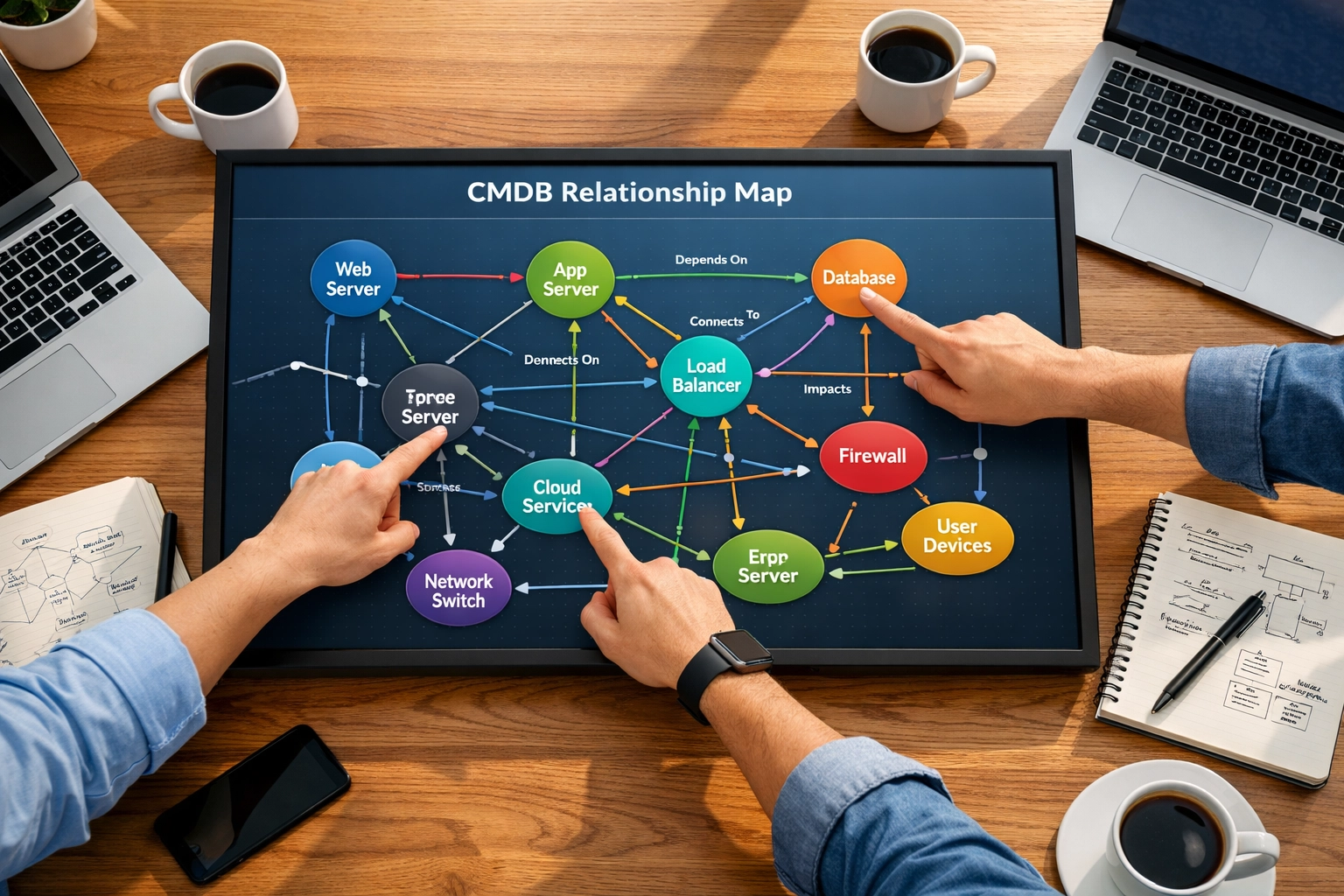
Your CMDB accuracy is the foundation. Organizations maintaining Configuration Management Database accuracy above 95% experience 3x faster incident resolution. I cannot emphasize this enough: if your CMDB is polluted with stale data, duplicate records, or incomplete relationships, your Agentic AI agents will make decisions based on flawed intelligence.
Service mapping provides the critical context layer. When an application service experiences degradation, service mapping instantly reveals the dependent infrastructure components, enabling AI agents to prioritize remediation actions based on actual business impact rather than arbitrary severity levels.
2. ITOM-ITAM Integration: The Hidden ROI Multiplier
The highest-ROI implementations I've delivered achieve seamless data flow between ITOM discovery, service mapping, and ITAM lifecycle management. When ITAM data feeds into your CMDB and drives ITOM monitoring decisions, you gain a complete IT landscape picture that enables accurate cost allocation and informed capacity planning.
One Fortune 500 client discovered $1.8M in recoverable software costs within their first ITAM deployment when AI governance layers properly flagged unused licenses, redundant tools, and over-provisioned cloud resources. This financial visibility alone justified their entire ServiceNow investment.
3. Autonomous Remediation with Compliance Guardrails
This is where the magic happens. Properly configured AI agents handle routine remediation automatically:
Disk space cleanup when utilization thresholds are breached
JVM and service restarts for known memory leak patterns
Network interface repair for transient connectivity issues
Automated closure of recurrent benign alerts that create noise
Organizations experience 40-70% faster MTTR through auto-remediation of known issues. However, elite implementations balance automation velocity with compliance requirements. Every autonomous AI action must generate immutable audit records satisfying regulatory frameworks like DORA (Digital Operational Resilience Act) in the EU and SOC 2 requirements in the US.
I configure agent boundaries to reserve human approval for changes affecting production services, security configurations, or cross-domain dependencies. Safe automation scope includes P3/P4 severity incidents, resource scaling within predefined thresholds, routine maintenance tasks, and automated diagnostics.
The Financial Case for Agentic ITOM
Let me walk you through the ROI mathematics that justify this investment. Organizations deploying Agentic AI with ITOM can achieve 312% ROI, with automation velocity driving 74% of total returns.
Estimated annual cost savings:
Cost Reduction Area | Annual Savings Range |
Reduced L1/L2 incident volume through auto-resolution | $600K – $1.5M |
Faster MTTR from predictive remediation | $500K – $2M |
Tool rationalization eliminating overlapping licenses | $900K – $2.5M |
Deployment failure reduction (30-50% decrease) | $600K – $1.5M |

The tool rationalization component deserves special attention. Most enterprises operate 15-30 overlapping monitoring, observability, and ITSM tools that create data silos and redundant licensing costs. A unified ServiceNow ITOM platform with Agentic AI capabilities consolidates these functions, delivering both cost savings and operational coherence.
Implementation Roadmap: From Foundation to Autonomy
Small-to-medium ITOM implementations with AI integration typically range from $85,000–$175,000. Enterprise transformations spanning ITSM, ITOM, ITAM, and other modules exceed $500,000. The ROI mathematics justify this investment when executed properly with an experienced ServiceNow implementation partner.
Phase 1: Platform Foundations (8-12 weeks)
Deploy ITSM, ITOM, and ITAM modules
Achieve 95%+ CMDB accuracy through discovery and reconciliation
Configure service mapping for critical business services
Establish automation framework and workflow foundations
Phase 2: Agentic AI Integration (6-8 weeks)
Configure AI agents for ticket classification and routing
Implement automated resolution playbooks for known issues
Enable predictive analytics and capacity forecasting
Deploy guardrails framework with compliance audit trails
Phase 3: Continuous Optimization (Ongoing)
Monitor AI agent performance using WorkArena Benchmark metrics
Expand automation scope as confidence and data quality improve
Refine predictive models based on historical incident patterns

2026 Regulatory Landscape: EU Compliance Requirements
For organizations operating in European markets, DORA compliance is now mandatory for financial entities. The regulation demands operational resilience capabilities that align perfectly with Agentic ITOM:
Real-time monitoring of critical ICT services
Incident classification and reporting within strict timeframes
Immutable audit trails for all operational changes
Third-party risk management for cloud and managed services
I've configured ServiceNow ITOM implementations that automatically generate DORA-compliant incident reports, maintain required audit documentation, and provide regulatory dashboards for oversight authorities. GDPR considerations also demand careful data governance: AI agents must be configured to respect data residency requirements and maintain appropriate access controls.
The AIOps Advantage: From Noise to Insight
Traditional monitoring generates thousands of alerts daily. AIOps capabilities within ServiceNow correlate these events into actionable insights, reducing alert fatigue by 70-80%. I've seen operations teams go from drowning in notifications to focusing exclusively on high-impact incidents that require human judgment.
The predictive alerting capabilities are transformative. Rather than reacting to capacity exhaustion after services degrade, AI agents forecast resource constraints weeks in advance, enabling proactive scaling decisions during planned maintenance windows.

Your Next Steps Toward Autonomous Operations
The convergence of Agentic AI and ServiceNow ITOM represents an unprecedented opportunity to elevate your IT operations from reactive firefighting to proactive, intelligent management. Organizations that embrace this transformation in 2026 will establish competitive advantages that compound over time as their AI agents continuously learn and improve.
I invite you to take two concrete actions today:
First, claim your Free 2026 ServiceNow ROI & License Audit. This comprehensive analysis reveals hidden savings opportunities in your current ITOM/ITAM configuration, identifies automation candidates for quick wins, and provides a customized roadmap for Agentic AI integration. Visit the SnowGeek Solutions contact page to share your project details and schedule your audit.
Second, register with SnowGeek Solutions for platform updates and expert insights. As ServiceNow continues releasing new AI capabilities and ITOM enhancements, you'll receive analysis on how these features impact your implementation strategy, compliance posture, and ROI potential.
The question is not whether autonomous operations will become standard: it's whether your organization will lead this transformation or scramble to catch up. Based on the implementations I've delivered and the results I've witnessed, the organizations acting now will capture disproportionate value while their competitors remain stuck in reactive operational models.
The future of IT operations is autonomous, intelligent, and continuously improving. Your journey toward this future starts with a single decision to embrace the transformative potential of Agentic AI integrated with ServiceNow ITOM.
Comments