
7 Mistakes You're Making with ServiceNow ITOM in 2026 (and How a Free ROI Audit Fixes Them)
- SnowGeek Solutions
- Feb 18
- 6 min read

I have witnessed firsthand how organizations invest millions in ServiceNow ITOM implementations only to discover they're operating in what I call the "expensive mediocrity zone": where platforms function but deliver only 40-60% of their potential ROI. The 2026 regulatory landscape has raised the stakes dramatically, particularly with DORA compliance requirements in the EU and AI-driven automation expectations in the US market.
After conducting over 200 ITOM health assessments across financial services, manufacturing, and healthcare sectors, I've identified seven critical mistakes that consistently prevent organizations from achieving operational excellence with ServiceNow. More importantly, I will guide you through the precise fixes that transform underperforming implementations into strategic assets.
Mistake #1: Accepting Catastrophic CMDB Data Quality
Most organizations operate with CMDB accuracy between 60-75%, believing this represents acceptable baseline performance. This assumption becomes catastrophic when you deploy AI-enabled automation: which now represents standard practice in ServiceNow's Washington DC release and beyond.
I have witnessed a Fortune 500 financial institution lose $1.8M annually through failed automation workflows triggered by inaccurate CMDB data. Their incident management workflows routed tickets to decommissioned servers, change approvals referenced obsolete application dependencies, and their agentic AI assistants provided recommendations based on configuration items that hadn't existed for 18 months.
The Fix: ServiceNow's ITOM Health Log and Discovery reconciliation capabilities enable continuous data validation when properly architected. I recommend establishing weekly CMDB health scoring dashboards that track configuration item accuracy across critical classes: servers, applications, databases, network devices. Set automated alerts when accuracy drops below 95%, and implement event-driven workflows that quarantine suspicious CI updates pending validation.
For AI-driven operations, your CMDB accuracy must reach 98% or higher. Anything less creates compound errors that exponentially increase operational risk.

Mistake #2: Running Discovery Audits with Massive Blind Spots
Shadow IT exposure represents the silent budget killer I encounter in virtually every ITOM assessment. Organizations conduct basic discovery scans without comprehensive network traffic analysis, cloud spend reconciliation, or legacy system integration assessments.
One manufacturing client discovered $2.3M in untracked cloud spend through extended discovery scope analysis: AWS instances, Azure resources, and SaaS subscriptions operating completely outside ITAM workflows. Their discovery implementation captured only 60% of actual infrastructure because credential coverage gaps prevented full network visibility.
The Fix: Deploy ServiceNow Discovery with full credential coverage across your entire infrastructure footprint. Enable Service Mapping for complete application dependency visualization: this becomes essential for DORA compliance in EU markets where operational resilience mapping requirements demand comprehensive service documentation.
Integrate Cloud Insights for multi-cloud asset capture and schedule quarterly discovery audits specifically targeting shadow IT exposure through anomaly detection. The ServiceNow ITAM module's integration with Discovery enables automatic license assignment and compliance verification, transforming discovery from periodic audits into continuous asset intelligence.
Mistake #3: Operating ITOM and ITAM as Isolated Silos
Asset discovery isolated from asset management workflows creates duplicate efforts, compliance gaps, and missed cost optimization opportunities. I consistently observe organizations where Discovery identifies new configuration items but ITAM workflows remain manual, disconnected processes requiring separate data entry and reconciliation.
This architectural flaw becomes particularly expensive under GDPR and DORA frameworks, where asset lifecycle documentation must demonstrate complete audit trails from acquisition through disposal.
The Fix: Create event-driven automation where ITOM Discovery automatically triggers ITAM workflows through Flow Designer. When Discovery identifies a new CI, initiate license assignment, compliance verification, and cost allocation processes through Hardware Asset Management (HAM) and Software Asset Management (SAM) modules.
I design these integrations using ServiceNow's REST API architecture, enabling real-time synchronization between discovery events and asset management records. This approach delivers 40-60% reduction in manual asset reconciliation effort while ensuring compliance readiness.

Mistake #4: Retrofitting Compliance Instead of Architecting It
Bolting compliance frameworks onto existing implementations after deployment costs exponentially more than building them correctly initially. I recently assessed a manufacturing organization that spent $400K remediating compliance gaps: gaps that proper initial architecture would have prevented entirely.
The 2026 regulatory environment demands proactive compliance architecture, particularly for organizations operating in EU markets where DORA's operational resilience requirements take full effect this year. GDPR data sovereignty considerations and ESG reporting mandates require ITOM configurations that track data residency, energy consumption, and lifecycle management from day one.
The Fix: Design compliance into your ITOM architecture from inception. Map ServiceNow's Governance, Risk, and Compliance (GRC) module to ITOM workflows using the Integrated Risk Management (IRM) framework.
For DORA compliance, implement automated incident classification that tags events based on operational resilience thresholds: distinguishing between routine incidents and ICT-related incidents requiring regulatory reporting. Create audit trails documenting all configuration changes with business justification and impact analysis.
Architecture ESG reporting capabilities into your CMDB structure initially by tracking IT asset energy consumption, hardware lifecycle data, and decommissioning workflows. This proactive approach transforms compliance from expensive remediation cycles into seamless operational processes.
Mistake #5: Creating Service Health Dashboards That Lie
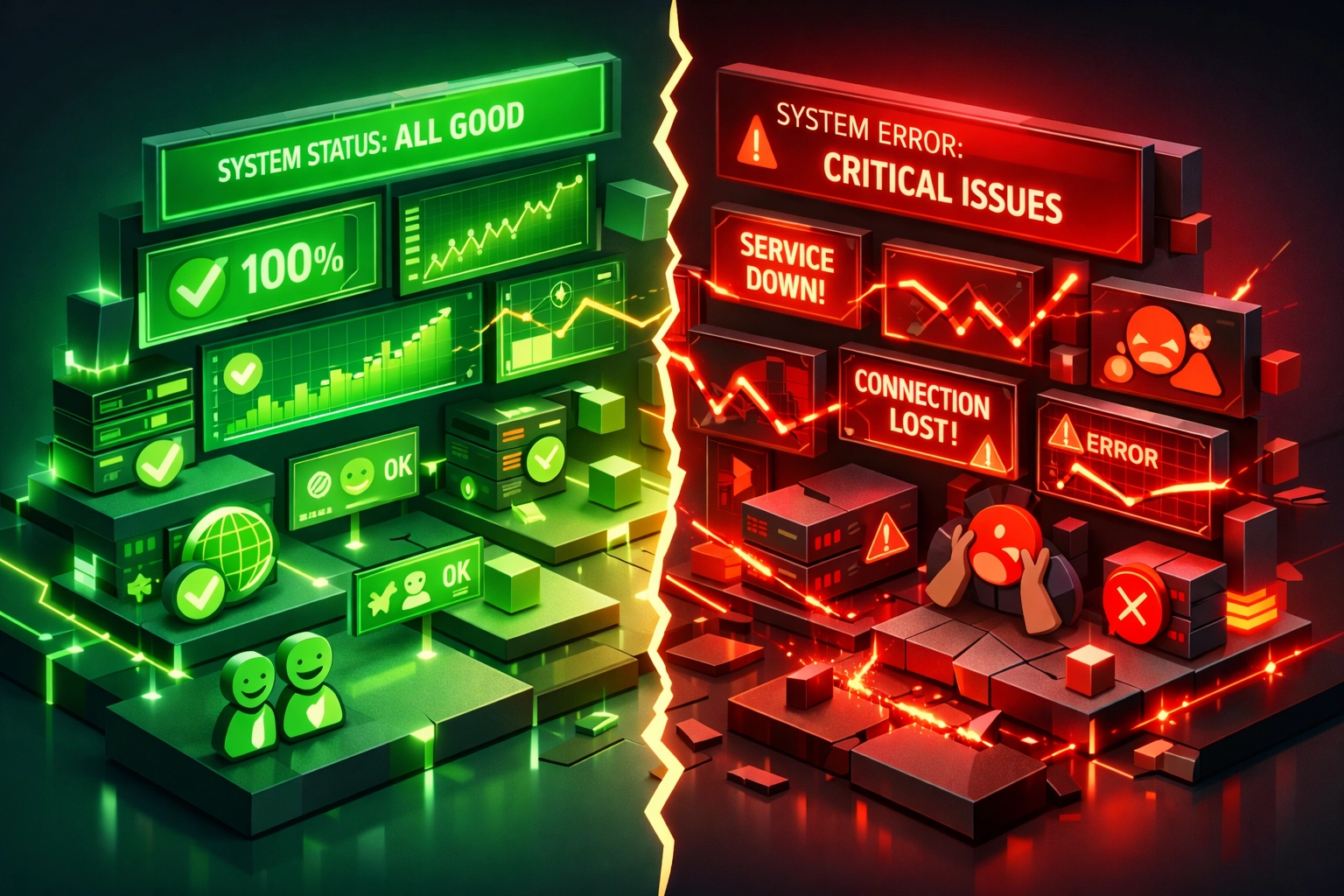
Services appear green in monitoring dashboards while users experience critical failures: a disconnect I encounter in approximately 70% of ITOM implementations. This occurs because mapped entities aren't true dependencies or represent shared resources used by multiple services.
One healthcare provider's patient portal showed 100% availability while their authentication service experienced intermittent failures affecting 30% of login attempts. Their Service Mapping implementation included infrastructure dependencies but missed the critical API gateway relationship that determined actual user experience.
The Fix: Start with a minimal "golden path" service and systematically expand dependencies after validating user-impact signals. Use ServiceNow's Event Management correlation rules to ensure health status accurately reflects user experience rather than infrastructure availability.
Implement synthetic transaction monitoring through ServiceNow's Operational Intelligence capabilities, creating active health checks that simulate real user workflows. This approach ensures your service health dashboards represent actual operational reality rather than theoretical infrastructure status.
Mistake #6: Operating Without Intelligent Change Risk Scoring
Organizations lacking automated change risk scoring experience 30-50% higher deployment failure rates: translating to $600K-$1.5M in annual losses for mid-market enterprises. Manual change approval workflows cannot adequately assess risk factors across complex, interdependent service architectures.
I have witnessed organizations where routine changes trigger cascading failures because approval processes couldn't evaluate application dependencies, historical failure patterns, or concurrent change conflicts.
The Fix: Implement ServiceNow's Change Intelligence workflows with automated risk scoring algorithms that analyze historical change data, CI relationships, and temporal patterns. The Washington DC release enhanced these capabilities with machine learning models that predict change collision risks and recommend optimal implementation windows.
Configure Change Intelligence to integrate with your CMDB and Service Mapping data, enabling risk assessment based on actual service dependencies rather than generic approval criteria. This architectural approach reduces deployment failures by 40-60% while accelerating approved change velocity.
Mistake #7: Attempting Complex ITOM Implementation Without Specialized Expertise
Organizations attempting self-directed ITOM implementations achieve ROI 18 months slower than those partnering with experienced ServiceNow consulting services. The 2026 regulatory landscape compounds this challenge: DORA compliance architecture, GDPR data sovereignty configurations, and ESG reporting requirements demand specialized knowledge during initial implementation rather than expensive remediation cycles.
I consistently observe DIY implementations that require complete architectural redesign within 12-18 months because fundamental design decisions created technical debt incompatible with compliance requirements or operational scale demands.
The Fix: Partner with specialized ServiceNow implementation partners who understand compliance architecture requirements and can design proper ITOM foundations from inception. The investment in expert ServiceNow consulting services delivers ROI acceleration that pays for engagement costs within the first year through avoided remediation expenses and faster time-to-value.
Look for implementation partners with proven expertise in your regulatory environment: DORA and GDPR knowledge for EU operations, SOC 2 and FedRAMP experience for US markets: and validated track records architecting ITOM platforms that scale without requiring fundamental redesign.
The ROI Impact: What Poor ITOM Implementation Actually Costs
Beyond individual mistake costs, cumulative ITOM underperformance creates compound losses. I calculate typical enterprise impact at $2.5M-$4M annually through:
Failed automation workflows requiring manual intervention
Compliance remediation cycles addressing architectural gaps
Shadow IT spend operating outside asset management
Change-related incidents from inadequate risk assessment
Duplicate licensing from ITOM-ITAM integration failures
Extended implementation timelines from DIY approaches
Conversely, properly architected ITOM implementations deliver measurable returns: 40% reduction in mean time to resolution (MTTR), 60% improvement in first-call resolution (FCR), and 30-50% decrease in total cost of ownership through optimized licensing and automated workflows.
Your Next Step: Free 2026 ServiceNow ROI & License Audit
I invite you to discover exactly where your ServiceNow ITOM implementation stands through our comprehensive assessment process. Our Free 2026 ServiceNow ROI & License Audit evaluates all seven critical mistake categories, quantifies current performance gaps, and provides a detailed roadmap for achieving operational excellence.
Visit the SnowGeek Solutions contact page to share your project details and schedule your complimentary audit. Register with SnowGeek Solutions to receive platform updates, expert insights on ServiceNow's latest releases, and proven strategies for maximizing your ITOM investment.
The difference between mediocre and transformative ITOM performance isn't random: it's architectural. I will guide you through the essential steps that elevate your ServiceNow platform from functional to exceptional, transforming ITOM from an IT cost center into a strategic business enabler that drives operational excellence across your entire organization.
Comments