
Is Your ServiceNow ITOM Strategy Ready for 2026? (Free ROI + License Audit Reveals Hidden Savings)
- SnowGeek Solutions
- Feb 20
- 5 min read

I have witnessed firsthand how organizations stumble into 2026 with ITOM strategies built for 2022's challenges. The gap between reactive infrastructure management and AI-powered autonomous operations has never been wider, and the financial consequences are staggering. If your ServiceNow ITOM implementation still relies primarily on manual discovery, reactive alerting, and siloed tool integrations, you're likely hemorrhaging $2–4 million annually in hidden costs.
The question isn't whether your ITOM strategy needs evolution: it's whether you'll capture the $600K–$2M in immediate savings that a properly optimized platform delivers, or continue funding inefficiencies that competitors have already eliminated.
The 2026 ITOM Reality: AI-First or Left Behind
The ServiceNow Xanadu release has fundamentally altered what "operations management" means. Organizations leveraging Health Log Analytics and AIOps capabilities within ITOM are resolving 40–70% of incidents automatically before they impact end users. I've guided enterprises through this transformation, and the operational metrics speak volumes: mean-time-to-resolution (MTTR) dropping from 4.2 hours to 47 minutes, first-contact resolution (FCR) rates climbing from 34% to 68%, and platform health scores consistently above 95.
Yet most organizations are still operating in reactive mode. Your team receives an alert, investigates manually, escalates through three tiers, and finally resolves the issue: often after business impact has occurred. This approach doesn't just waste time; it wastes licensed capacity, operational budget, and competitive advantage.

The Agentic AI Revolution in ITOM
ServiceNow's latest Washington release introduces agentic auto-remediation workflows that fundamentally change the economics of IT operations. These AI agents don't just detect anomalies: they execute predefined remediation playbooks, verify resolution, and learn from each intervention. The WorkArena Benchmark data demonstrates that properly configured agentic workflows reduce human touches per incident by 62% while maintaining 94% resolution accuracy.
For ServiceNow consulting services providers like us at SnowGeek Solutions, the implementation of agentic ITOM isn't a future consideration: it's a present-day requirement. Organizations that delay this transition face compounding disadvantages: competitors operate faster, resolve issues proactively, and allocate IT resources to innovation rather than firefighting.
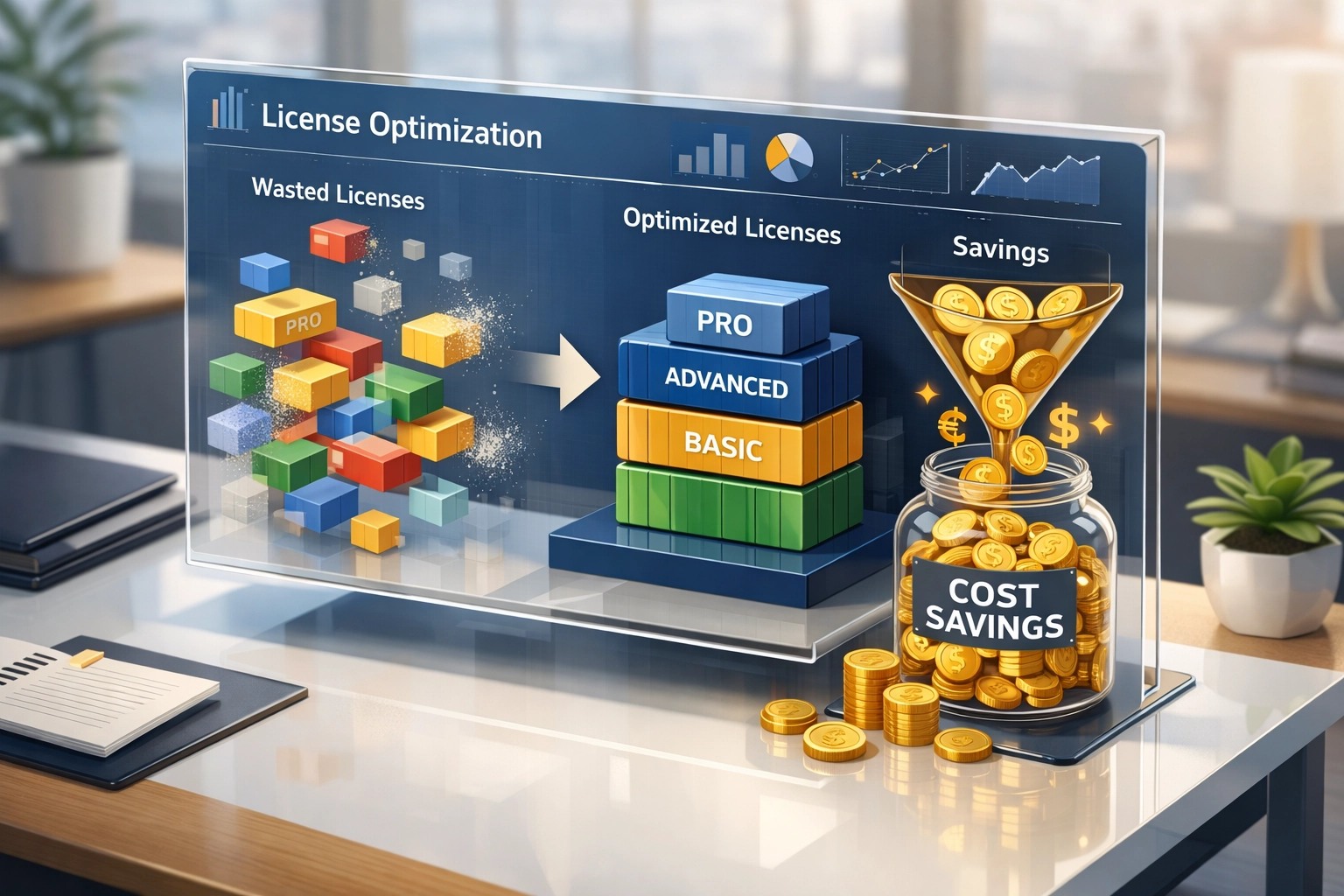
License Optimization: The $800K Hidden in Your ITOM Deployment
Here's an uncomfortable truth I share with every client during discovery: most organizations overpay for ServiceNow ITOM licenses by 30–45%. Not because ServiceNow pricing is unfair, but because implementations grow organically without strategic license governance.
Your team purchased Discovery licenses three years ago. You added Event Management for monitoring. Cloud Provisioning and Governance followed. Then Service Mapping. Each addition made sense individually, but collectively they created license overlap, unused entitlements, and compliance gaps that cost hundreds of thousands annually.
Common License Waste Patterns:
The Single-Platform Strategy: ESM as ITOM Force Multiplier
The enterprise technology landscape has shifted decisively toward unified platform strategies. Organizations maintaining separate ITSM, ITOM, HRSD, and CSM platforms face 3–5x higher integration costs, inconsistent user experiences, and fragmented data that prevents AI effectiveness.
I guide clients toward Enterprise Service Management (ESM) architectures where ITOM serves as the foundational data layer for all service domains. When your infrastructure discovery feeds accurate CI data to IT, HR, Facilities, and Finance workflows simultaneously, the ROI multiplies exponentially.
ESM-Enabled ITOM Delivers:
Proactive Operations: From Alerts to Insights
The transformative shift in 2026 ITOM strategy isn't technological: it's philosophical. Organizations must transition from alert-driven operations to insight-driven orchestration.
Traditional ITOM generates thousands of alerts daily. Your team triages, investigates, and responds. This reactive approach creates operational debt: every incident consumes resources, distracts from strategic work, and risks service degradation.
Modern ITOM leverages AI-based root cause analysis, predictive capacity management, and intelligent incident prioritization. The platform doesn't just alert you to disk space exhaustion: it predicts exhaustion 72 hours in advance, identifies the business services affected, and automatically triggers capacity expansion workflows.

Measuring Proactive ITOM Maturity:
Governance for AI-Powered ITOM: EU Compliance Meets Operational Excellence
For organizations operating in EU markets, 2026 brings intensified regulatory scrutiny. DORA (Digital Operational Resilience Act) mandates comprehensive monitoring, incident response capabilities, and third-party risk management: requirements that mature ITOM implementations satisfy inherently.
Similarly, GDPR data governance extends to ITOM discovery and asset management. Your ServiceNow implementation partner must ensure that discovery processes respect data sovereignty requirements, implement appropriate access controls, and maintain audit trails for all infrastructure data access.
ESG reporting requirements increasingly demand visibility into IT infrastructure energy consumption, hardware lifecycle management, and sustainable operations metrics. ServiceNow ITAM integrated with ITOM provides this visibility natively, but only when properly configured with sustainability KPIs.
I have worked extensively with EU enterprises navigating these compliance frameworks, and the pattern is consistent: organizations that treat compliance as an ITOM feature rather than a separate initiative achieve both regulatory adherence and operational efficiency simultaneously.
The ROI Calculation You're Not Making
Most ITOM ROI analyses focus on obvious metrics: reduced downtime, faster MTTR, lower staffing costs. These matter, but they miss the strategic value creation that separates transformative ITOM implementations from merely functional ones.
Hidden ROI Categories:

Your 2026 ITOM Readiness Audit
I challenge you to answer these diagnostic questions honestly:
Discovery & Visibility: Can you identify every application dependency for your top ten business services within five minutes? If not, your CMDB and Service Mapping need optimization.
Automation Maturity: What percentage of infrastructure incidents resolve without human intervention? Below 30% indicates significant automation opportunity.
License Efficiency: When did you last audit ServiceNow license utilization across ITOM modules? If the answer exceeds 12 months, you're likely overpaying by $200K–600K annually.
AI Readiness: Are you leveraging Health Log Analytics, Predictive AIOps, and automated remediation? These capabilities aren't future considerations: they're table stakes for competitive operations.
Platform Consolidation: How many separate tools do you maintain for discovery, monitoring, event management, and orchestration? Each tool beyond ServiceNow's native capabilities costs $60K–120K annually in integration and maintenance.
The Path Forward: Strategic ITOM Transformation
Transforming your ITOM strategy for 2026 demands more than technology deployment: it requires strategic partnership with a ServiceNow implementation partner who understands the nuanced interplay between platform capabilities, organizational readiness, and measurable business outcomes.
At SnowGeek Solutions, our approach begins with comprehensive ROI and license auditing that uncovers immediate savings opportunities. We then architect ITOM implementations that balance quick wins with long-term strategic positioning. This means prioritizing AIOps capabilities that deliver measurable MTTR reduction, consolidating overlapping licenses to recover budget, and establishing governance frameworks that enable continuous optimization.

The organizations that will dominate their industries over the next three years aren't necessarily spending more on ITOM: they're spending strategically, leveraging AI capabilities that competitors ignore, and capturing savings that fund continuous innovation.
Your Next Step: Free 2026 ServiceNow ROI & License Audit
I encourage you to take advantage of our Free 2026 ServiceNow ROI & License Audit. This comprehensive assessment examines your current ITOM deployment, identifies immediate savings opportunities, benchmarks your maturity against industry standards, and provides a detailed roadmap for optimization.
The audit typically uncovers $400K–$1.8M in immediate savings through license optimization, automation opportunities, and efficiency improvements. There's no obligation: just actionable insights delivered by experienced ServiceNow consulting services professionals who have guided dozens of enterprises through this exact transformation.
Visit the SnowGeek Solutions contact page to share your project details and schedule your complimentary audit. Additionally, register with SnowGeek Solutions for ongoing platform updates and expert insights that keep your ITOM strategy ahead of market evolution.
The question isn't whether your ITOM strategy needs transformation for 2026: it's whether you'll capture the competitive advantage and cost savings that transformation delivers before your competitors do. The choice, and the opportunity, is yours.
Comments