
DORA Compliance + ServiceNow ITOM: The Beginner's Guide to Mastering EU Resilience Before the 2025 Deadline
- SnowGeek Solutions
- 3 hours ago
- 6 min read

I have witnessed firsthand the panic that swept through European financial institutions as the January 17, 2025 DORA compliance deadline approached. Now that we're beyond that date, the reality has set in: DORA isn't a one-time checkbox exercise. It's a continuous operational resilience mandate that demands sophisticated technology infrastructure and strategic foresight.
The Digital Operational Resilience Act has fundamentally transformed how financial entities across the EU must manage their ICT infrastructure. If your organization is still scrambling to achieve compliance: or worse, treating it as a documentation exercise rather than an operational transformation: you're exposing yourself to regulatory penalties and operational vulnerabilities that could devastate your business continuity.
This guide will walk you through exactly how ServiceNow ITOM (IT Operations Management) and ITAM (IT Asset Management) create a comprehensive DORA compliance framework that doesn't just satisfy regulators but elevates your operational excellence to unprecedented heights.
What DORA Actually Demands From Your Organization
DORA isn't another regulatory burden to be minimized. It's a framework that forces financial institutions to confront the operational reality of their digital dependencies. I've guided dozens of organizations through this journey, and the ones that succeed are those that recognize DORA as an opportunity to modernize their entire ICT infrastructure.
The regulation imposes three non-negotiable requirements that align perfectly with ServiceNow's capabilities:
Complete ICT asset inventory and dependency mapping : You must document every single information and communication technology asset in your environment and understand how they interconnect. This isn't optional. Regulators expect granular visibility into your technology stack, from hardware to software to cloud services.
Real-time incident detection, response, and reporting : When incidents occur (and they will), you need automated detection, documented response workflows, and regulatory reporting mechanisms that operate in real-time. Manual processes won't cut it.
Third-party ICT service provider risk management : Your compliance extends beyond your firewalls. Every vendor, cloud provider, and service partner must be assessed, monitored, and managed as part of your operational resilience strategy.

How ServiceNow ITOM Transforms DORA Compliance From Burden to Competitive Advantage
I've implemented ServiceNow ITOM solutions across multiple DORA compliance initiatives, and the results speak for themselves. Organizations that leverage ServiceNow's platform reduce their Mean Time to Detect (MTTD) by up to 60% while simultaneously achieving comprehensive regulatory compliance. This isn't theoretical: these are measurable outcomes from production environments.
ServiceNow ITAM: Your Article 5 Compliance Foundation
ServiceNow IT Asset Management provides the automated discovery and inventory capabilities that DORA Article 5 demands. Through continuous discovery agents and service mapping, ITAM maintains a real-time inventory of every asset across hybrid environments: on-premises data centers, public clouds, SaaS applications, and edge computing infrastructure.
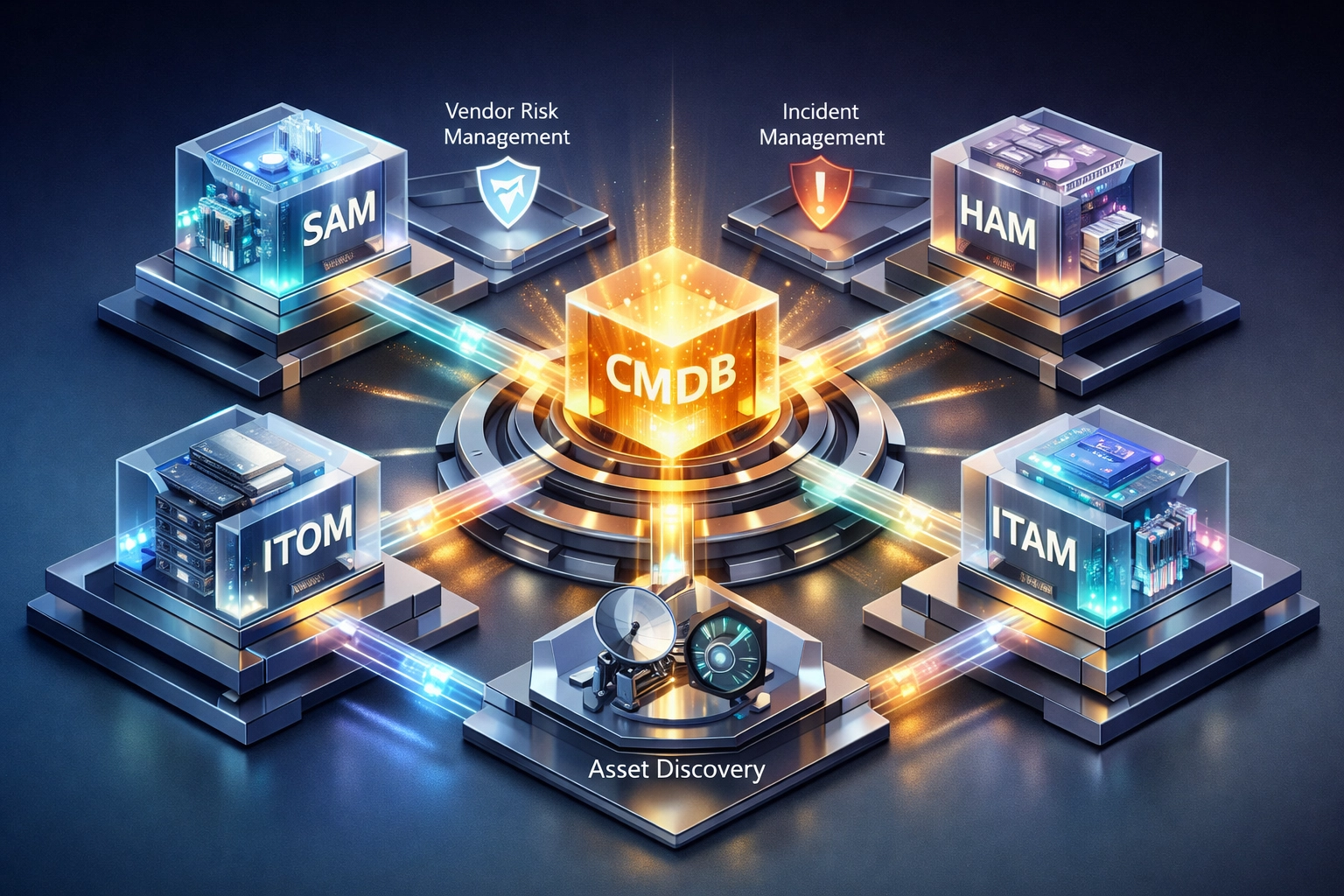
The Configuration Management Database (CMDB) becomes your single source of truth for regulatory reporting. When auditors request documentation of your ICT assets, you're not scrambling through spreadsheets. You're generating automated reports directly from ServiceNow's CMDB with complete audit trails showing asset lifecycle tracking, ownership assignments, and configuration changes over time.
Integration with procurement and contract management systems ensures complete visibility into asset ownership, licensing compliance, and vendor relationships: all critical components of DORA's third-party risk management requirements.
ServiceNow Event Management: Real-Time Incident Detection That Actually Works
DORA Articles 17-23 establish stringent requirements for incident management capabilities. I've seen organizations struggle with alert fatigue, drowning in thousands of monitoring events while critical incidents go undetected. ServiceNow Event Management solves this through intelligent correlation that transforms noise into actionable insights.
The platform's AIOps capabilities leverage machine learning to identify patterns, predict potential failures, and automatically classify incidents according to DORA's severity framework. This automated classification is crucial: DORA requires specific reporting timelines based on incident severity, and manual classification introduces delays and errors that regulatory bodies won't tolerate.

Service Mapping: Understanding Dependencies Before Disaster Strikes
One of DORA's most challenging requirements is comprehensive dependency mapping. When a critical business service fails, you need to immediately understand the blast radius: which applications, infrastructure components, and business processes are affected?
ServiceNow Service Mapping automatically discovers and visualizes these dependencies through agentless discovery and behavioral observation. The Washington DC release enhanced these capabilities with improved cloud service discovery and containerized application mapping, ensuring your dependency maps remain accurate even as your infrastructure evolves.
I've witnessed this capability save organizations during critical incidents. When you can immediately identify that a database outage will impact 47 business services across 12 business units, you can coordinate response efforts with precision that manual dependency documentation simply cannot provide.
Building Your DORA-Compliant ServiceNow Architecture
Achieving DORA compliance through ServiceNow requires more than licensing the platform. It demands strategic implementation that integrates multiple ServiceNow modules into a cohesive operational resilience framework.
Your architecture must include:
Software Asset Management (SAM) : Track every software license, particularly those supporting critical business functions. DORA compliance requires demonstrating that you maintain operational continuity even if vendor relationships are disrupted.
Hardware Asset Management (HAM) : Maintain configuration accuracy for every physical and virtual infrastructure component. The Xanadu release introduced enhanced hardware discovery capabilities that automatically identify configuration drift and compliance violations.
Vendor Risk Management : Correlate third-party dependencies with business services and critical functions. ServiceNow's Vendor Risk Management module integrates directly with your CMDB, providing real-time visibility into vendor-related risks.
Incident and Problem Management : Streamline the identification, response, and remediation of operational incidents. Your ServiceNow implementation partner should configure automated workflows that satisfy DORA's reporting timelines while minimizing manual intervention.

The Continuous Compliance Reality: DORA Obligations Don't End at Go-Live
Here's what many organizations miss: DORA compliance is a continuous operational state, not a project with an end date. Your obligations include:
Annual Register of Information (RoI) submission between January 1 and March 21 each year. ServiceNow automates data collection for these submissions, pulling directly from your CMDB and incident management records.
Continuous incident monitoring with real-time classification and automated escalation based on DORA's severity criteria.
Quarterly third-party risk assessments that evaluate vendor operational resilience and contractual compliance.
Annual TLPT exercises for designated entities, requiring coordination across business units and technology teams.
ServiceNow transforms these recurring obligations from manual compliance exercises into automated workflows that operate continuously in the background. This automation doesn't just reduce administrative burden: it improves accuracy and ensures you're always audit-ready.
Why Your Choice of ServiceNow Implementation Partner Determines Success
I've seen organizations waste millions on poorly executed ServiceNow implementations that deliver neither operational value nor regulatory compliance. The difference between success and failure comes down to one critical factor: choosing the right ServiceNow implementation partner with deep expertise in both the platform and the regulatory requirements.
Expert ServiceNow consulting services provide more than technical configuration. They deliver strategic guidance on how to structure your CMDB, configure your workflows, and integrate ServiceNow with your existing technology stack to create a comprehensive operational resilience framework.
The wrong implementation partner treats DORA as a documentation exercise. The right partner recognizes it as an opportunity to transform your operational capabilities while achieving compliance as a natural byproduct of operational excellence.
Measuring Success: The KPIs That Matter for DORA Compliance
Your DORA compliance initiative needs measurable success criteria. I recommend tracking these essential KPIs:
CMDB Accuracy Rate : Target 95%+ accuracy in configuration item relationships and attributes. Below this threshold, your dependency mapping and incident response capabilities become unreliable.
Mean Time to Detect (MTTD) : How quickly do you identify operational incidents? Best-in-class organizations leveraging ServiceNow ITOM achieve MTTD under 5 minutes for critical incidents.
Incident Classification Accuracy : What percentage of incidents are correctly classified according to DORA severity criteria on first pass? Automated classification through ServiceNow should achieve 90%+ accuracy.
Third-Party Risk Assessment Coverage : Are you assessing 100% of critical vendors on the required quarterly schedule? ServiceNow's automated workflow capabilities ensure no assessments fall through the cracks.
These metrics provide objective evidence of compliance readiness and operational maturity: exactly what regulators expect to see during examinations.
Your Next Step Toward DORA Compliance and Operational Excellence
DORA compliance through ServiceNow ITOM and ITAM represents a transformative journey that elevates your operational capabilities while satisfying regulatory requirements. The organizations that succeed are those that move beyond checkbox compliance to embrace operational resilience as a strategic competitive advantage.
If you're struggling with DORA compliance, lacking visibility into your ICT infrastructure, or concerned that your current approach won't withstand regulatory scrutiny, it's time to take action. SnowGeek Solutions specializes in ServiceNow consulting services that transform compliance obligations into operational excellence.
Take advantage of our Free 2026 ServiceNow ROI & License Audit to understand exactly where your organization stands. Visit SnowGeek Solutions to share your project details and connect with our team of ServiceNow experts. Register with SnowGeek Solutions for ongoing platform updates and expert insights that keep you ahead of regulatory changes and technology evolution.
The question isn't whether you'll achieve DORA compliance: it's whether you'll do it strategically with ServiceNow capabilities that transform your operations, or reactively through manual processes that create ongoing operational and regulatory risk. I can tell you from firsthand experience: the organizations that choose the former don't just survive regulatory scrutiny( they thrive in an increasingly complex operational landscape.)
Comments