
7 Mistakes You're Making with ServiceNow ITOM Implementation (and How a Free 2026 Audit Fixes Them)
- SnowGeek Solutions
- Feb 21
- 5 min read

I have witnessed firsthand how organizations pour hundreds of thousands: sometimes millions: into ServiceNow ITOM implementations only to fall short of their ROI projections. After conducting dozens of post-implementation reviews across the US and European markets, I've identified a pattern: the same seven architectural mistakes appear again and again, quietly eroding the transformative potential of what should be a game-changing platform.
What makes 2026 particularly critical is the convergence of regulatory pressure: DORA operational resilience mandates in the EU, heightened GDPR enforcement, and ESG reporting requirements: alongside the massive ROI opportunities unlocked by AI-driven automation. The organizations that fix these mistakes now will gain unprecedented operational excellence. Those that don't will find themselves paying premium licensing fees for suboptimal performance.
This guide will walk you through the seven most expensive ITOM implementation mistakes and reveal how a comprehensive 2026 audit identifies and fixes them before they compound into technical debt.
Mistake #1: Accepting Mediocre CMDB Data Quality
Here's the uncomfortable truth: if your Configuration Management Database (CMDB) accuracy sits between 60-75%, you're operating in what I call the "catastrophic zone" for AI-driven automation.
I've seen this scenario unfold repeatedly. Organizations deploy ServiceNow's Xanadu or Washington DC releases with powerful predictive capabilities, then wonder why their AI-driven incident resolution fails systematically. The answer lies in data quality. At 75% accuracy, your predictive AI capabilities cannot distinguish signal from noise. Cascading failures ripple across incident management, change management, and asset tracking.
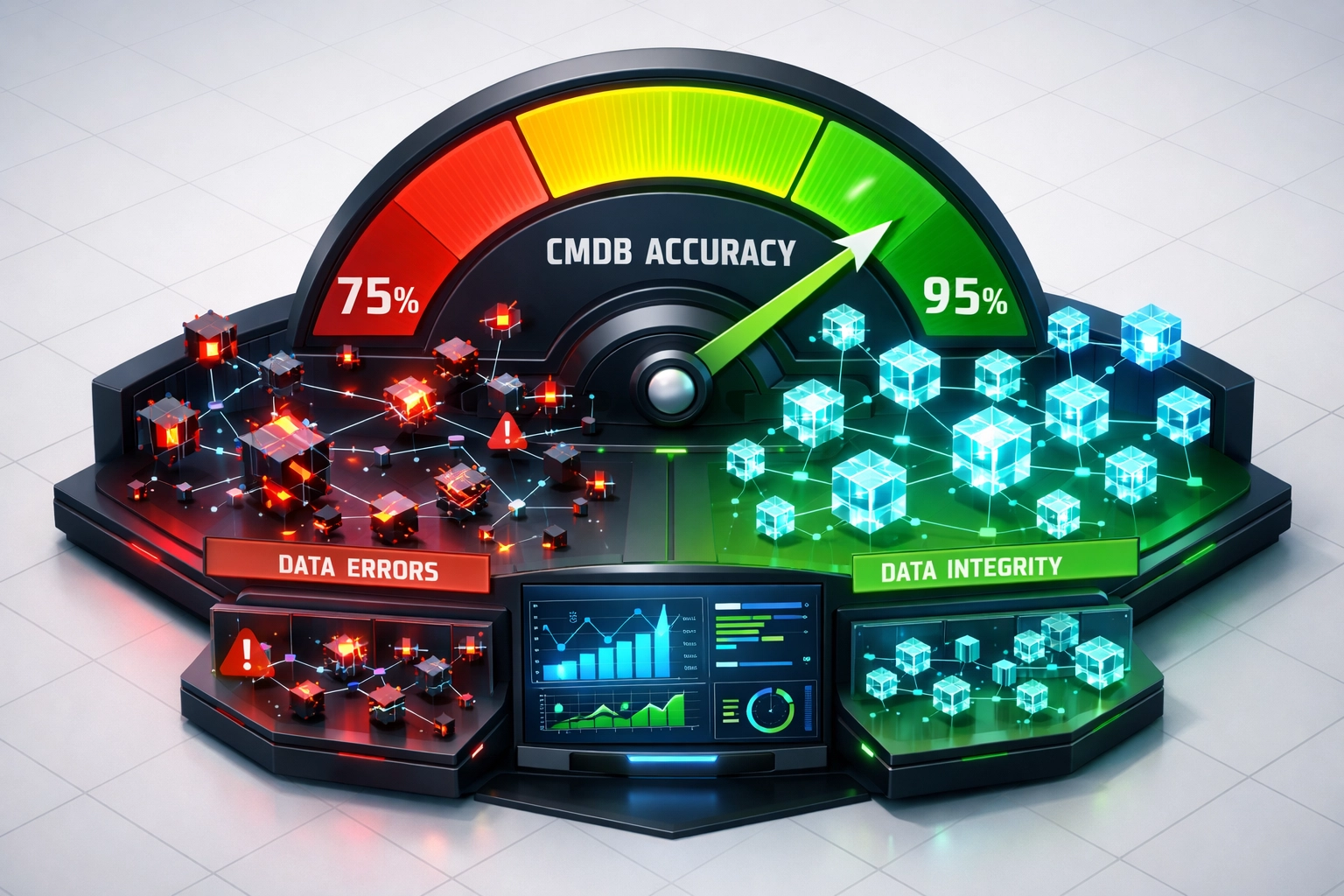
The threshold where AI-driven automation becomes genuinely transformative? Above 85% accuracy. This isn't arbitrary: it's the inflection point where ServiceNow's Change Intelligence and Predictive AIOps begin delivering measurable impact.
The fix demands rigorous implementation of Discovery patterns with automated validation rules. As your ServiceNow implementation partner, we've developed validation frameworks that continuously monitor CMDB health, flagging inconsistencies before they propagate through your ITOM architecture.
Mistake #2: Ignoring Discovery Scope Limitations: The Phantom Confidence Problem
I've audited environments where organizations deployed ITOM Discovery with credential coverage for only 40-60% of their actual IT estate, yet built their entire ITOM strategy assuming complete visibility. This creates what I refer to as "phantom confidence": the dangerous belief that you understand your infrastructure when critical blind spots exist.
The implications extend beyond operational visibility. Under DORA regulations, European financial institutions must demonstrate comprehensive operational resilience, including complete asset inventories. Incomplete Discovery scope creates compliance gaps that auditors will identify.
A proper 2026 audit conducts comprehensive Discovery scope assessment, mapping credential coverage against your complete IT estate: cloud resources, containerized workloads, legacy systems, and third-party SaaS applications. We identify gaps systematically, prioritizing credential acquisition based on risk and compliance requirements.
Mistake #3: Treating ITOM and ITAM as Separate Domains: The $800K ROI Gap
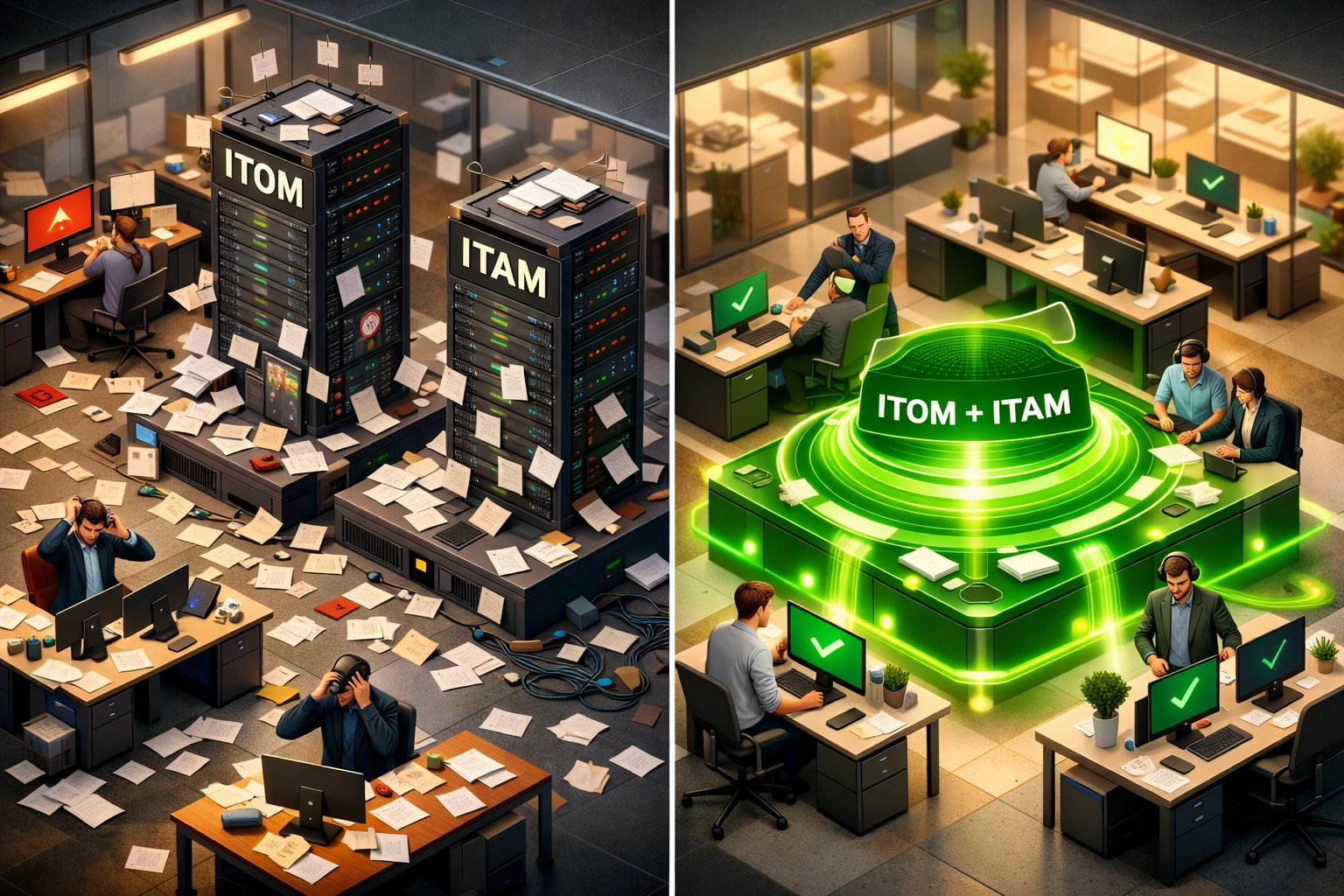
This siloed approach represents one of the most extraordinarily expensive architectural decisions I encounter. Organizations that properly integrate ITOM and ITAM through ServiceNow consulting services achieve First Call Resolution (FCR) rates of 91% compared to just 68% without integration.

Let me quantify this: for mid-market enterprises, that 23-percentage-point FCR improvement translates to $400K-$800K in annual ROI improvements. The math is straightforward: higher FCR means fewer escalations, reduced Mean Time to Resolution (MTTR), and dramatically lower operational costs.
The integration extends beyond operational metrics. For EU organizations navigating GDPR, unified ITOM-ITAM architecture provides the data lineage necessary to demonstrate compliance with data sovereignty requirements. You can trace precisely which assets process personal data, where that data resides, and which configuration items support those data flows.
Mistake #4: Inadequate Service Mapping Implementation
I consistently see organizations deploy Service Mapping as an afterthought rather than alongside Discovery. This fundamentally limits visibility into business service dependencies: the connections between your technology infrastructure and actual business outcomes.
When critical applications fail, do you immediately understand the downstream business impact? Can you quantify which revenue-generating services are affected? Without proper Service Mapping implementation, these questions remain unanswered during the exact moments when answers matter most.
ServiceNow's Business Service Mapping workspace, properly configured with pattern-based mapping for common application architectures, transforms incident response. Your teams move from reactive firefighting to proactive business continuity management.
For organizations pursuing ESG reporting mandates, Service Mapping provides the foundation for tracking technology's environmental impact. You can correlate energy consumption with specific business services, enabling data-driven sustainability decisions.
Mistake #5: Suboptimal Change Management Architecture
Many organizations implement ServiceNow ITOM yet fail to leverage Change Intelligence capabilities fully. These predictive risk scoring features analyze historical failure patterns, affected CI relationships, and current infrastructure health to forecast change success probability.
I've tracked Change Success Rates across multiple implementations. Organizations without mature Change Intelligence architectures average 78-82% success rates. Those with properly configured risk scoring, collision detection, and automated approvals? They consistently exceed 95% success rates.
The 2026 audit evaluates your Change Management maturity against industry benchmarks, identifying specific configuration gaps that elevate risk. We implement automated risk scoring frameworks, collision detection to prevent conflicting changes, and establish continuous monitoring against Change Success Rate targets of 95% or higher.
Mistake #6: Lacking Specialized ServiceNow Implementation Partner Expertise
This mistake differs from the others: it's about pattern recognition rather than configuration. Internal teams struggle not from lack of intelligence but from missing exposure to multiple enterprise implementations across diverse industries.
Here's what internal teams cannot know: which architectural decisions create technical debt six months down the road, which integration patterns cause performance degradation at scale, how DORA requirements specifically impact ITOM architecture for financial institutions, or what GDPR data sovereignty demands mean for cross-border Discovery patterns.
Specialized ServiceNow consulting services bring this accumulated knowledge. We enforce an "out-of-the-box first" philosophy, customizing only when business requirements genuinely demand it. We've implemented DORA, GDPR, and ESG-compliant ITOM architectures repeatedly, understanding the regulatory nuances that generic implementations miss.
Mistake #7: Building Custom Systems in Parallel
I've encountered organizations that, rather than leveraging native Service Mapping and Discovery capabilities, build parallel custom systems attempting to replicate functionality. This creates redundancy, maintenance burdens, and integration complexity that compounds over time.
ServiceNow releases like Washington DC and Xanadu deliver increasingly sophisticated out-of-the-box capabilities. The platform evolves rapidly: custom systems don't. As ServiceNow introduces new features, custom-built alternatives become technical debt requiring constant updates to maintain parity.
The audit identifies these parallel systems, quantifying maintenance costs and presenting migration pathways to native ServiceNow capabilities. We've seen organizations reduce annual operational costs by $150K-$300K simply by retiring custom systems in favor of platform-native alternatives.
How a Comprehensive 2026 ROI & License Audit Fixes These Mistakes
Our Free 2026 ServiceNow ROI & License Audit addresses each mistake systematically:
Assessment Phase: We evaluate CMDB accuracy against infrastructure reality, Discovery scope completeness, ITOM-ITAM integration maturity, compliance readiness for DORA/GDPR/ESG, Service Mapping effectiveness, Change Management maturity, and overall architectural soundness.
Quantification Phase: We calculate the financial impact of each mistake: not theoretical costs but actual ROI erosion specific to your environment. You'll receive precise figures: "Your 68% CMDB accuracy costs $427K annually in extended MTTR and failed automation."
Remediation Phase: We prioritize fixes based on ROI potential, regulatory urgency, and implementation complexity. Each recommendation includes specific configuration changes, estimated effort, and projected ROI impact.
Compliance Validation: For EU organizations, we map remediation against DORA operational resilience requirements, GDPR data sovereignty mandates, and ESG reporting frameworks.
The audit reveals not just problems but the path forward: transforming your ITOM implementation from adequate to exceptional.
Your Next Step Toward ITOM Excellence
The difference between mediocre and transformative ServiceNow ITOM implementation often lies in identifying and correcting these seven mistakes before they compound into technical debt and ROI erosion.
Ready to discover what's holding back your ITOM ROI? Visit snowgeeksolutions.com to share your project details and schedule your Free 2026 ServiceNow ROI & License Audit. Our team will conduct a comprehensive assessment and deliver actionable insights tailored to your specific environment.
Don't let these mistakes continue eroding your ServiceNow investment. Register with SnowGeek Solutions for platform updates, regulatory compliance insights, and expert guidance on maximizing your ITOM architecture's potential. Whether you're navigating DORA requirements in Europe or pursuing AI-driven ROI improvements in the US market, we'll guide you toward operational excellence and measurable business outcomes.
Comments