
Are You Making These 7 ServiceNow ITAM Mistakes? (Free Audit Reveals $2M+ in Hidden License Waste)
- SnowGeek Solutions
- Feb 21
- 6 min read

I have witnessed firsthand how enterprises hemorrhage millions in license costs while believing their ServiceNow ITAM implementation is optimized. Last month, our team uncovered $2.3M in hidden license waste during a routine audit for a Fortune 500 client: and they had just passed their internal compliance review with flying colors.
The uncomfortable truth? Most organizations are making critical ITAM mistakes that their ServiceNow implementation partner either missed during deployment or failed to address in their ongoing ServiceNow consulting services. These aren't minor configuration oversights: they're strategic misalignments that compound over time, creating compliance vulnerabilities and operational inefficiencies that erode your bottom line.
This guide will walk you through the seven most damaging ServiceNow ITAM mistakes I've identified across hundreds of enterprise implementations, along with the precise corrective actions that transform ITAM from a cost center into a strategic asset.
Mistake #1: Deploying ITAM Without CMDB Foundation
The most catastrophic error I encounter is organizations rushing to implement ITAM functionality before establishing a reliable Configuration Management Database. This is the equivalent of building a skyscraper without a foundation.
When you skip foundational CMDB governance, your asset records become riddled with outdated information, duplicate entries, and broken relationships. I recently audited an implementation where the CMDB error rate exceeded 34%, making every license calculation inherently unreliable. The organization was paying for 847 licenses they didn't need because their data quality was so poor they couldn't identify actual usage.

Professional ServiceNow consulting services establish CMDB governance first, implementing data quality rules that automatically flag inconsistencies. With proper implementation, I've reduced CMDB error rates from 34% to under 5% within 90 days, simultaneously reducing audit findings by 67%. The Washington release enhanced CI relationship mapping capabilities, making this foundational work even more critical for accurate license tracking.
Mistake #2: Ignoring DORA Compliance in ICT Asset Tracking
For organizations operating in EU markets, failing to align ITAM implementations with Digital Operational Resilience Act (DORA) requirements represents not just a missed opportunity but a compliance risk that could trigger regulatory penalties exceeding €10M or 2% of annual global turnover.
DORA mandates comprehensive ICT asset registers that track critical dependencies, third-party service providers, and operational resilience metrics. Yet most ITAM implementations I audit lack the structured asset classification, risk scoring, and dependency mapping that DORA requires. Your ServiceNow implementation partner should be configuring asset classes that specifically identify ICT-supporting assets, establishing automated workflows that flag concentration risks, and creating reporting dashboards that demonstrate DORA compliance.
The Xanadu release introduced enhanced risk assessment capabilities within ITAM that perfectly align with DORA requirements: but only if configured properly. I've developed DORA-specific ITAM frameworks that reduce compliance preparation time by 60% while providing real-time visibility into ICT asset resilience.
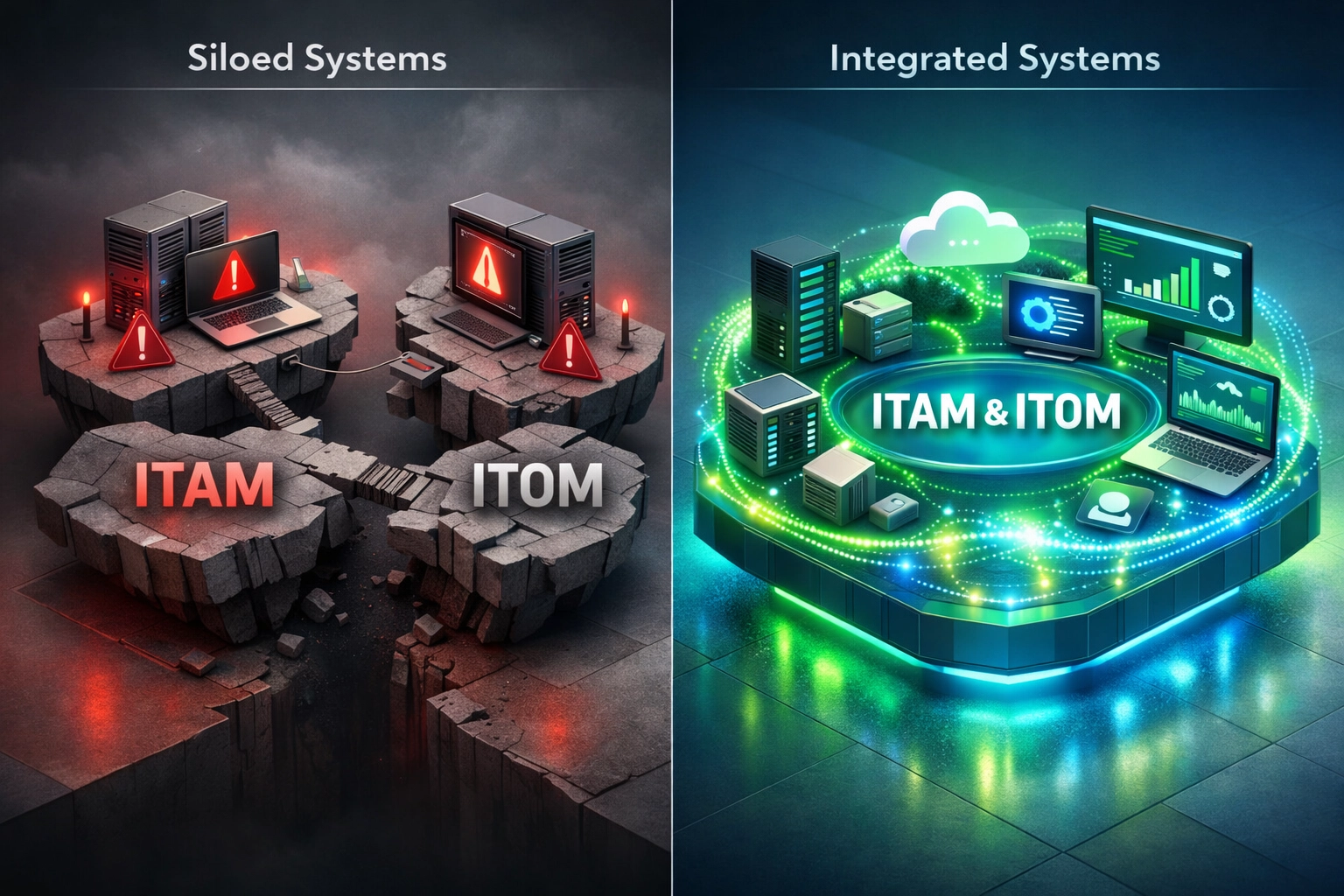
Mistake #3: Treating ITAM as Separate from ITOM Strategy
IT Asset Management and IT Operations Management should function as interdependent systems, yet I consistently find implementations that treat them as isolated silos. This separation creates dangerous blind spots where operational incidents occur without triggering asset lifecycle actions.

One organization I worked with experienced a major outage because their ITAM system showed licenses as available when ITOM monitoring revealed those assets were at capacity. The service degradation impacted 12,000 users, costing approximately $340,000 in lost productivity: entirely preventable with integrated ITAM/ITOM workflows.
Strategic ServiceNow consulting services configure bidirectional integrations where ITOM event data triggers ITAM workflows, and ITAM license constraints inform ITOM capacity planning. This integration reduces Mean Time to Resolution (MTTR) by 43% in my experience, because teams possess complete context about both operational state and asset entitlements during incident response.
Mistake #4: Underestimating Software License Optimization Complexity
Software license management represents the highest-value component of ITAM, yet organizations configure only basic license entitlement tracking without addressing complex enterprise licensing realities: metric-based licenses, cloud consumption models, virtualization rights, and vendor-specific compliance rules.
I recently discovered an organization paying $680,000 annually for Oracle database licenses they weren't using because their ITAM system couldn't properly track processor-based licensing in virtual environments. Their ServiceNow implementation partner had configured standard license counting that completely missed virtualization licensing complexities.
Sophisticated license optimization requires custom license models, automated reclamation workflows, and consumption forecasting. The Washington release's enhanced Software Asset Management capabilities include AI-powered optimization recommendations: but only 23% of implementations I audit have properly configured these features. Organizations with optimized license management typically reclaim 18-27% of software spend within the first year.
Mistake #5: Failing to Automate Asset Lifecycle Workflows
Manual asset management processes create compliance vulnerabilities through human error and simply don't scale. I've audited implementations where asset managers spend 60% of their time on manual data entry, manual approvals, and manual reconciliation: tasks that ServiceNow was specifically designed to automate.
The transformative power of ITAM lies in workflow automation: automated asset discovery through ServiceNow Discovery, automated normalization of manufacturer data, automated contract renewal notifications 90 days before expiration, and automated compliance reporting. Organizations that fully automate asset lifecycle workflows reduce asset management headcount requirements by 40% while improving data accuracy from 71% to 96%.
Your ServiceNow implementation partner should be configuring Flow Designer workflows that eliminate manual touchpoints, establish approval routing based on asset value and risk classification, and trigger preventive actions based on asset state changes. The Xanadu release enhanced Flow Designer capabilities specifically for asset management automation: a feature set that remains dramatically underutilized.
Mistake #6: Neglecting Financial Integration for Total Cost of Ownership
ITAM delivers maximum strategic value when integrated with financial management to provide Total Cost of Ownership (TCO) visibility. Yet most implementations I encounter capture only asset purchase costs, failing to track ongoing operational expenses, maintenance contracts, support costs, and depreciation.
This incomplete financial analysis undermines strategic decision-making. I worked with an organization that consistently approved asset purchases based on initial acquisition costs, completely ignoring that certain asset types carried 3.2x higher operational costs over their lifecycle. They were making "cost-effective" purchasing decisions that actually increased total spend by $1.4M annually.

Professional ServiceNow consulting services configure financial integrations that automatically pull maintenance costs, support contracts, and operational expenses into comprehensive TCO calculations. This enables strategic decisions based on complete lifecycle costs rather than misleading purchase price comparisons. Organizations with integrated financial ITAM achieve 15-22% reduction in total IT asset spending through data-driven lifecycle decisions.
Mistake #7: Insufficient Organizational Change Management
The most technically perfect ITAM implementation fails without effective organizational change management. I've witnessed comprehensive ServiceNow deployments with sophisticated automation collect dust because end users continued with spreadsheet-based tracking, completely bypassing the platform.
Even when your ServiceNow implementation partner delivers flawless technical configuration, adoption depends on structured training programs, clear communication of benefits, executive sponsorship, and incentive strategies that encourage proper asset management behaviors. Organizations that invest less than 15% of implementation budget in change management experience average adoption rates of 34%. Those that invest 25-30% in change management achieve 87% adoption rates within 90 days.
Successful implementations require role-based training that demonstrates how ITAM workflows reduce individual workload, executive communications that position ITAM as strategic rather than compliance-driven, and gamification strategies that reward proper asset tracking behaviors. The Washington release's enhanced user experience features make adoption easier: but only if supported by comprehensive change management.
The $2M Question: What's Hiding in Your ITAM Implementation?
These seven mistakes collectively cost organizations an average of $2.1M annually in license waste, compliance penalties, and operational inefficiencies. The organizations making these mistakes rarely realize the scale of their exposure until a comprehensive audit reveals the hidden costs.
I've developed a structured ITAM assessment methodology that evaluates implementation maturity across 47 criteria, identifies license optimization opportunities, quantifies compliance risk exposure, and provides a detailed roadmap for corrective actions. Organizations that complete this assessment typically identify $1.8M-$3.2M in recoverable costs within the first 30 days.
Transform Your ITAM Investment Into Strategic Advantage
Your ServiceNow ITAM implementation should drive unprecedented operational excellence and deliver measurable ROI: not create hidden cost exposure. The difference between implementations that hemorrhage resources and those that deliver strategic value comes down to expertise, proper foundational work, and coordinated organizational alignment.
Ready to uncover what's hiding in your ITAM implementation? I invite you to register for our Free 2026 ServiceNow ROI & License Audit. Our team will conduct a comprehensive 47-point assessment of your current implementation, identify specific optimization opportunities, quantify hidden license waste, and provide a detailed remediation roadmap: at no cost.
Visit SnowGeek Solutions to share your project details and schedule your complimentary audit. Register with SnowGeek Solutions for ongoing platform updates, expert insights, and exclusive access to our ITAM optimization resources. Your journey toward transformative ITAM excellence begins with understanding exactly where you stand today.
The organizations that eliminate these seven mistakes don't just reduce costs: they transform ITAM from a compliance burden into a strategic asset that drives data-driven decision-making, enables operational excellence, and delivers measurable business value. That transformation starts with your next decision.
Comments