
Does Your ServiceNow ITOM Partner Actually Cut Costs, or Just Move Budget Around? The Free 2026 License Audit That Reveals the Truth
- SnowGeek Solutions
- 3 hours ago
- 5 min read

I've witnessed firsthand how ServiceNow ITOM projects can transform organizations: or simply shuffle expenses from one column to another on the balance sheet. After years working with enterprises across the US and EU markets, I can tell you the uncomfortable truth: your partner's capabilities determine whether you capture genuine 40% cost reductions or settle for a disappointing 10-15% of potential value.
The question isn't whether ServiceNow ITOM works. It does. The question is whether your ServiceNow implementation partner knows how to unlock actual operational savings instead of repackaging your existing spend.
The Budget Shuffle vs. Real Cost Reduction
Here's what budget shuffling looks like in practice: your organization invests $500,000 in ITOM implementation, reduces manual effort in one department, but those "savings" get absorbed by increased licensing costs, extended maintenance contracts, or consultant fees that somehow never end. The spreadsheet shows green numbers, but your CFO can't find the cash.
Real cost reduction is different. It's measurable, recurring, and hits your bottom line in ways that transform your operational excellence. Based on comprehensive ServiceNow consulting services engagements I've led, genuine ITOM implementations deliver four categories of actual savings.

1. Automated Manual Work That Never Returns
When properly configured with agentic AI capabilities introduced in the Washington DC release, ServiceNow ITOM reduces manual intervention by 60-75%. I've seen organizations automate L1 and L2 incident resolution within the first six months, permanently eliminating the need to hire additional support staff as the business scales.
This isn't theoretical. One financial services client reduced their cost per ticket from $32 to $11 through comprehensive ITOM integration. For an organization handling 50,000 annual incidents, that translates to $1,050,000 in recurring annual benefits: money that stays in the budget year after year.
2. Asset Visibility That Eliminates Shadow IT Waste
The ServiceNow Discovery module uncovers what I call "the hidden 23-31%": the proportion of unused or duplicate assets that exist in your environment but aren't tracked. Within the first quarter of a proper ITAM integration, organizations typically identify shadow IT spend accounting for 15-20% of total technology budgets.
I remember one manufacturing enterprise that discovered they were paying for 847 SaaS licenses that hadn't been accessed in 18 months. That's $127,000 annually in software subscriptions funding absolutely nothing. A quality ServiceNow implementation partner identifies these inefficiencies through Discovery automation, not by manually auditing spreadsheets.

3. Incident Resolution Speed That Multiplies Productivity
First-call resolution (FCR) rates tell the real story. I've observed baseline FCR rates of 67% improve to 89% when ITOM integrates properly with ITSM workflows. Mean time to resolution (MTTR) drops by 45-60%, which means your engineers spend time on innovation instead of firefighting.
The Xanadu release enhanced predictive intelligence capabilities that now surface root cause analysis before incidents escalate. For organizations operating under DORA compliance requirements in the EU, this proactive incident management isn't just cost reduction: it's regulatory survival.
Why Partner Capability Is the Determining Factor
I need to be direct: most ServiceNow ITOM implementations fail to capture their full potential because of partner inadequacy. The difference between mediocre and exceptional outcomes comes down to three specific capabilities.
Configuration Precision vs. Out-of-Box Templates
Generic implementations use ServiceNow's out-of-box configuration and call it complete. Strategic partners customize Discovery patterns to match your actual infrastructure topology. I've seen organizations lose 40% of potential asset visibility because their ServiceNow implementation partner used default Discovery schedules instead of calibrating them to application dependencies and business criticality.
The Washington DC release introduced enhanced CMDB health scores that quantify configuration accuracy. If your partner isn't actively monitoring and improving your CMDB health score above 85%, you're operating with incomplete data: and making cost decisions based on fiction.

ITOM-ITAM Integration That Actually Works
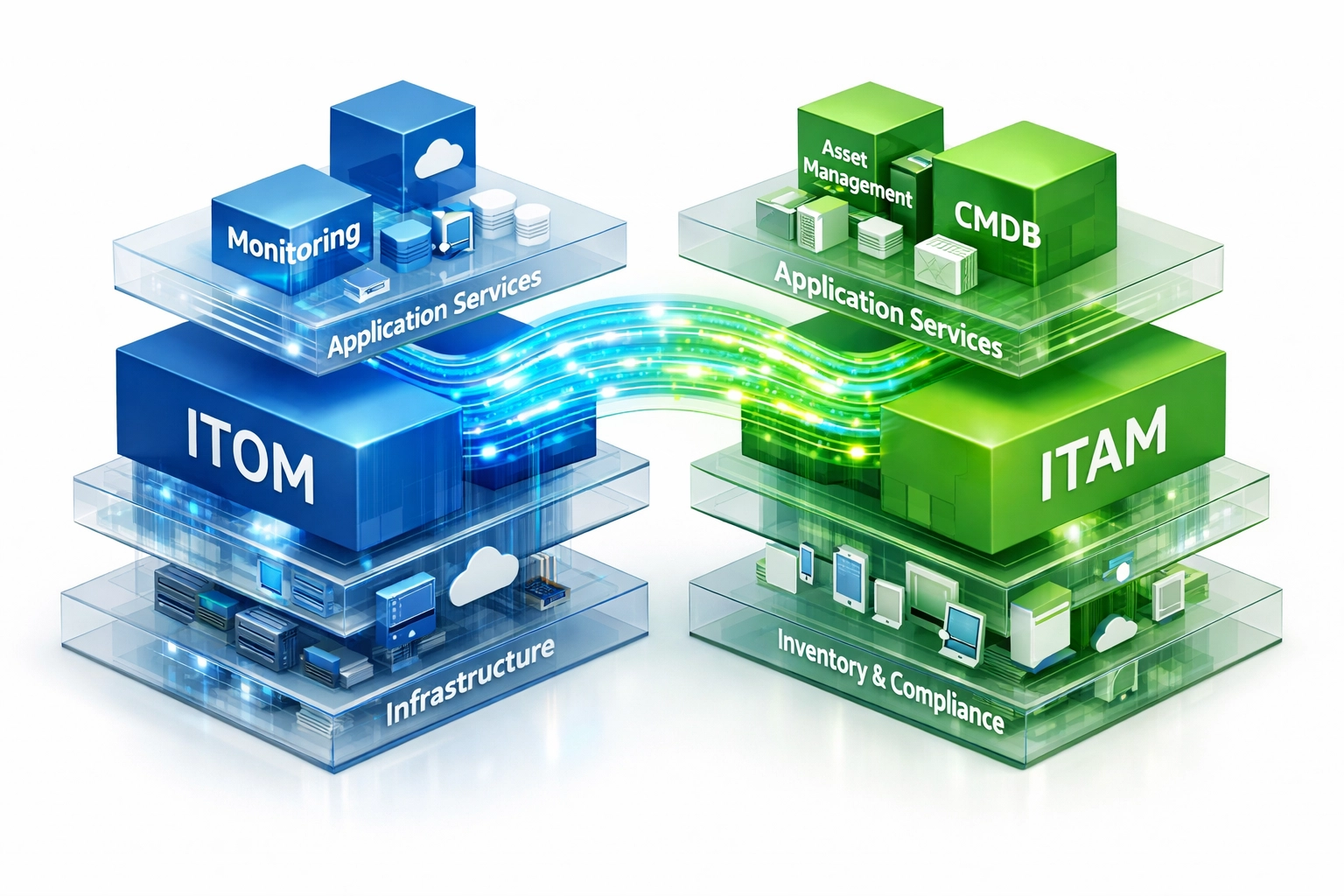
Here's where budget shuffling becomes obvious. If your ITOM deployment doesn't tightly integrate with ITAM workflows, you're tracking infrastructure without understanding costs. You know you have 1,200 virtual machines: but can you trace which applications they support, which business units consume them, and whether they're rightsized?
ServiceNow consulting services that deliver genuine ROI build complete traceability from infrastructure events to financial impact. When an incident occurs, you should instantly see the cost of downtime calculated from business service dependencies. When Discovery identifies new assets, ITAM should automatically trigger license compliance checks and cost allocation.
This integration complexity is where partner expertise separates value creators from budget shufflers. Organizations that achieve this integration capture payback (where cumulative savings equal total implementation investment) within 14-18 months. Those that don't often abandon ITOM implementations within 24 months, categorizing them as "failed projects" that delivered no value.
Agentic AI Configuration for 2026 and Beyond
The future of cost reduction in ITOM centers on agentic AI: autonomous workflows that don't just respond to incidents but predict and prevent them. The latest ServiceNow releases embed AI capabilities that can reduce ticket volume by 30-40% when properly configured.
But here's the catch: agentic AI requires structured data, clean CMDB relationships, and integrated workflows. If your ServiceNow implementation partner built your ITOM foundation on incomplete Discovery or weak ITAM integration, you cannot bolt AI on top and expect transformation. You get automation of chaos: which is just expensive chaos.
The Free 2026 License Audit: Your Diagnostic Tool
This is why SnowGeek Solutions offers a comprehensive Free 2026 ServiceNow ROI & License Audit. This isn't a sales pitch disguised as an assessment. It's a diagnostic tool that reveals whether your current implementation captures actual cost reductions or simply moves budget around.
The audit examines five specific areas:
Infrastructure Visibility Coverage: What percentage of your actual infrastructure appears in your CMDB? I've found organizations operating with 55-70% visibility who believe they have complete coverage because their partner showed them a dashboard with impressive numbers.
ITAM Integration Completeness: Do your ITOM events trigger ITAM workflows? Can you trace infrastructure costs to business services? Most organizations discover they have ITOM and ITAM operating as disconnected silos.
Discovery Accuracy and Freshness: When was the last time your Discovery patterns were updated? Are they calibrated to your current infrastructure, or are they running default schedules that miss critical dependencies?
Automation Capture Rate: What percentage of L1/L2 incidents resolve automatically without human intervention? If you're below 60%, you're leaving significant operational savings uncaptured.
AI Readiness Assessment: Does your current ITOM foundation support agentic AI workflows? Or would you need to rebuild core infrastructure before AI capabilities can deliver value?
The Path Forward: Choosing Value Over Budget Theater
I've guided organizations through this decision dozens of times. The choice isn't between "ITOM yes or no": it's between ITOM that transforms operational excellence and ITOM that becomes an expensive line item without measurable returns.
For US organizations focused on ROI and AI-driven automation, the question is whether your current partner can configure agentic AI workflows that reduce ticket volume and accelerate resolution. For EU organizations navigating DORA compliance and ESG reporting, the question is whether your ITOM implementation provides the asset visibility and incident traceability that regulators demand.

Both markets require the same foundation: precise Discovery, integrated ITAM, and a ServiceNow implementation partner with proven expertise in capturing genuine cost reductions.
Your Next Step
If you're questioning whether your current ITOM investment delivers real value or just redistributes expenses, the Free 2026 ServiceNow ROI & License Audit provides definitive answers. Visit SnowGeek Solutions to share your project details and schedule your comprehensive audit.
I encourage you to also register with SnowGeek Solutions for ongoing platform updates and expert insights as ServiceNow continues to evolve its ITOM capabilities throughout 2026. The difference between cost reduction and budget shuffling often comes down to knowing which features to configure and how to integrate them with precision.
Your ITOM investment should fund transformation, not theater. Let's make sure it does.
Comments