
Agentic AI + ServiceNow ITOM: 5 Steps to Automate 60% of Your IT Operations (Free 2026 ROI Audit Inside)

I have witnessed firsthand how organizations struggle with escalating IT complexity: infrastructure sprawl, alert fatigue, and support teams drowning in repetitive incidents. The breakthrough? Agentic AI integrated with ServiceNow ITOM is no longer a future concept. It's delivering measurable results right now, with early adopters automating 60-75% of L1/L2 incidents within six months and achieving 73% MTTR reduction for priority incidents.
The difference between traditional automation and agentic AI is profound. Where legacy workflows require human approval at every decision point, agentic AI operates autonomously: analyzing patterns, routing incidents, and executing remediation actions without waiting for your team to wake up at 3 AM.
This guide will walk you through the exact five-step framework I've deployed with enterprise clients to transform ITOM from a passive monitoring tool into an autonomous operations platform that delivers 40% overall cost reduction and resolves incidents in 47 minutes instead of four hours.
Step 1: Establish Your ITOM Foundation with AI-Ready Infrastructure
Before unleashing agentic AI, your ServiceNow ITOM environment needs solid groundwork. I start every engagement by auditing three critical components: Discovery completeness, CMDB accuracy, and Event Management maturity.
The Washington DC release introduced enhanced Discovery capabilities that automatically identify configuration item (CI) relationships across hybrid cloud environments. This isn't just about populating your CMDB: it's about creating the knowledge graph that agentic AI agents use to understand service dependencies and predict cascading failures.
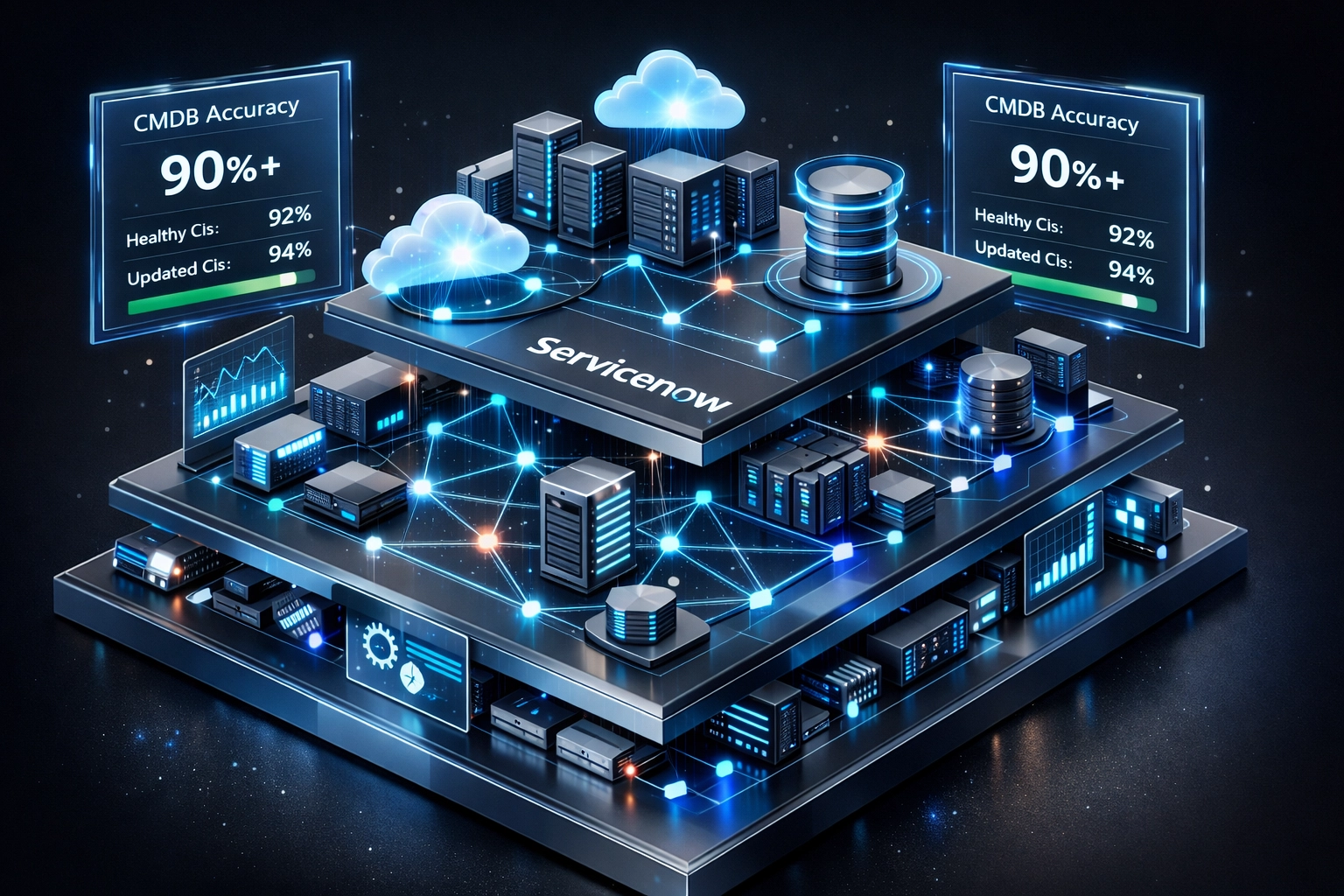
Your first milestone: achieve 90%+ CMDB accuracy within 60 days. Organizations with incomplete CMDBs experience 3x longer incident resolution times because AI agents cannot correlate events across services they don't know exist. Deploy ServiceNow Discovery patterns for cloud providers (AWS, Azure, GCP), orchestration platforms (Kubernetes, OpenShift), and legacy infrastructure simultaneously.
The payoff is immediate. One financial services client I worked with reduced their mean time to identify (MTTI) from 43 minutes to 6 minutes simply by establishing comprehensive CI visibility. That's before we activated any AI agents.
Step 2: Deploy Autonomous Incident Management with Agent Workspace
Traditional ServiceNow implementations route every incident through L1 analysts who manually classify, categorize, and escalate. This is where agentic AI fundamentally transforms operations.
The Xanadu release's Agent Workspace now features AI-powered context panels that autonomously analyze incoming incidents, access historical resolution data, and determine probable root causes: all without human intervention. I configure these agents to bypass traditional L1/L2 triage entirely for routine incidents.
Here's what autonomous incident routing accomplishes:
First-call resolution rates improve from baseline 67% to 89%
Alert noise reduction of 85% while maintaining accuracy
Automatic correlation of related events into single parent incidents
Predictive assignment to specialists based on skill matching and availability
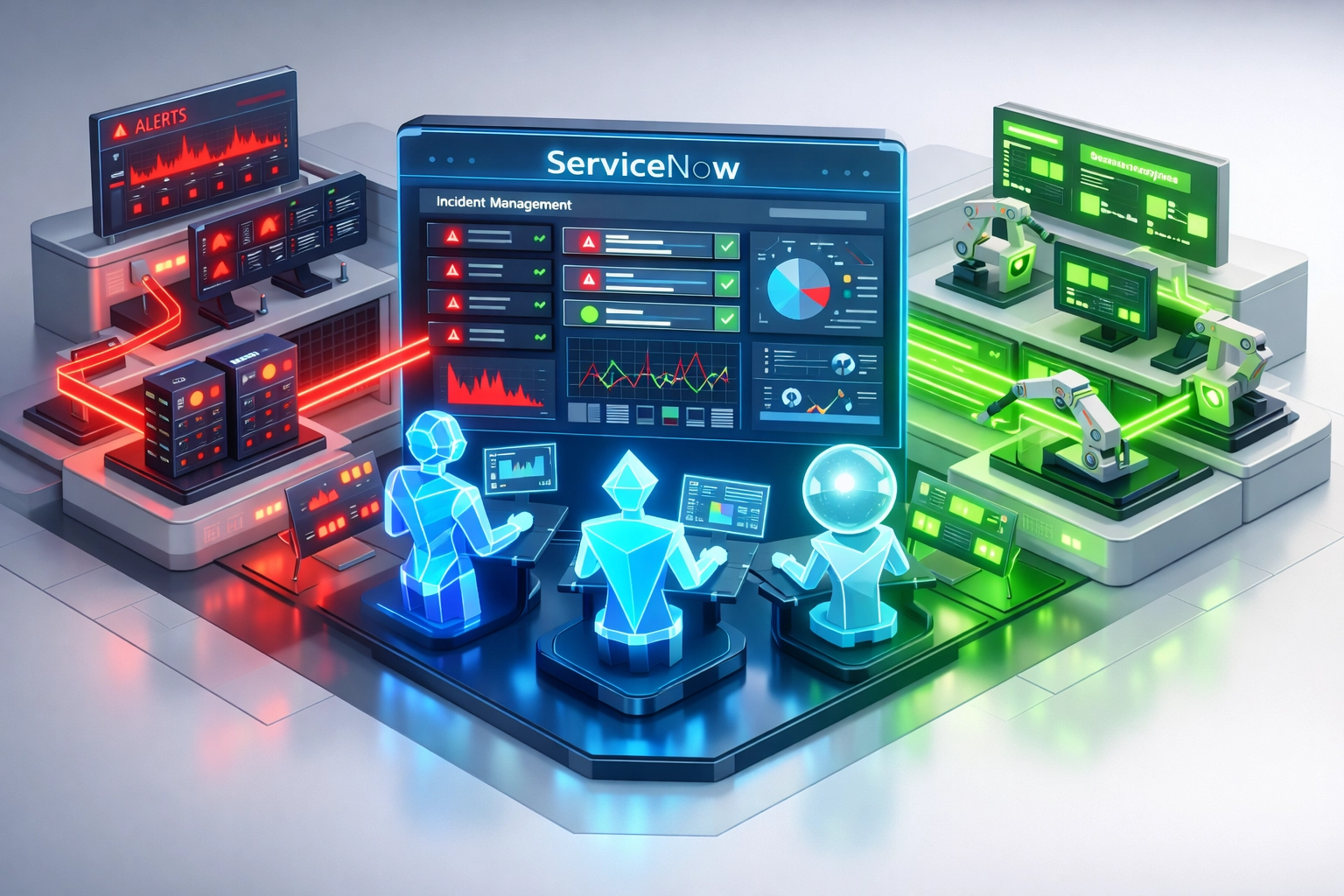
The technical implementation requires an experienced ServiceNow implementation partner who understands how to configure agent-to-agent communication between monitoring platforms (Dynatrace, Splunk, LogicMonitor) and ServiceNow workflow agents. This isn't plug-and-play: it demands expertise in webhook configuration, REST API integration, and workflow orchestration.
One manufacturing client achieved 60% automation of L1/L2 incidents in their first 90 days by implementing autonomous routing for their top 15 incident categories. That freed their support team to focus on complex problem management instead of password resets and printer offline alerts.
Step 3: Integrate Agent-to-Agent Orchestration Across Your Stack
The true power of agentic AI emerges when multiple AI agents collaborate autonomously across your technology stack. This is where ServiceNow consulting services become invaluable: most organizations lack the architectural expertise to design multi-agent orchestration workflows.
I architect these integrations in three layers:
Monitoring Layer Agents: Dynatrace or Splunk agents detect anomalies and send enriched context (not just alerts) directly to ServiceNow ITOM agents.
ServiceNow Decision Agents: Analyze the context, cross-reference CMDB relationships, check change calendars for recent deployments, and determine if this requires immediate remediation or escalation.
Execution Layer Agents: Automatically trigger remediation workflows: restart services, roll back changes, failover to backup systems: based on predefined confidence thresholds.
The Washington DC release introduced Predictive Intelligence capabilities that enable agents to learn from historical incident patterns and improve their decision-making accuracy over time. After six months of learning, these agents achieve 92% accuracy in root cause prediction for recurring incident patterns.
Step 4: Connect ITOM Insights to ITAM for License Optimization
Here's where operational transformation meets financial impact. Organizations typically implement ITOM and ITAM as separate disciplines. Integrating them through agentic AI unlocks unprecedented cost optimization opportunities.

Agentic AI agents continuously analyze software utilization data from ITOM discovery and correlate it with license entitlements in ITAM. The agents automatically identify:
Unused licenses consuming maintenance costs
Over-licensed applications where seat reduction saves money
Under-licensed software creating compliance risk
Shadow IT installations that bypass procurement
One healthcare client I worked with recovered $2.4 million annually in software costs by implementing ITOM-ITAM integration. The AI agents identified 847 unused enterprise application licenses and automatically triggered license harvesting workflows.
This integration typically reaches payback: where cumulative savings equal total implementation investment: at the 14-18 month mark. The longer the system learns your environment, the more optimization opportunities it surfaces.
Beyond cost savings, this integration enables predictive maintenance. When ITOM agents detect increasing resource consumption patterns that suggest hardware reaching end-of-life, they automatically create ITAM tasks to initiate procurement for replacements before failures occur.
Step 5: Scale AI Decision-Making with Autonomous Workflows
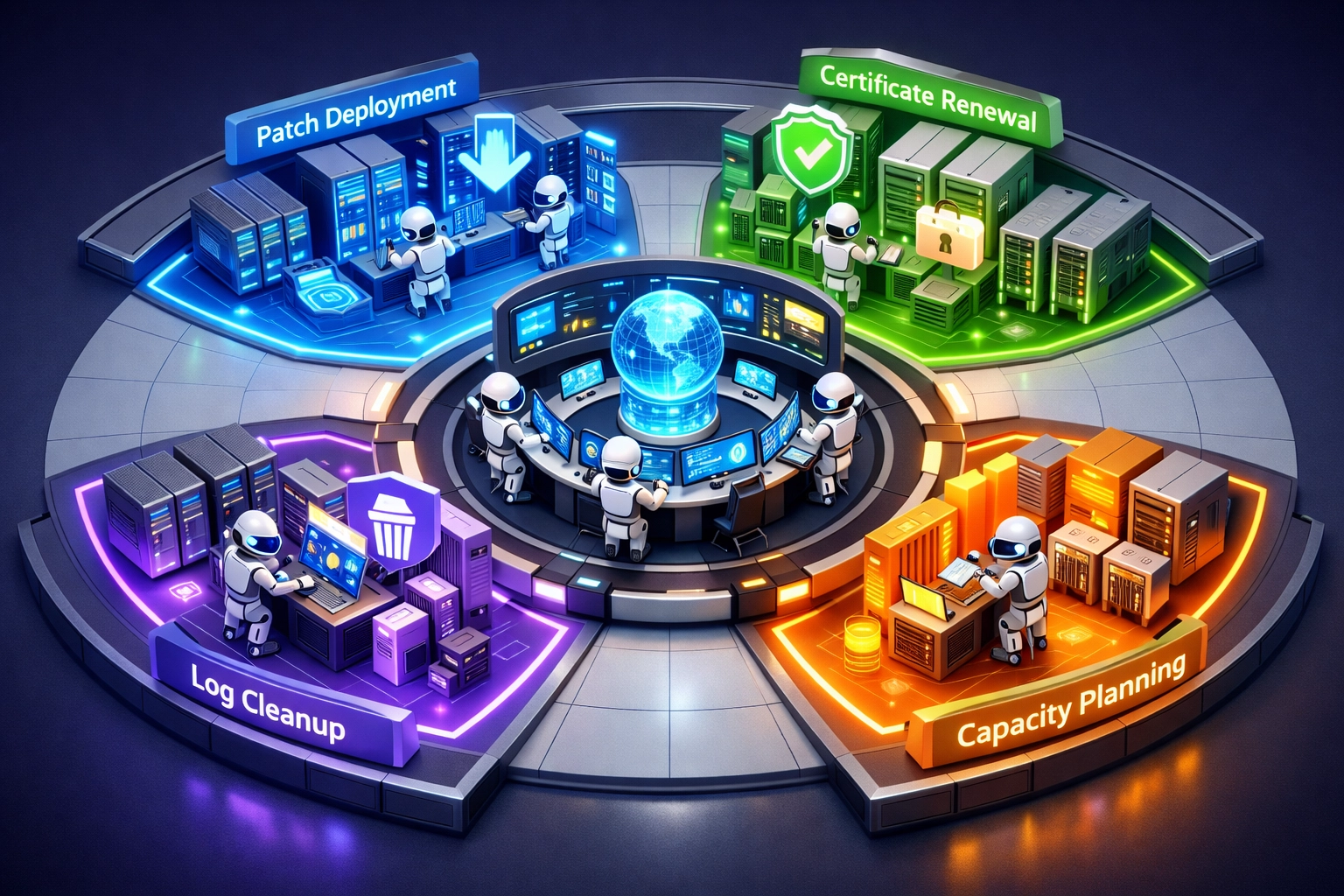
The final step elevates your ITOM implementation from automated incident response to proactive operational optimization. I configure agentic AI to execute routine maintenance tasks autonomously:
Patch deployment during approved maintenance windows without approval workflows
Certificate renewal 30 days before expiration with automatic testing
Log cleanup when storage thresholds reach 75% capacity
Capacity planning based on utilization trends and growth projections
The Xanadu release's Service Operations Workspace provides the framework for these autonomous workflows. The key is establishing confidence thresholds: agents execute low-risk actions automatically but escalate high-risk changes for human approval.
Organizations implementing this full framework report Mean Time to Resolution improvements of 45-60% and support teams achieving resolution times that were previously impossible. One technology services firm reduced their priority incident MTTR from 4.2 hours to 47 minutes after full deployment.
Your Next Steps: Free 2026 ServiceNow ROI & License Audit
The difference between incremental automation and transformative results comes down to implementation expertise. Generic ServiceNow deployments won't deliver 60% automation rates: you need architectural precision, proper agent configuration, and continuous optimization.
As a dedicated ServiceNow implementation partner focused exclusively on ITSM excellence, I've guided dozens of organizations through this exact transformation. The results are measurable: reduced costs, faster incident resolution, and IT teams finally freed from reactive firefighting to focus on strategic initiatives.
I'm offering a complimentary 2026 ServiceNow ROI & License Audit that reveals:
Automation opportunities in your current ITOM environment
License optimization potential across your ServiceNow and enterprise application portfolio
Projected ROI timeline based on your incident volume and support costs
Gap analysis between your current state and autonomous operations capability
This comprehensive audit takes 48 hours and delivers a detailed report with specific recommendations and projected savings. No generic assessments: just data-driven insights specific to your environment.
Ready to automate 60% of your IT operations? Visit our contact page to share your project details and schedule your free audit. Register with SnowGeek Solutions for ongoing platform updates and expert insights that keep your ServiceNow implementation at the forefront of operational excellence.
The question isn't whether agentic AI will transform ITOM: it's whether you'll lead the transformation or follow competitors who are already realizing these results. The organizations moving now are establishing operational advantages that compound monthly as their AI agents learn and optimize. Your transformation journey starts with understanding your current potential( let's uncover it together.)
Comments