
7 Mistakes You're Making with ServiceNow ITOM Implementation (and How a Free 2026 ROI Audit Fixes Them)
- SnowGeek Solutions
- Feb 22
- 6 min read

I have witnessed firsthand how ServiceNow ITOM implementations fail: not because of platform limitations, but because organizations unknowingly make seven critical mistakes that compound exponentially over time and sabotage ROI before they realize what's happening. As a ServiceNow implementation partner who has audited dozens of deployments across the US and EU markets, I can tell you with absolute certainty: these mistakes cost mid-market enterprises between $400K and $2M annually in lost automation value, license waste, and operational inefficiency.
This guide will walk you through the seven most damaging ITOM implementation mistakes and show you exactly how a comprehensive 2026 ROI and License Audit identifies and corrects them: often uncovering immediate savings opportunities within 48 hours.
Mistake #1: Accepting Mediocre CMDB Data Quality
Here's the brutal truth: if your Configuration Management Database (CMDB) accuracy sits between 60-75%, you're operating in what I call the "catastrophic zone" for AI-driven automation. Organizations tolerate this mediocre data quality thinking it's "good enough," but when CMDB accuracy falls below 75%, it systematically guarantees that Washington release's predictive AI capabilities will fail.
The cascading impact is devastating. Incident management routes tickets to the wrong teams. Change management can't accurately assess downstream impacts. ITAM license counts become unreliable. Your entire ITOM foundation crumbles because every automation, every workflow, every AI prediction depends on accurate configuration data.
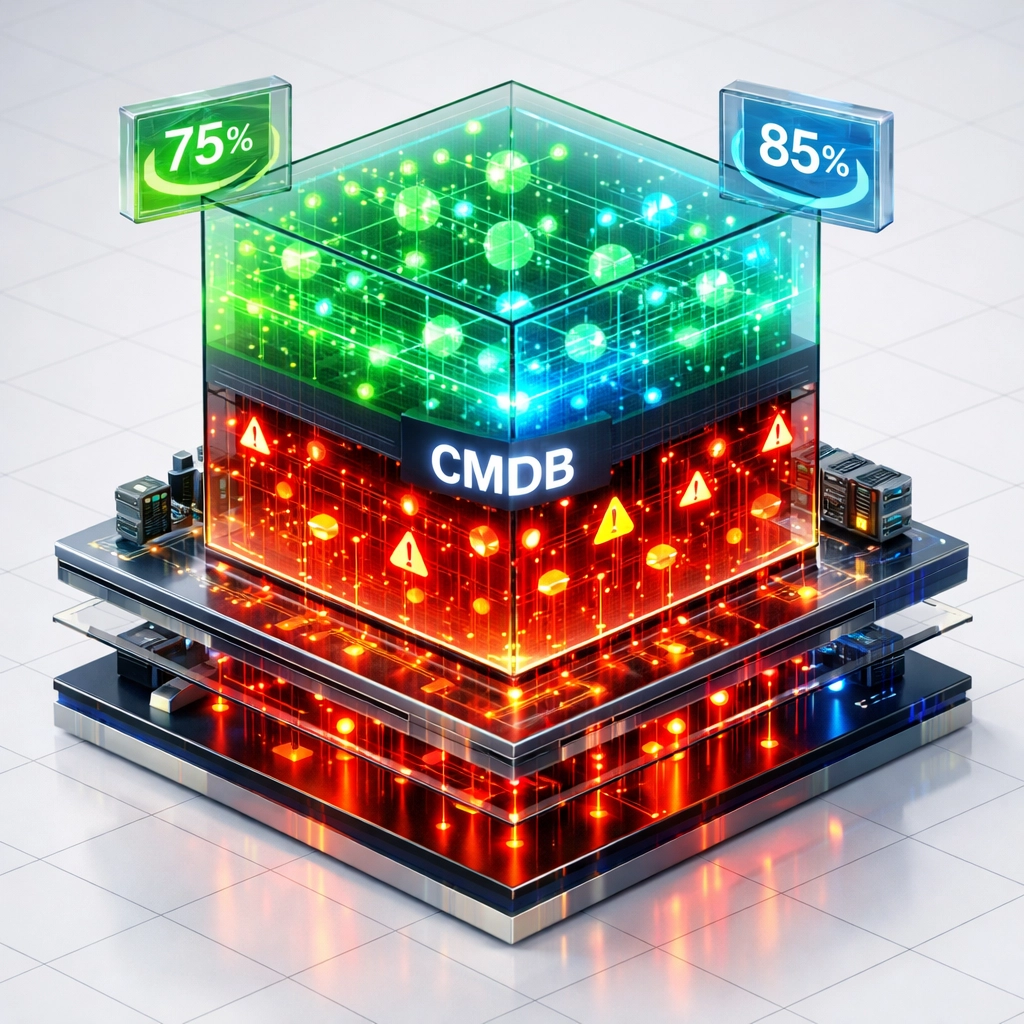
The Fix: The Washington release introduced enhanced Service Mapping capabilities that, when properly implemented with automated Discovery validation rules, push CMDB accuracy above 85%: the threshold where AI-driven automation becomes transformative rather than theoretical. A 2026 ROI Audit measures your actual CMDB accuracy against infrastructure reality, identifies the top 20% of configuration items driving 80% of incidents, and establishes automated validation workflows that flag inconsistencies in real-time.
Organizations that correct this mistake see Mean Time to Resolution (MTTR) improvements of 40-60% within the first quarter post-correction.
Mistake #2: Ignoring Discovery Scope Limitations and MID Server Misplacement
I consistently encounter enterprises that deploy ITOM Discovery with incomplete credential coverage, leaving massive blind spots in infrastructure visibility. They're covering only 40-60% of their actual IT estate while building entire ITOM strategies assuming complete visibility: creating what I call "phantom confidence."
Even worse? Single MID server deployments serving all purposes. This architectural choice creates bottlenecks where the same Discovery schedule works sometimes but fails other times, and large subnets take excessive time to scan. Wrong MID placement causes high latency and inconsistent Discovery performance that technical teams spend months troubleshooting.
The Fix: A comprehensive Discovery scope assessment maps credential coverage against your complete IT estate. Deploy multiple MID servers strategically placed near network zones rather than one centralized MID. Align Discovery schedules to each MID's reachable scope to reduce scan time and failures.
ServiceNow consulting services specializing in ITOM architecture typically identify 30-50 uncredentialed systems during initial audits: systems generating incidents, consuming licenses, and representing security risks that your CMDB doesn't even know exist.
Mistake #3: Treating ITOM and ITAM as Separate Domains
This siloed approach is extraordinarily expensive, and the data proves it. Organizations that properly integrate ITOM and ITAM achieve First Call Resolution (FCR) rates of 91% compared to just 68% without integration: a 23-percentage-point difference translating to $400K-$800K in annual ROI improvements for mid-market enterprises.

Why such dramatic improvement? Because integrated ITOM-ITAM architecture enables service desk agents to see the complete context: hardware configuration, software licenses, warranty status, maintenance contracts, and incident history in a unified view. Without integration, agents toggle between modules, make decisions with incomplete information, and escalate tickets unnecessarily.
The Fix: Map your Governance, Risk, and Compliance (GRC) module to ITOM workflows during initial design. Implement integrated Service Mapping strategies that automatically correlate discovered assets with software entitlements. A 2026 ROI Audit quantifies the exact ROI impact of your current siloed versus unified architecture potential and provides a roadmap for integration that typically pays for itself within 90 days through reduced escalations alone.
Mistake #4: Trusting "Green" Dashboards Without End-User Validation
Your ITOM health metrics show green. Infrastructure monitoring reports normal. Service availability stands at 99.8%. Yet users are calling the service desk complaining about application slowness and connectivity issues.
I've seen this scenario dozens of times. Traditional ITOM dashboards measure infrastructure health: server CPU, memory utilization, network latency: but miss the actual end-user experience. A database server can show perfect health metrics while query performance degrades 300% due to unoptimized indexes.
The Fix: Combine infrastructure signals with end-user signals through Digital Experience (DEX) and Application and Content Correlation (ACC) capabilities. Define experience-based Service Level Objectives (SLOs) that measure what users actually experience, not just what infrastructure health suggests.
A comprehensive ROI Audit examines the gap between your infrastructure metrics and actual user satisfaction scores, then establishes unified observability that reveals true impact. Organizations implementing this fix reduce "phantom incidents": where monitoring shows healthy but users are impacted: by 70-85%.
Mistake #5: Neglecting Data Retention and Archive Policies
Platform performance degradation from heavy ITOM tables is one of the most overlooked implementation mistakes. Slow list loads, reporting delays, extended ECC queue processing times: all symptoms of inadequate data retention policies.

Discovery stores historical configuration data. Event Management accumulates millions of events. Service Mapping maintains relationship histories. Without proper archive and purge policies, these tables grow to millions of records, degrading platform performance across all modules, not just ITOM.
The Fix: Implement targeted archive and purge policies based on data classification and compliance requirements. European organizations must balance GDPR's data minimization principle with DORA's operational resilience requirements: a nuanced challenge that demands expert ServiceNow consulting services. Index strategies for frequently queried ITOM tables stabilize platform performance even during Discovery runs.
A 2026 ROI Audit identifies tables consuming disproportionate database resources and provides precise retention policies aligned with both operational needs and regulatory frameworks like DORA (Digital Operational Resilience Act) for EU financial services organizations.
Mistake #6: Misunderstanding Licensing and Entitlements
I cannot count how many times I've encountered organizations that designed ITOM strategies expecting features that aren't available in their license tier or discovered costs exceeding budget by 200-400% during implementation.
Features expected during design: advanced Event Management correlation, AIOps predictive capabilities, comprehensive Service Mapping: aren't available, or they require additional license purchases that weren't budgeted. The implementation stalls. ROI timelines extend. Stakeholder confidence erodes.
The Fix: Confirm entitlements early and comprehensively: including Discovery scope limitations, Event Management capabilities, AIOps availability, Service Mapping restrictions, and DEX licensing. A 2026 ROI and License Audit examines your actual entitlements against your implementation roadmap, identifies gaps, and provides optimization strategies.
Organizations conducting these audits consistently uncover 15-30% license optimization opportunities through unused entitlements, redundant modules, or more cost-effective licensing structures aligned with actual usage patterns.
Mistake #7: Skipping Compliance-Ready Architecture (DORA/GDPR/ESG)
For organizations operating in EU markets, this mistake carries regulatory risk that extends far beyond ROI considerations. DORA mandates comprehensive operational resilience capabilities: incident classification, escalation procedures, third-party risk tracking: that must be embedded in ITOM architecture from day one, not retrofitted later.
GDPR demands data sovereignty controls that affect how Discovery credentials are stored, where CMDB data resides, and how Service Mapping handles personally identifiable infrastructure information. Environmental, Social, and Governance (ESG) reporting increasingly requires IT asset tracking for carbon footprint calculations: data that lives in your ITOM foundation.
The Fix: Design compliance-ready ITOM architecture that addresses DORA operational resilience, GDPR data sovereignty, and ESG tracking capabilities as foundational requirements. A comprehensive 2026 ROI Audit assesses compliance readiness across all three frameworks and provides architectural corrections before regulatory audits identify deficiencies.
US organizations shouldn't dismiss this as "EU-only": these compliance frameworks are increasingly influencing global enterprise standards, and proactive implementation positions organizations as preferred partners for European subsidiaries and customers.
How a Free 2026 ServiceNow ROI & License Audit Transforms Your ITOM Implementation
A comprehensive ROI and License Audit examines all seven mistakes simultaneously, measuring actual performance against potential across these critical dimensions:
CMDB accuracy measured against infrastructure reality
Discovery scope completeness with credential gap identification
ITOM-ITAM integration maturity quantified through FCR metrics
Dashboard accuracy versus end-user experience correlation
Platform performance impact from ITOM data volumes
License optimization opportunities and entitlement alignment
Compliance readiness across DORA, GDPR, and ESG frameworks
Organizations conducting these audits uncover immediate savings opportunities while establishing the foundation for transformative ITOM capabilities that deliver measurable ROI within 90 days.
Your Next Steps Toward ITOM Excellence
The difference between mediocre and transformative ServiceNow ITOM implementation isn't platform capability: it's implementation precision and architectural correctness from day one. These seven mistakes cost organizations millions in lost automation value, but they're entirely correctable when identified early.
Ready to transform your ITOM implementation? Visit the SnowGeek Solutions contact page to share your project details and request your complimentary 2026 ServiceNow ROI & License Audit. Our team will conduct a comprehensive assessment, identify your specific optimization opportunities, and provide a roadmap for ITOM excellence.
Register with SnowGeek Solutions for platform updates, release insights, and expert guidance that keeps your ServiceNow investment delivering maximum value quarter after quarter. The journey to operational excellence starts with understanding exactly where you stand today: and a free ROI audit reveals that picture with unprecedented clarity.
Comments