
7 Mistakes You're Making with ServiceNow ITOM Implementation (And How a Free 2026 ROI Audit Fixes Them)
- SnowGeek Solutions
- Feb 19
- 6 min read

I have witnessed firsthand how organizations invest hundreds of thousands: sometimes millions: into ServiceNow ITOM implementations, only to discover six months later that their infrastructure visibility remains clouded, their automation initiatives stall, and their ROI projections evaporate. After guiding dozens of enterprises through ITOM transformations, I can tell you this: the failures rarely stem from ServiceNow's capabilities. They originate from seven specific, preventable mistakes that organizations make during implementation.
The difference between a transformative ITOM deployment and a costly disappointment often comes down to foundational decisions made in the first 90 days. Let me guide you through the essential mistakes I see organizations repeat: and more importantly, how a comprehensive 2026 ROI audit identifies and fixes them before they derail your entire IT operations strategy.
Mistake #1: Operating in the CMDB "Catastrophic Zone"
Here's a metric that should alarm every IT leader: if your Configuration Management Database operates between 60-75% accuracy, you're in what the ServiceNow community calls the "catastrophic zone" for AI-driven automation. I've seen organizations proudly announce their CMDB implementations while operating at 70% accuracy, completely unaware they're building their entire automation strategy on a foundation of quicksand.
When your CMDB doesn't accurately reflect infrastructure reality, every automated workflow becomes unreliable. Incident routing sends tickets to the wrong teams. Change management approvals miss critical dependencies. Asset tracking reports phantom devices that were decommissioned months ago. The cascading failures extend across your entire IT service management ecosystem.
The fix demands enhanced Service Mapping capabilities combined with automated validation rules. Organizations that push CMDB accuracy above 85%: the genuine transformation threshold: experience a fundamental shift in their ITOM capabilities. Suddenly, AI-driven automation becomes reliable. Predictive insights become actionable. This isn't incremental improvement; it's the difference between theoretical ITOM and operational excellence.

Mistake #2: Building Strategy on Phantom Confidence
I call it "phantom confidence": the dangerous belief that you have complete infrastructure visibility when Discovery covers only 40-60% of your actual IT estate. This mistake compounds exponentially when organizations build entire ITOM strategies assuming complete visibility, then wonder why their Service Mapping initiatives reveal massive blind spots.
Discovery scope limitations often stem from incomplete credential coverage. Perhaps your Windows domain credentials work perfectly, but your network device credentials are outdated. Maybe your cloud infrastructure wasn't included in the initial Discovery scope. Each gap represents applications, services, and dependencies invisible to your ITOM platform.
A comprehensive Discovery scope assessment maps credential coverage against your complete IT estate. This includes on-premises infrastructure, multi-cloud environments, SaaS applications, and network devices. Deploy Service Mapping alongside Discovery: not as an afterthought: to understand true application dependencies. The ServiceNow Washington release enhanced Discovery patterns with improved credential management and expanded support for containerized environments, making comprehensive coverage more achievable than ever.
Mistake #3: Treating ITOM and ITAM as Divorced Domains
This mistake carries an extraordinary price tag. Organizations that properly integrate ITOM and ITAM achieve First Call Resolution rates of 91% compared to just 68% without integration: a 23-percentage-point difference that translates to $400K-$800K in annual ROI improvements for mid-market enterprises.
The separation stems from organizational silos: ITOM reports to operations, ITAM reports to finance or procurement. But in ServiceNow, these capabilities exist on a unified platform. When your Service Mapping understands application dependencies (ITOM) and your Hardware Asset Management tracks license entitlements (ITAM), magic happens. Incident resolution accelerates because agents see both the technical configuration and the contract details. Software license optimization becomes data-driven because you understand actual usage patterns across your infrastructure.
As a specialized ServiceNow implementation partner, I emphasize unified architecture during every ITOM deployment. The integration isn't a phase two nice-to-have: it's a foundational requirement for maximizing platform potential.
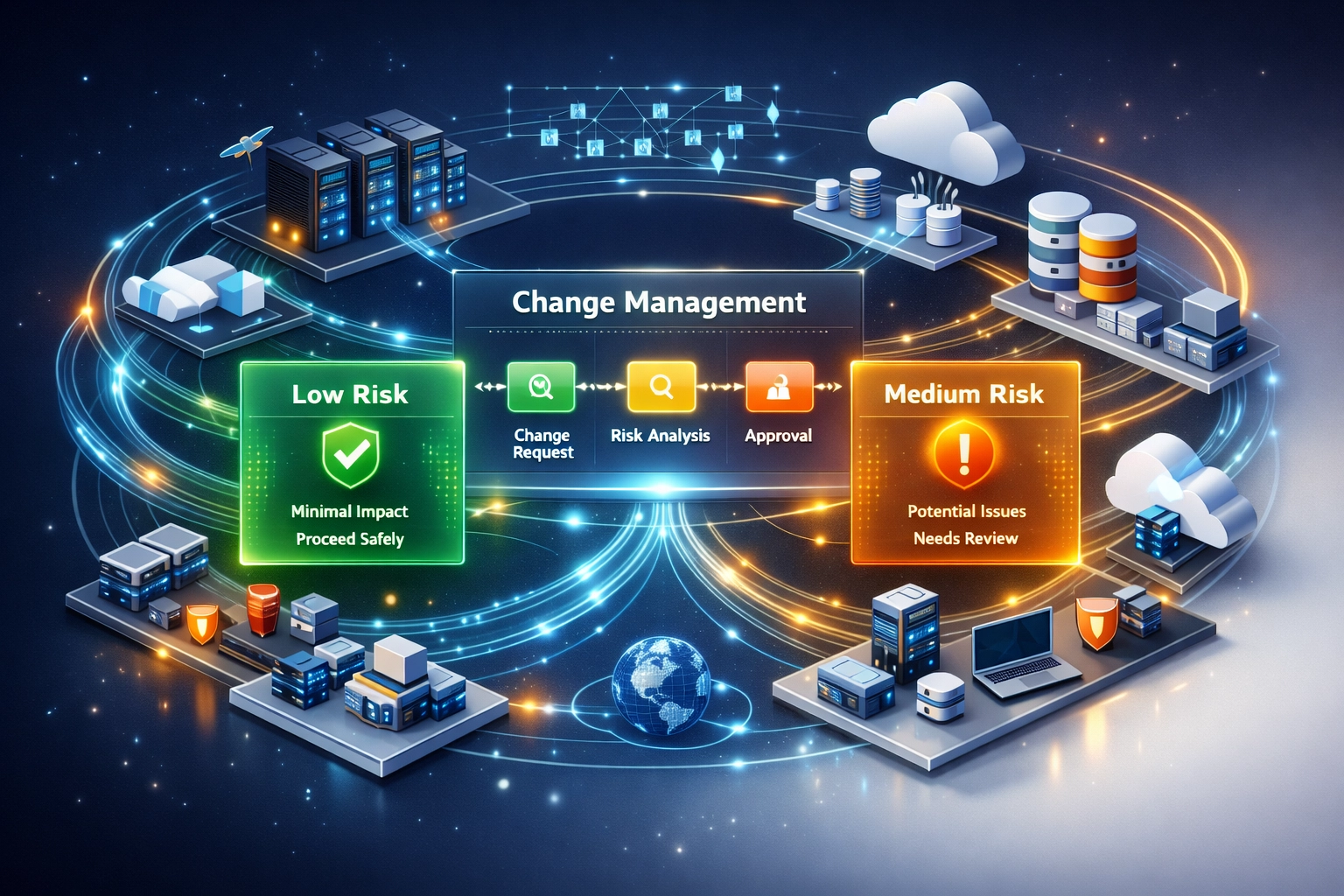
Mistake #4: Neglecting Change Management Architecture
Here's a pattern I see repeatedly: organizations implement Discovery and Service Mapping, celebrate their infrastructure visibility gains, then completely neglect the Change Management implications. They continue using manual risk assessment processes while sitting on a CMDB that could automate 80% of change risk scoring.
The ServiceNow Xanadu release introduced enhanced Change Management capabilities with AI-powered risk prediction. But these capabilities demand accurate Service Mapping data. Without proper application dependency mapping, your Change Risk Assessment remains guesswork. With comprehensive Service Mapping, your Change Success Rate climbs from industry averages of 85% to best-in-class levels exceeding 95%.
A structured change management architecture leverages your ITOM investment to transform change processes. Standard Changes become genuinely low-risk because you understand exact dependencies. Emergency Changes benefit from faster impact analysis. Your Change Advisory Board makes data-driven decisions instead of relying on institutional knowledge and educated guesses.
Mistake #5: Architectural Decisions That Create Technical Debt
I've inherited too many ITOM implementations where well-intentioned architects made decisions that seemed reasonable at the time but created crushing technical debt. Building custom discovery patterns instead of leveraging out-of-the-box capabilities. Creating parallel CMDB systems because "ServiceNow doesn't handle our unique requirements." Customizing core ITOM workflows to match legacy processes instead of adopting ServiceNow best practices.
These decisions compound over time. Each ServiceNow release requires additional testing because your customizations might break. Upgrade cycles extend from weeks to months. Your ServiceNow consulting services costs escalate because consultants spend more time maintaining custom code than driving business value.
The "out-of-the-box first" philosophy isn't about limiting capabilities: it's about leveraging ServiceNow's continuous innovation. When you use native Service Mapping and Discovery capabilities, each release brings automatic improvements. Your ITOM platform evolves with the product rather than becoming frozen in time.
Mistake #6: Over-Customization Without Governance
This mistake deserves its own spotlight because it's so seductive. Your stakeholders demand specific features. Your developers can build anything. Before you realize it, you've customized your way into a corner.
I enforce a simple rule: every customization requires documented business justification and technical alternatives analysis. Can configuration accomplish this objective? Does a ServiceNow IntegrationHub connector solve this without custom code? What are the long-term maintenance implications?
Organizations that maintain strict customization governance experience 40% faster upgrade cycles and 60% lower maintenance costs over three-year periods. These aren't arbitrary numbers: they're measurable outcomes from disciplined architectural decisions.
Mistake #7: Ignoring Compliance and Regulatory Requirements
The 2026 landscape demands ITOM implementations that address regulatory requirements from day one. For European organizations, DORA operational resilience mandates comprehensive infrastructure visibility and change management controls. GDPR data sovereignty requirements influence Discovery scope and data retention policies. ESG tracking capabilities increasingly depend on accurate asset management data.
For US organizations, the focus shifts toward ROI maximization and AI-readiness. Your ITOM platform should support Agentic AI initiatives by providing the high-quality CMDB data that AI agents require for autonomous operations. Without accurate infrastructure data, your AI investments deliver theoretical benefits rather than measurable outcomes.
A forward-looking ITOM implementation integrates these requirements architecturally rather than treating them as compliance checkboxes. Your Service Mapping should track data flows for GDPR compliance. Your Asset Management should capture power consumption metrics for ESG reporting. These capabilities transform compliance from cost centers into strategic differentiators.
How a 2026 ROI Audit Fixes Everything
A comprehensive ROI audit examines seven specific dimensions that directly address these mistakes:
CMDB Accuracy and Data Quality Metrics – We measure actual accuracy against infrastructure reality, identifying the gap between your perceived and actual visibility. This assessment reveals whether you're operating in the catastrophic zone or approaching the transformation threshold.
Discovery Scope Completeness – We map credential coverage against your complete IT estate, quantifying blind spots and prioritizing remediation. This includes multi-cloud environments, SaaS applications, and network infrastructure often overlooked in initial implementations.
ITOM-ITAM Integration Maturity – We quantify the ROI impact of siloed versus unified architecture, measuring FCR rates, incident resolution times, and license optimization opportunities. The assessment reveals the specific dollar value you're leaving on the table through architectural separation.
Compliance Readiness – For EU organizations, we assess DORA operational resilience, GDPR data sovereignty, and ESG tracking capabilities. For US organizations, we evaluate AI-readiness and ROI maximization opportunities.
Service Mapping Deployment – We analyze business service visibility and dependency mapping maturity, identifying critical applications operating without proper documentation.
Change Management Effectiveness – We measure Change Success Rate and risk scoring maturity, revealing automation opportunities that reduce change-related incidents.
Overall Architectural Soundness – We identify technical debt and provide remediation priorities, ensuring your ITOM platform evolves with ServiceNow releases rather than becoming frozen in time.
The audit delivers a detailed roadmap with specific, prioritized recommendations. More importantly, it quantifies the ROI impact of each improvement, helping you build business cases for proper ITOM investment.
Your Next Steps Toward ITOM Excellence
If you recognize your organization in these seven mistakes, you're not alone: and you're not without options. The gap between theoretical ITOM capabilities and operational excellence is bridgeable with proper guidance and systematic remediation.
I invite you to take advantage of our Free 2026 ServiceNow ROI & License Audit. This comprehensive assessment examines your current ITOM implementation across all seven dimensions, identifies specific improvement opportunities, and quantifies the financial impact of proper remediation. Visit the SnowGeek Solutions contact page to share your project details and schedule your audit.
Additionally, register with SnowGeek Solutions for ongoing platform updates and expert insights. As ServiceNow continues releasing enhanced ITOM capabilities, staying informed ensures you maximize your investment and maintain competitive advantage.
Your ServiceNow ITOM implementation represents significant investment and strategic importance. Don't let preventable mistakes undermine its potential. Let's transform your ITOM capabilities from disappointing to transformative( together.)
Comments