
7 Mistakes You're Making with ServiceNow ITOM (and How to Fix Them Before Your 2026 Budget Review)
- SnowGeek Solutions
- Feb 19
- 5 min read

I've witnessed firsthand how organizations hemorrhage budget and opportunity through preventable ITOM implementation mistakes. With 2026 budget reviews approaching and regulatory frameworks like DORA enforcement tightening across EU markets, the technical debt you're carrying isn't just inconvenient: it's existential.
After working with dozens of enterprises struggling to maximize their ServiceNow ITOM investments, I've identified seven critical architectural mistakes that compound over time. The good news? Each one is fixable before your leadership starts questioning your platform ROI.
Mistake #1: Operating in the CMDB "Catastrophic Zone"
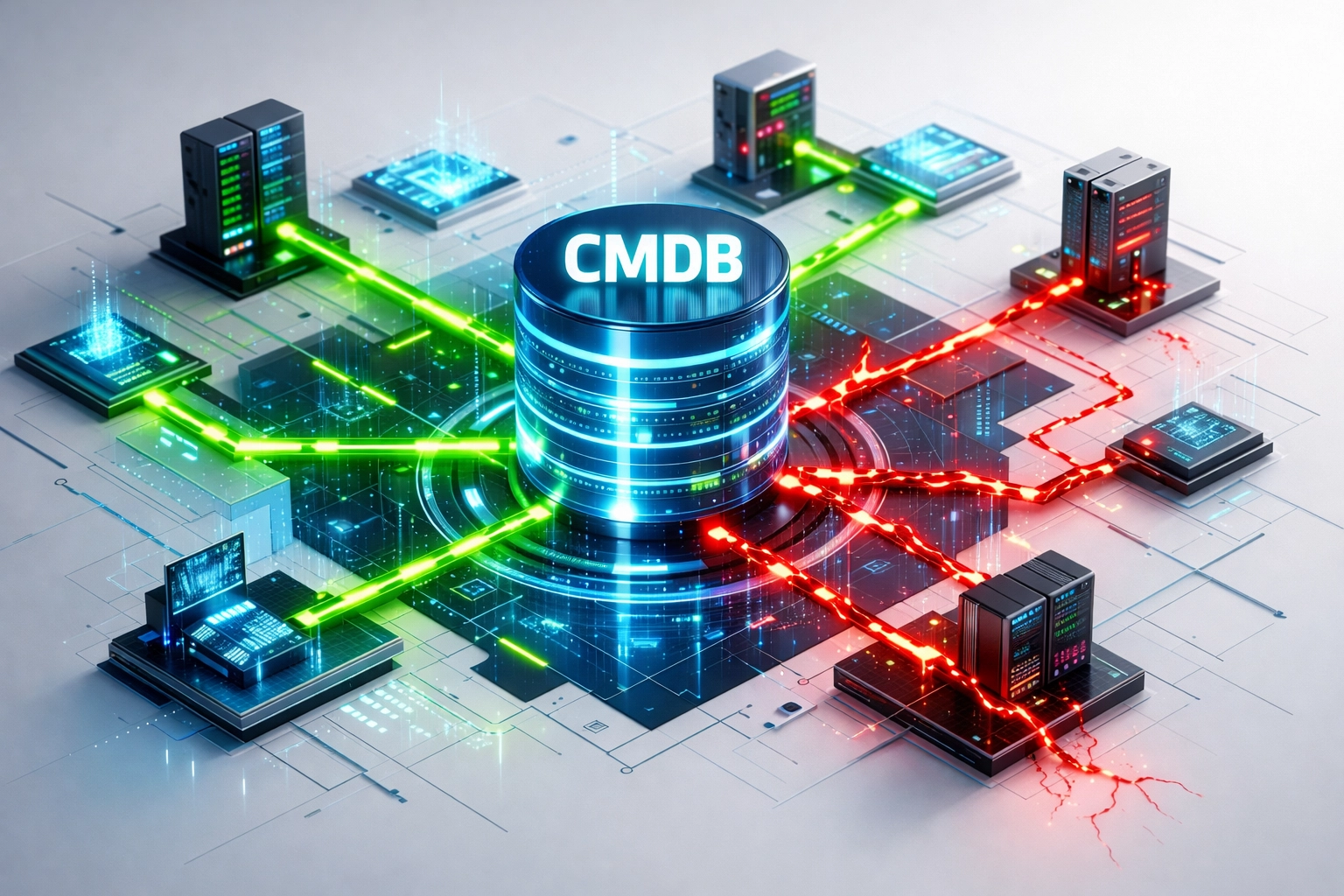
Your Configuration Management Database accuracy sits somewhere between 60-75%. You think that's acceptable. It's not.
I call this range the "catastrophic zone" for AI-driven automation. At this accuracy level, your CMDB becomes fundamentally unreliable as a single source of truth, triggering cascading failures across incident management, change management, and asset tracking. The Washington DC release introduced enhanced Service Mapping capabilities specifically designed to push organizations beyond this threshold.
The Fix: Implement automated validation rules and enhanced Service Mapping to drive CMDB accuracy above 85%: the threshold where AI-driven automation transforms from theoretical promise to measurable business value. Organizations achieving this accuracy benchmark report MTTR reductions of 40% and incident resolution improvements exceeding 20 percentage points.
Mistake #2: Living with Discovery Blind Spots
Here's what I consistently observe: organizations deploy Discovery with incomplete credential coverage, leaving 40-60% of their IT infrastructure completely invisible. This creates what I term "phantom confidence": you believe you understand your infrastructure while making critical decisions on incomplete data.
Incomplete network architecture mapping doesn't just reduce visibility; it increases Mean Time to Resolution by an average of 40%. Under DORA's operational resilience requirements, this technical gap introduces unacceptable ICT risk that regulators will scrutinize.
The Fix: Conduct a comprehensive Discovery scope assessment mapping credential coverage against your complete IT estate. Deploy ServiceNow's Service Mapping alongside Discovery to understand true application dependencies, not just infrastructure components. This integrated approach delivers the visibility GDPR data flow mapping and ESG reporting frameworks demand.
Mistake #3: Maintaining the ITOM/ITAM Silo
This mistake carries the highest financial penalty I've tracked. Organizations integrating ITOM and ITAM achieve First Call Resolution rates of 91% compared to just 68% without integration: a 23-percentage-point difference translating to $400K-$800K in annual ROI improvements for mid-market enterprises.
The performance degradation extends beyond FCR. Siloed approaches degrade MTTR performance by 40%, with fragmented implementations stalling around 4-6 hours for Priority 2 incidents versus sub-2-hour resolution in integrated implementations. When ITOM and ITAM aren't integrated from inception, CMDB accuracy typically plateaus around 60-70%, perpetuating the data quality issues that undermine automation initiatives.
The Fix: Integrate ITOM and ITAM from the outset. The Washington DC release introduced enhanced Service Graph Connectors and expanded Discovery patterns specifically designed to unify ITOM data collection with CMDB enrichment. Working with experienced ServiceNow consulting services that understand this architectural sequencing saves organizations months of remediation work and hundreds of thousands in opportunity costs.

Mistake #4: Creating MID Server Traffic Jams
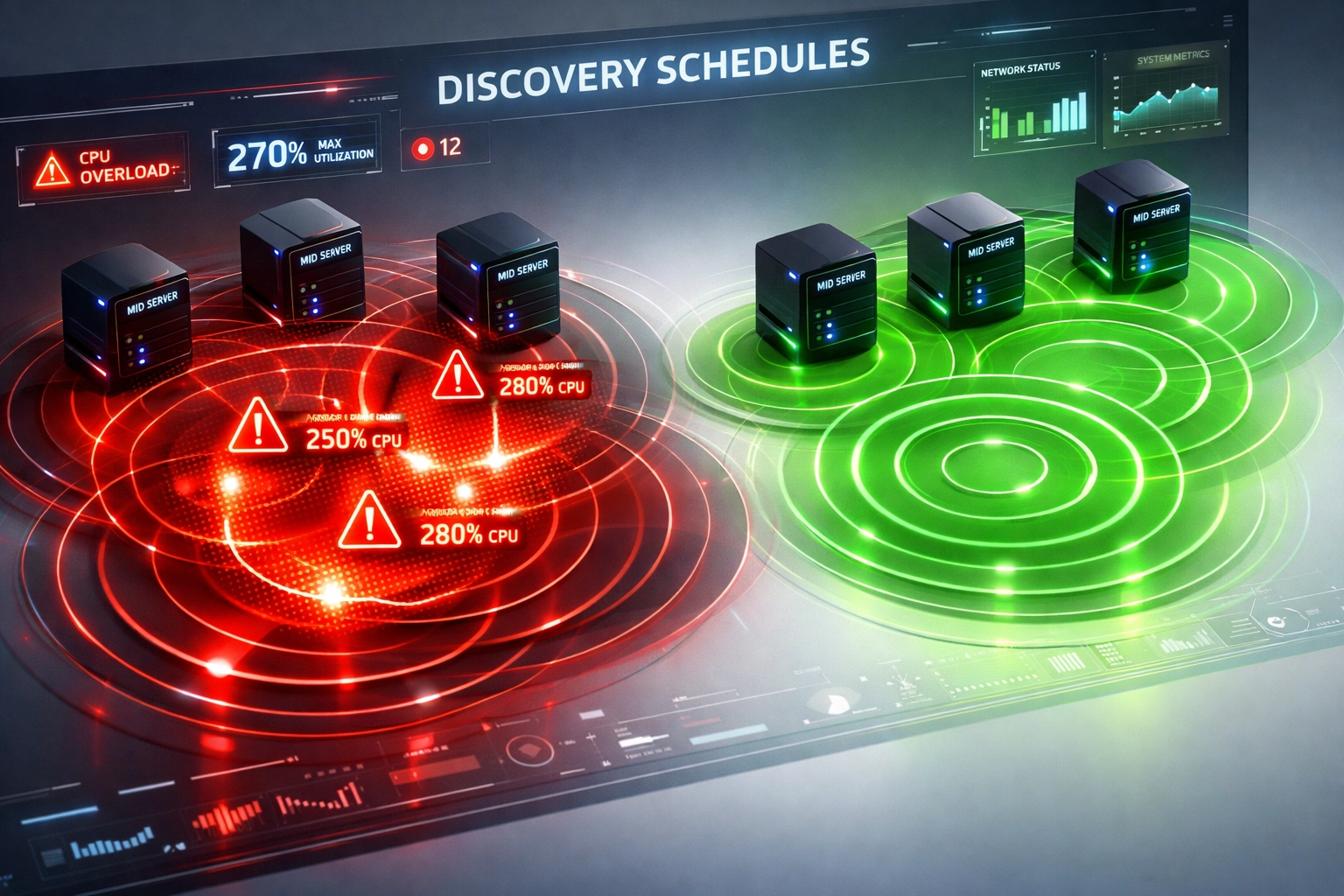
Multiple discovery processes targeting identical network segments simultaneously cause MID server CPU utilization spikes of 200-300%. I've watched organizations trigger discovery timeouts and conflicting CMDB updates that systematically undermine data integrity: all because nobody coordinated their discovery schedules.
The Fix: Schedule Discovery processes sequentially rather than simultaneously. Coordinate Windows, Linux, and Network discovery scans to avoid infrastructure bottlenecks. This operational discipline maintains CMDB accuracy while reducing infrastructure strain by 60-70%. For organizations operating under DORA's digital operational resilience testing requirements, this scheduling discipline becomes non-negotiable.
Mistake #5: Tolerating Duplicate Configuration Items
Inadequate CI identification rules create duplicate CIs that proliferate throughout the CMDB like weeds. Organizations with duplicate CI rates between 15-30% experience broken dependency mapping, incorrect relationships, and unreliable impact analysis.
The technical root cause is straightforward but widely misunderstood: different discovery methods (WMI, SSH, SNMP) identify identical devices using different attributes (hostname versus serial number versus MAC address), resulting in single servers represented as multiple CIs.
The Fix: Establish robust CI identification rules that standardize how discovery methods identify and deduplicate configuration items across your infrastructure. A specialized ServiceNow implementation partner can architect these identification rules to account for your specific infrastructure patterns while maintaining platform upgradeability.

Mistake #6: Treating Service Mapping as Optional
Many organizations deploy Discovery without proper Service Mapping implementation, leaving them blind to critical application dependencies. Without understanding how Configuration Items relate to business services, change impact analysis becomes expensive guesswork.
This architectural gap particularly impacts ESG reporting initiatives, where understanding the complete infrastructure dependency chain supporting specific business services becomes essential for accurate emissions accounting and sustainability reporting.
The Fix: Deploy Service Mapping alongside Discovery from the start, not as an afterthought. Use the Business Service Mapping workspace to visualize dependencies and configure pattern-based mapping for common application architectures. The ROI materializes quickly: organizations with comprehensive Service Mapping report 35-50% improvements in change success rates and dramatic reductions in unplanned outages.
Mistake #7: Customizing Out-of-the-Box Discovery Patterns
This mistake carries the longest-term consequences. Directly customizing ServiceNow's out-of-the-box discovery patterns blocks platform upgrades and security patches for years. Organizations with extensively modified OOB patterns spend 60-80% more on platform maintenance and face remediation costs between $150,000 and $400,000 during forced upgrades.
Under DORA's operational resilience requirements, this technical debt introduces unacceptable ICT risk. Your ability to apply critical security patches directly impacts your operational resilience posture: something regulators will examine closely.
The Fix: Enforce an "out-of-the-box first" philosophy, leveraging native Service Mapping and Discovery capabilities rather than building parallel custom systems. When custom patterns become absolutely necessary, implement them as extensions rather than modifications, preserving upgradeability.
Your 2026 Budget Defense Starts Now
These seven mistakes share a common thread: they compound over time, creating technical debt that becomes exponentially more expensive to remediate. With 2026 budget reviews approaching and regulatory frameworks tightening, now is the moment to audit your ITOM implementation against these architectural principles.
Organizations that address these mistakes before budget season consistently demonstrate 30-50% improvements in operational KPIs, positioning their ServiceNow investments as strategic enablers rather than cost centers requiring justification.
Take Your Next Strategic Step
I encourage you to assess your current ITOM implementation against these seven critical mistakes. SnowGeek Solutions offers a Free 2026 ServiceNow ROI & License Audit specifically designed to identify these architectural gaps and quantify the financial impact on your organization.
Visit SnowGeek Solutions to share your project details and connect with our team of specialized ServiceNow consulting services professionals. Register with SnowGeek Solutions for platform updates and expert insights that keep your implementation aligned with emerging regulatory requirements and architectural best practices.
The difference between defending your budget and justifying it often comes down to addressing these foundational issues before they become boardroom conversations. Your 2026 budget review will thank you.
Comments