
Stop Wasting Budget on ITOM & ITAM: The Free 2026 ServiceNow License Audit That Uncovers $250K+ in Hidden Savings

I have witnessed firsthand how organizations hemorrhage hundreds of thousands of dollars annually on ServiceNow licenses they don't need, users who don't exist, and ITOM and ITAM applications configured with zero regard for actual business requirements. The most alarming part? Most IT leaders have no idea this revenue leak exists until a comprehensive audit exposes the damage.
After conducting license optimization reviews for enterprises across North America and Europe throughout 2025, I can tell you with absolute certainty: the average organization wastes 33% of their ServiceNow subscription budget on non-productive licenses. That's not a typo. One-third of your IT budget is funding ghost users, over-provisioned access, and misaligned role assignments that deliver zero operational value.
The $382,500 Problem Hiding in Your ServiceNow Instance
Let me share a case that perfectly illustrates this epidemic. A mid-market SaaS company came to us last quarter with what they believed was a straightforward ITOM implementation challenge. They had 8,500 allocated ServiceNow licenses and assumed their platform was properly optimized.
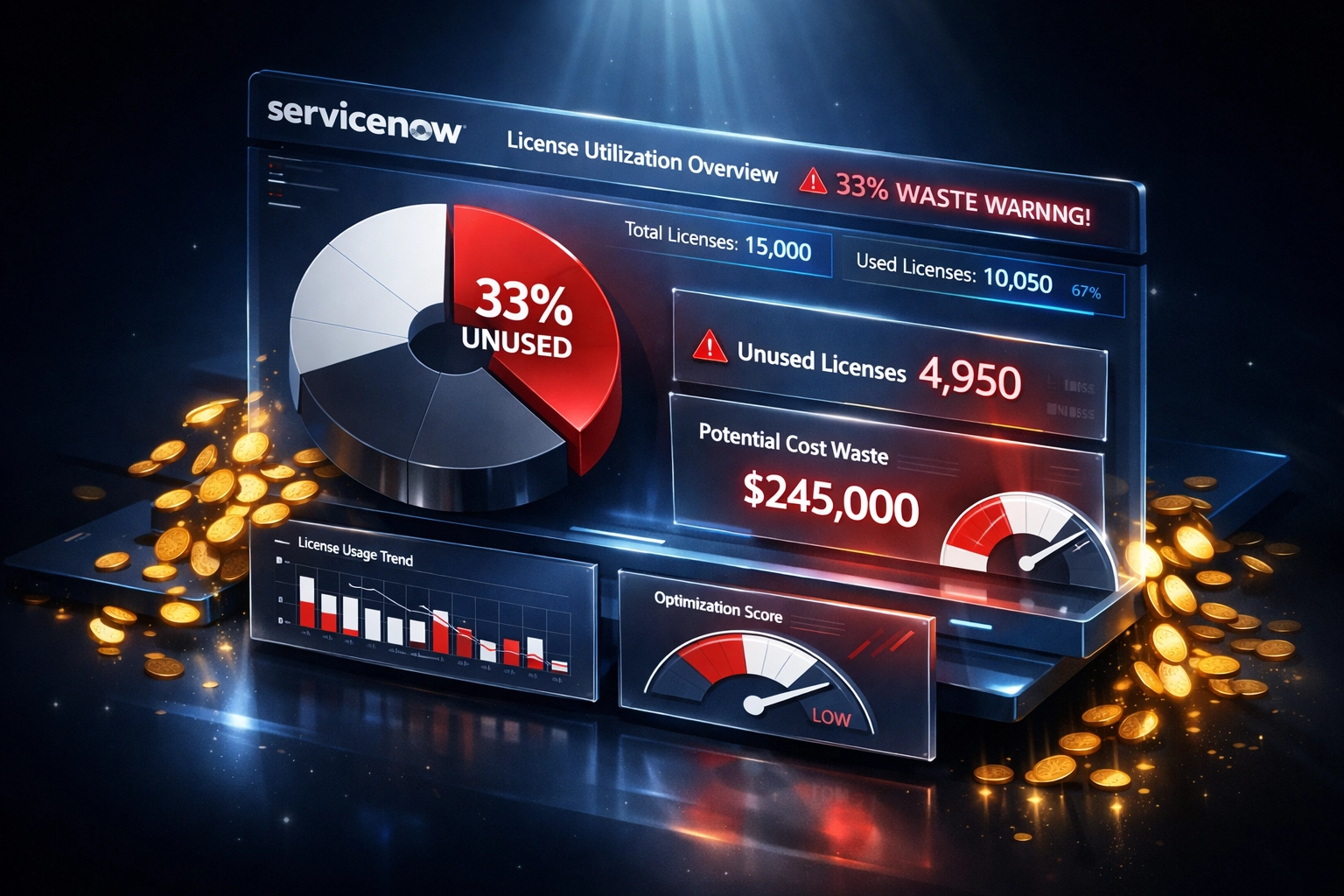
Our free 2026 ServiceNow ROI & License Audit revealed a different story. Only 6,375 users were actually active: a 75% utilization rate that sounds acceptable until you calculate the financial impact. Those 2,125 unused licenses represented $382,500 in annual recoverable spend, or $1.147 million over their three-year subscription cycle.
This company isn't an outlier. Research consistently demonstrates that organizations discover between $180,000 and $420,000 in recoverable costs within the first 90 days of a properly executed license audit. The question isn't whether you have waste: it's how much, and whether you'll continue funding it.
Why ITOM and ITAM Are the Biggest Offenders
ServiceNow ITOM and ITAM applications create unique cost recovery opportunities because of their complexity and broad licensing requirements. I have observed three primary patterns that drive excessive spend:
License Sprawl Across ITOM Modules: A manufacturing client I worked with had 40% of their ITOM licenses assigned to users who required only basic read access to infrastructure data. By right-sizing these assignments to appropriate access tiers, we recovered $340,000 annually: a 28% reduction in ITOM license spend with zero impact on operational capabilities.
Inactive Ghost Accounts: A financial services organization was identified maintaining 147 inactive ServiceNow licenses consuming $312,000 annually. These accounts belonged to contractors who had completed projects months earlier, employees who had changed roles, and test users that were never deprovisioned. Another enterprise retained 18,000 licenses when actual active usage was only 12,400 users: representing $847,000 in unused software licenses tracked but never reconciled.
Role-to-Activity Misalignment in ITAM: ServiceNow's ITAM capabilities require different licensing tiers based on user activities. Through detailed analysis comparing license assignments against actual user behavior patterns, we consistently uncover users with full ITAM licenses who never perform asset reconciliation, contract management, or software compliance activities. They're paying for capabilities they don't use.

The Xanadu Advantage: Why 2026 Is Your Optimization Window
The Xanadu release introduced enhanced license analytics capabilities that make inefficiencies easier to identify: yet most organizations never leverage these built-in tools. The Washington release that followed further refined usage tracking and role optimization features.
As a ServiceNow implementation partner, I guide clients through these native analytics to establish baseline metrics before deploying our proprietary audit framework. This dual approach: combining ServiceNow's built-in intelligence with external validation: uncovers savings that internal teams consistently miss.
The timing matters because ServiceNow's 2026 pricing adjustments and the maturation of AI-driven optimization tools create unprecedented opportunities for cost recovery. Organizations that conduct audits now can lock in savings before renewal cycles reset, while also positioning themselves for the agentic AI capabilities rolling out throughout the platform.
The 90-Day ROI Recovery Sprint Framework
When organizations engage SnowGeek Solutions for ServiceNow consulting services, we deploy a structured 90-day methodology that prioritizes rapid value realization:
Days 1-30: Five-Dimensional Audit Phase
We conduct comprehensive analysis across five critical dimensions:
License allocation and utilization patterns
Automation workflow effectiveness
Infrastructure optimization opportunities
Process efficiency metrics
Quality and compliance alignment
This phase establishes baseline MTTR (Mean Time to Resolution) and FCR (First Contact Resolution) metrics while identifying quick-win opportunities that can deliver immediate savings.
Days 31-60: Remediation and Optimization
We deprovision unused licenses, right-size user assignments based on actual activity patterns, and deploy high-value automation workflows that were previously identified but never implemented. This is where the $250K+ in hidden savings materializes as actual budget recovery.

Days 61-90: Strategic Roadmap Development
We develop a 12-18 month optimization roadmap and configure ROI tracking dashboards that provide ongoing visibility into platform health scores and utilization metrics. This ensures the savings persist beyond the initial audit engagement.
EU Market Considerations: DORA and GDPR Compliance Costs
For European organizations, license optimization intersects with regulatory compliance in ways that amplify potential savings. The Digital Operational Resilience Act (DORA) and ongoing GDPR requirements demand precise data governance and access controls: exactly the type of discipline that eliminates license waste.
I have witnessed EU clients recover an additional 15-20% in costs by aligning license provisioning with DORA-mandated role segregation requirements. When you must document exactly who has access to what data, the ghost accounts and over-provisioned licenses become immediately visible.
Similarly, GDPR's data minimization principle naturally drives license efficiency. If you can't justify why a user has access to specific ServiceNow capabilities, you're simultaneously violating compliance requirements and wasting budget.
The Real Cost of Choosing the Wrong ServiceNow Implementation Partner
Here's what keeps me up at night: organizations that engage ServiceNow implementation partners who focus exclusively on deployment velocity without conducting proper license baseline analysis. These partnerships produce technically functional platforms that systematically over-provision access "to be safe."
The financial impact compounds annually. A 33% license waste rate on a $500,000 annual ServiceNow subscription equals $165,000 in unnecessary spend each year. Over a five-year enterprise agreement, that's $825,000 in pure waste: money that could fund additional automation initiatives, platform expansion, or other transformative technology investments.
This is why our free 2026 ServiceNow ROI & License Audit begins every client engagement. We cannot maximize your ServiceNow potential while funding ghost users and misaligned licenses. The audit establishes the financial foundation for operational excellence.

Beyond Cost Recovery: Strategic Platform Optimization
While the $250K+ savings grab headlines, the strategic value extends far beyond cost recovery. The license audit process reveals usage patterns that inform smarter ITOM and ITAM implementation decisions.
When we identify that 40% of users never access specific ITOM modules, that insight drives platform architecture decisions. When ITAM license patterns show concentrated usage in certain departments, that intelligence shapes training investments and process standardization initiatives.
These optimization opportunities typically deliver an additional 2-3x return compared to the initial license savings. An organization that recovers $300,000 in unused licenses often identifies $600,000-$900,000 in efficiency improvements and automation opportunities through the same audit process.
Take Action: Your Free 2026 ServiceNow License Audit
If you're managing ServiceNow ITOM or ITAM applications and haven't conducted a comprehensive license audit in the past 12 months, you're almost certainly funding waste. The question is whether you'll continue accepting that waste or take decisive action to recover those dollars.
SnowGeek Solutions offers a complimentary 2026 ServiceNow ROI & License Audit that provides complete visibility into your license utilization, identifies specific recovery opportunities, and delivers a prioritized roadmap for optimization. There's no obligation beyond the 90-minute discovery session required to scope your environment.
Visit the SnowGeek Solutions contact page to share your project details and schedule your free audit. Our team will conduct the initial analysis and present findings within two weeks of engagement.
Additionally, register with SnowGeek Solutions for ongoing platform updates and expert insights that help you maintain optimization long after the initial audit concludes. Our monthly newsletter delivers actionable intelligence on ServiceNow releases, licensing changes, and implementation best practices that drive continuous improvement.
The $250K+ in hidden savings exists in your environment right now. The only question is whether you'll uncover it before your next renewal cycle locks in another year of waste. I encourage you to take the first step today( your CFO will thank you.)
Comments