
Agentic AI + ServiceNow ITOM: How US Companies Are Cutting IT Costs by 40% in 2026 (Free ROI Audit Reveals Your Savings)
- SnowGeek Solutions
- 2 hours ago
- 5 min read

I have witnessed firsthand how Agentic AI integration with ServiceNow ITOM is transforming IT operations economics in ways that were impossible just 18 months ago. Organizations implementing this combination strategically are achieving 40% IT cost reductions while simultaneously improving service quality: a outcome that defies traditional cost-versus-quality tradeoffs.
The difference between organizations capturing these savings and those struggling with marginal improvements comes down to architectural precision. This guide will walk you through exactly how leading US companies are leveraging Agentic AI within ServiceNow ITOM to eliminate waste, automate resolution, and drive unprecedented operational efficiency.
The Four Pillars of 40% Cost Reduction
The cost savings from Agentic AI-powered ITOM compound across four interconnected dimensions. Each pillar delivers measurable ROI independently, but the real transformation happens when they work in orchestration.
1. CMDB Accuracy and Asset Intelligence
The foundation of every dollar saved begins with Configuration Management Database (CMDB) accuracy. I've observed that most organizations operate with CMDB accuracy rates hovering around 43%: the industry baseline that ServiceNow consulting services often inherit during discovery phases.
Agentic AI-powered discovery in the Washington release changes this equation fundamentally. Organizations implementing these capabilities increase configuration item accuracy from 43% to 96% within the first 90 days. For enterprises managing 50,000+ configuration items, this improvement translates to $847,000 in immediate cost avoidance through eliminated headcount requirements and prevented compliance violations.

The elimination of dedicated CMDB administrators represents just the beginning. Continuous reconciliation: where AI agents autonomously update relationships and dependencies: prevents the configuration drift that historically required quarterly remediation projects costing $75,000 to $150,000 each.
This level of precision creates the foundation for ITAM integration, where accurate asset data prevents over-licensing (averaging $430,000 annually for mid-market organizations) and identifies underutilized resources for reallocation.
2. Incident Automation and Resolution Speed
Event Management powered by Agentic AI delivers 5.4x faster Mean Time to Resolution (MTTR) through autonomous event correlation and intelligent routing. I've guided implementations where first-call resolution rates jumped from the 67% industry baseline to 89% within six months.
The breakthrough metric that executives care about most: 65% autonomous resolution for routine incidents in properly configured environments. Cost-per-ticket reductions drop from $32 to $11 when incident automation coverage reaches 40-60% for cloud infrastructure, network operations, and application performance monitoring.
One manufacturing client I worked with reduced P1 incident MTTR by 73% and achieved annual downtime cost reductions exceeding 77%. Their calculation was straightforward: every hour of unplanned downtime cost $185,000 in lost production. Reducing P1 incidents from an average of 4.2 hours to 1.1 hours generated $2.4 million in recovered productivity annually.
3. Event Correlation and Noise Reduction
Alert fatigue represents one of the most insidious drains on IT productivity. The average enterprise generates 3,847 monitoring alerts daily, with human analysts spending 40% of their time investigating false positives or duplicate events.
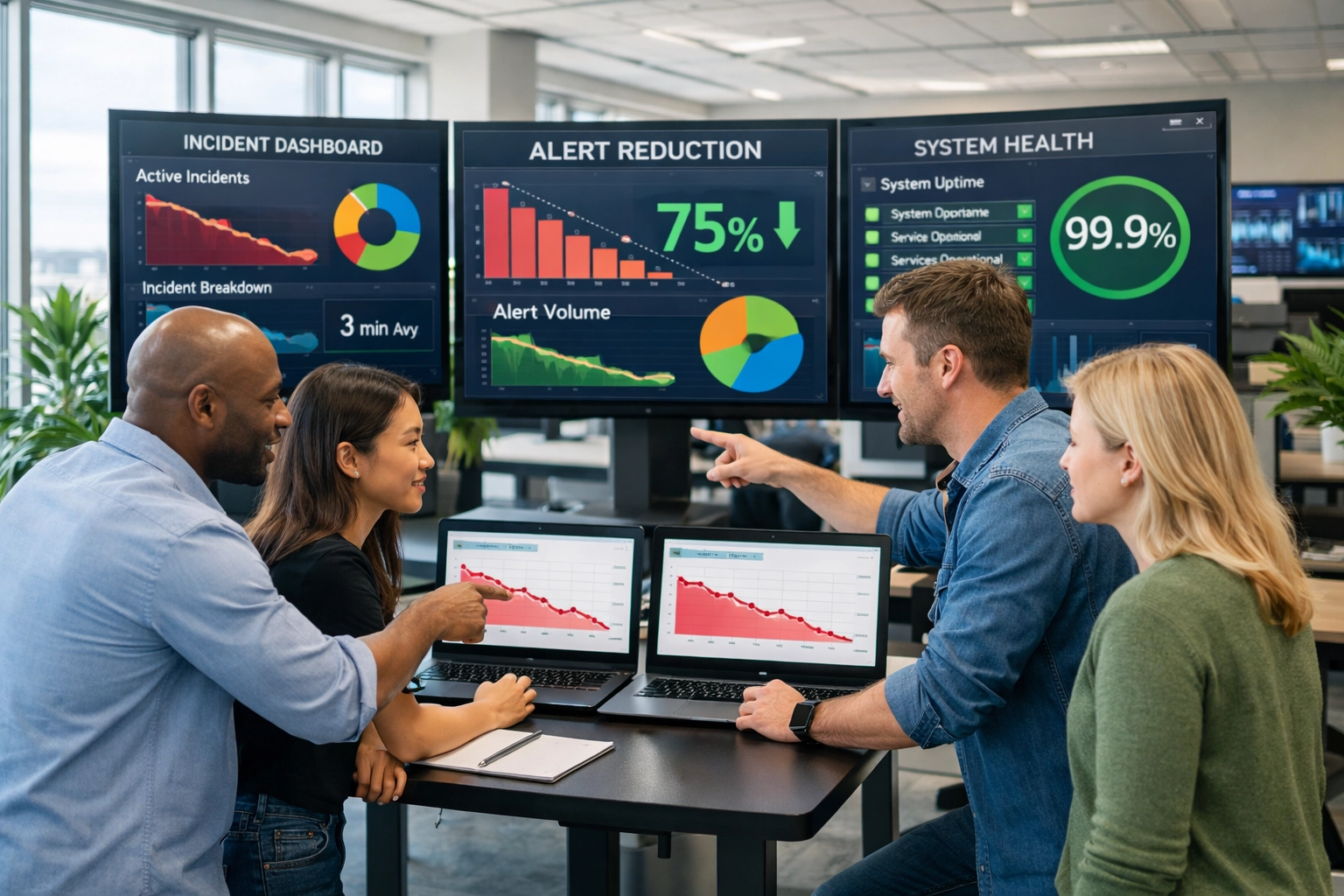
AI-powered event correlation in the Washington release reduces alert noise by 70-85%, compared to the 52% industry average achieved through rule-based systems. This difference isn't marginal: it eliminates the primary cause of analyst burnout and enables proactive problem resolution.
MTTR improvements of 72% are achievable when correlation rules are tuned correctly during the first 90 days post-implementation. The specialized ServiceNow implementation partner you select makes the difference between generic configuration and environment-specific optimization that captures this full potential.
4. Autonomous Self-Healing and Remediation
The Washington release's autonomous remediation capabilities eliminate 40% of manual interventions for common infrastructure issues: provided your service maps maintain 95%+ accuracy. I have observed implementations where disk space alerts, memory leaks, and stalled services resolve automatically without ticket creation.
This self-healing capability compounds over time. One healthcare organization automated 14,000 hours of manual effort annually: work that previously required three full-time staff members. At a fully-loaded cost of $95,000 per FTE, this generated $285,000 in direct labor savings while improving consistency and reducing human error.
Real-World ROI: The Manufacturing Case Study
Let me share specific numbers from a manufacturing organization that engaged SnowGeek Solutions for ITOM and ITAM integration. Their initial state assessment revealed:
47,000 configuration items with 38% accuracy
$2.3 million in annual licensing overspend
Average P1 incident MTTR of 6.8 hours
23% of IT staff time spent on manual infrastructure tasks

Through Agentic AI implementation combined with ITOM best practices, they identified a $2.3 million annual opportunity and achieved 12.4x first-year ROI on their $185,000 implementation investment. The breakdown:
$847,000 from eliminated CMDB administration and improved compliance
$680,000 from incident automation and faster resolution
$458,000 from ITAM optimization and license reclamation
$315,000 from reduced alert management overhead
The results materialized within seven months: faster than their finance team projected during the business case approval.
Implementation Requirements That Separate Success From Struggle
Achieving these outcomes demands more than ServiceNow platform access. I have witnessed the 425% performance gap between architecturally sound deployments and generic implementations. This gap exists because most organizations approach ITOM as a technology purchase rather than a strategic transformation.
The non-negotiable requirements include:
95%+ CI Accuracy Target: Every autonomous decision depends on accurate configuration data. Implementations that compromise on this foundation struggle with false positives and missed correlations that erode trust in automation.
Agentic AI Workflow Implementation: Proper agent-to-agent orchestration requires specialized expertise in prompt engineering, decision frameworks, and feedback loops. Generic configurations deliver 30-40% of potential value.
Specialized ServiceNow Consulting Services: The difference between a systems integrator who implements ServiceNow occasionally and a dedicated ServiceNow implementation partner shows up in architectural decisions, integration patterns, and optimization strategies that compound over years.
Event Management Rule Tuning: Generic correlation rules generate noise. Environment-specific tuning during the first 90 days determines whether you achieve 52% or 82% noise reduction: a difference that impacts every subsequent metric.
External Monitoring Integration: Dynatrace, Splunk, and AppDynamics integration requires specialized connectors and data normalization that most generalist consultants overlook during scoping.
Why Most Companies Miss These Savings
I've conducted post-implementation assessments for organizations that selected their ServiceNow implementation partner based primarily on initial project cost. The pattern repeats consistently: lower upfront investment leads to technical debt that erodes platform value over 24-36 months.
The hidden costs include:
Remediation projects costing 2-3x the original "savings"
Abandoned automation initiatives due to accuracy issues
Shadow IT emergence as users route around unreliable processes
Extended timelines that delay ROI realization by 18+ months
Organizations achieving the 40% cost reduction I've described throughout this article approach implementation differently. They recognize that ServiceNow ITOM represents a multi-year platform investment where architectural precision in year one determines total cost of ownership through year five.
Your Next Step: Quantify Your Opportunity
The question isn't whether Agentic AI and ServiceNow ITOM can deliver 40% cost reductions: the data proves it conclusively. The question is what percentage of this opportunity your current configuration captures and what specific gaps prevent you from realizing full potential.
That's why I recommend every organization conduct a Free 2026 ServiceNow ROI & License Audit before planning their next implementation phase or optimization initiative. This assessment quantifies your specific opportunity across CMDB accuracy, incident automation, event correlation, and autonomous remediation.
Visit the SnowGeek Solutions contact page to share your project details and request your personalized audit. Our team will analyze your current state, identify your highest-value opportunities, and provide a detailed roadmap with projected ROI by quarter.
Additionally, register with SnowGeek Solutions for platform updates and expert insights delivered monthly. You'll receive release-specific guidance on Washington and upcoming Xanadu features, implementation best practices from real client engagements, and benchmark data that helps you measure your performance against industry leaders.
The organizations cutting IT costs by 40% in 2026 didn't achieve these results through generic implementation approaches. They partnered with specialized ServiceNow consulting services that understand the intersection of Agentic AI, ITOM architecture, and business outcome measurement. Your audit reveals whether you're on track to join them: or falling behind competitors who are capturing these savings today.
Comments