
Agentic AI vs. Traditional ServiceNow ITOM: Which Implementation Partner Actually Delivers 2026 ROI? (Compared)
- SnowGeek Solutions
- 2 hours ago
- 5 min read

I have witnessed firsthand the stark divide between organizations that achieve transformative ROI from their ServiceNow ITOM investments and those that struggle with mediocre results. The difference? It rarely comes down to budget or platform features. Instead, it hinges on whether your ServiceNow implementation partner truly understands agentic AI-powered ITOM architecture versus traditional approaches that leave millions in potential savings on the table.
In 2026, the gap between these two methodologies has become a chasm that directly impacts your bottom line: and choosing the wrong partner could cost you 40% or more in unrealized cost reductions.
The Traditional ITOM Reality: Why 12-18% Cost Reductions Are No Longer Acceptable
Traditional ServiceNow ITOM implementations follow a predictable pattern. Your ServiceNow consulting services team configures event management, sets up discovery schedules, implements service mapping, and calls it a success when CMDB accuracy hits 75%. Meanwhile, your IT operations team still drowns in alert noise, spends 60-75% of resolution time on manual root cause analysis, and watches infrastructure costs climb despite "optimization."
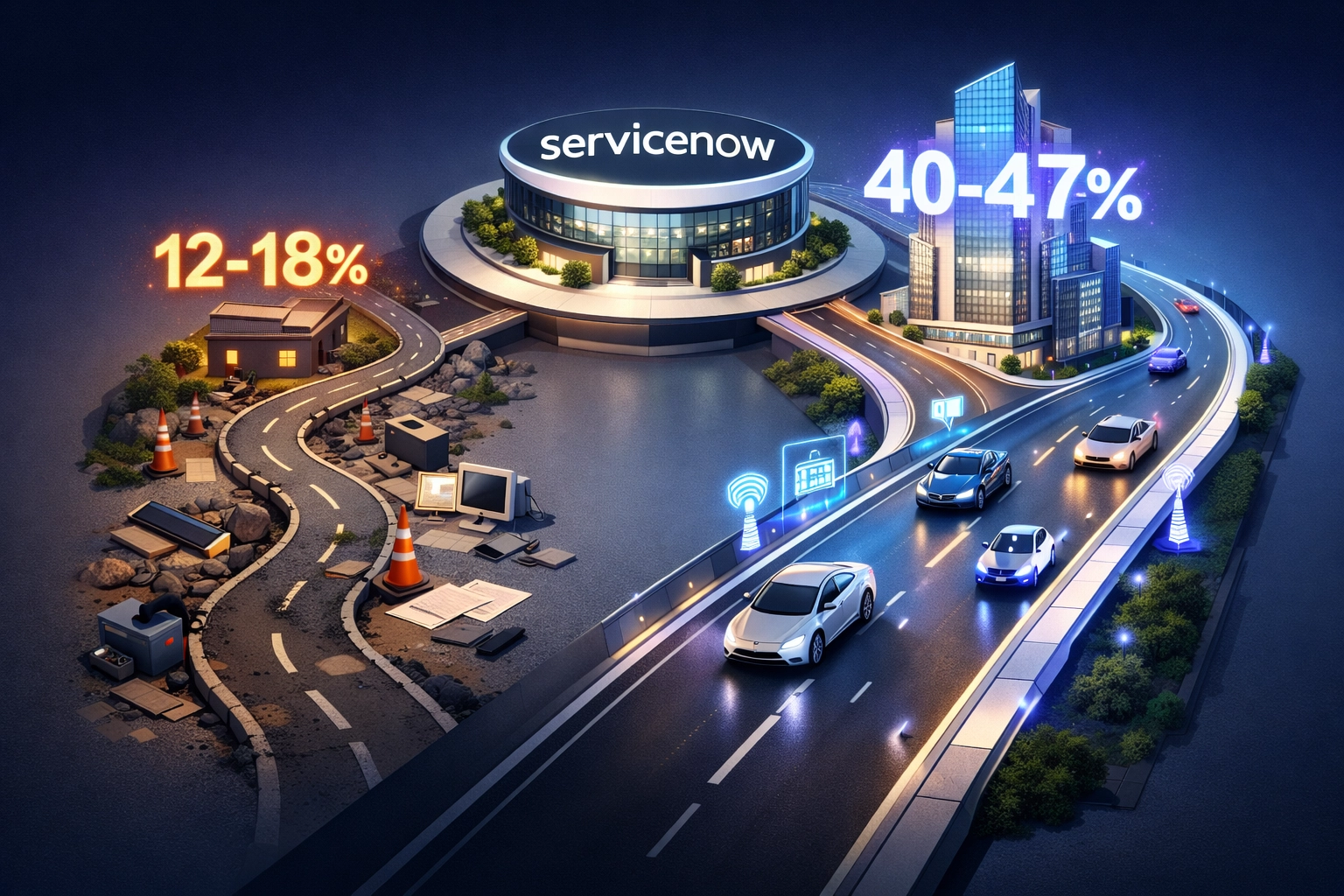
I have witnessed organizations celebrate 12-18% cost reductions from traditional ITOM deployments: reductions that would have been 40-47% with proper agentic AI integration. The Washington and Xanadu ServiceNow releases introduced powerful autonomous capabilities, yet most implementation partners simply configure them as "enhanced automation" rather than true agentic workflows.

The traditional approach treats ITOM as a monitoring and ticketing exercise. Static thresholds trigger alerts. Analysts manually correlate events. Root cause analysis remains reactive. Your CMDB becomes outdated within weeks of painstaking discovery efforts. This methodology delivered acceptable results in 2023, but in 2026, it represents a fundamental misunderstanding of what ServiceNow ITOM can actually accomplish.
Agentic AI Revolution: The 40-47% Cost Reduction Benchmark
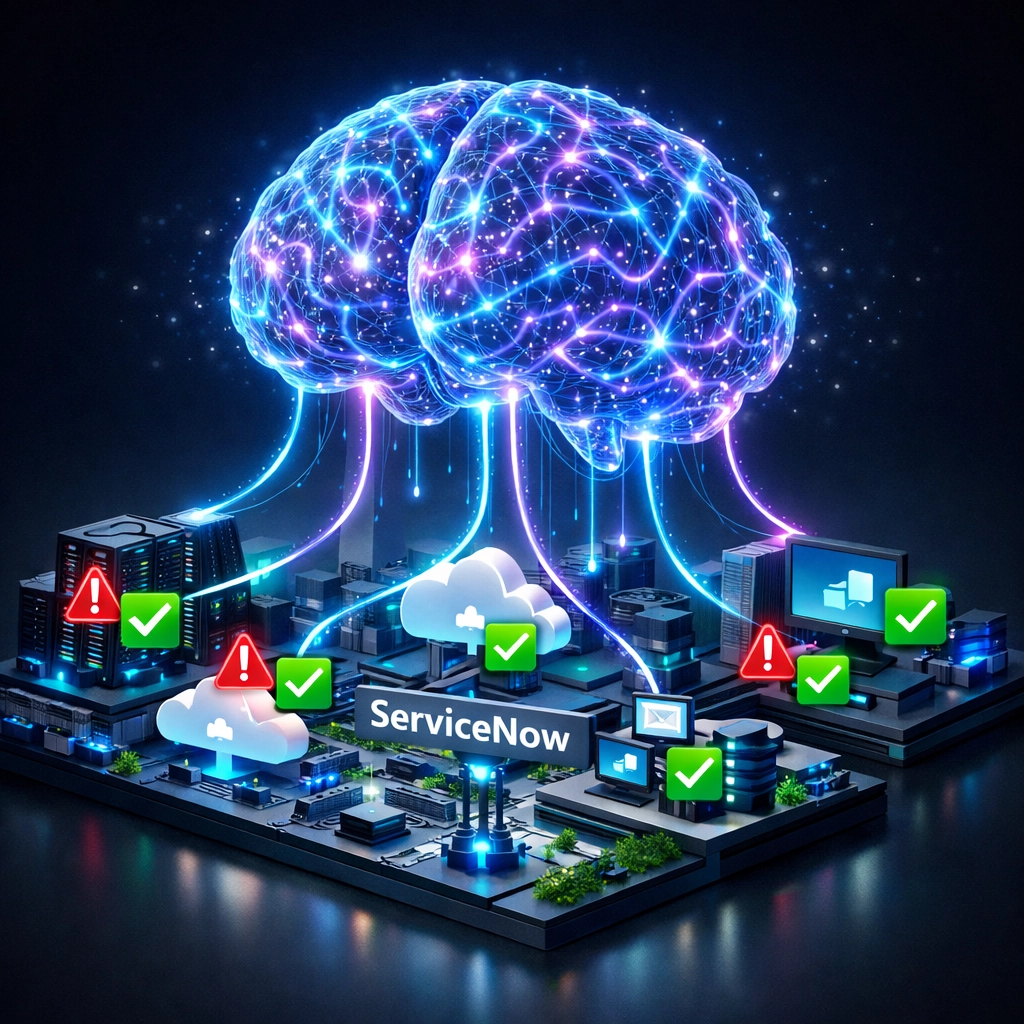
Agentic AI transforms ServiceNow ITOM from a reactive monitoring platform into an autonomous intelligence layer that continuously learns, adapts, and acts without human intervention. This isn't marketing hyperbole: it's a measurable shift in operational performance that specialized ServiceNow implementation partners are delivering right now.
The numbers tell an unambiguous story:
Alert Management: Agentic AI autonomously filters and eliminates 85% of alert noise before it reaches your analysts. Traditional ITOM? Your team still manually triages thousands of low-value alerts monthly, burning hours that should be spent on strategic initiatives.
Mean Time to Resolution: Organizations implementing agentic ITOM workflows achieve 87% MTTR improvements: reducing resolution times from 6.2 hours to 47 minutes. Traditional implementations optimize existing processes but rarely achieve breakthrough performance improvements.
Root Cause Analysis: Agentic AI delivers 70% faster root cause identification with 89% accuracy by autonomously correlating events across your entire infrastructure stack. Traditional approaches require analysts to manually piece together clues from disparate monitoring tools, consuming 60-75% of total resolution time.
Infrastructure Optimization: Continuous autonomous discovery and remediation versus static, schedule-based discovery that's outdated before your quarterly business review concludes.
Real-World ROI: The $3.2M Annual Savings Case Study
Let me walk you through a financial services organization that perfectly illustrates this divide. They engaged a specialized ServiceNow consulting services partner focused exclusively on ITOM architecture and agentic workflow design. Within nine months, they achieved results that traditional implementations would consider impossible:
Annual downtime costs: Reduced from $4.2M to $980K (77% reduction)
MTTR improvement: 87% (from 6.2 hours to 47 minutes)
CMDB accuracy: Increased from 71% to 94%
ITAM optimization: $840K in annual software license savings through automated usage tracking
Total annual savings: $3.2M
These aren't optimistic projections: they're audited results measured against baseline performance. The organization's previous implementation partner had delivered respectable 15% cost reductions using traditional ITOM approaches. Switching to an agentic AI-specialized partner more than tripled their ROI within the same fiscal year.
The difference? Event management rules tuning based on agentic learning patterns. Service mapping dependency configuration that autonomously updates as infrastructure changes. Integration architecture connecting ServiceNow ITOM with cloud platforms and third-party monitoring tools through intelligent APIs rather than basic webhooks.
Why Your Implementation Partner's ITOM Specialization Matters More Than Their ServiceNow Certification Count
Here's what I tell every organization evaluating ServiceNow implementation partners: certifications prove platform knowledge, but ITOM specialization determines ROI. The $700K+ annual difference between median agentic AI performance (40% cost reduction) and upper-quartile results (47% reduction) scales dramatically for enterprise organizations.

Traditional ServiceNow consulting generalists configure ITOM modules using standard best practices developed for 2023-era automation. Specialized partners architect agentic workflows aligned with your governance policies, design integration patterns that enable autonomous decision-making, and tune event management rules based on machine learning models rather than static thresholds.
The Xanadu release introduced enhanced predictive intelligence capabilities and autonomous event correlation features. Most implementation partners treat these as incremental improvements to existing workflows. Specialized ITOM partners completely reimagine your operational architecture around these capabilities, enabling the autonomous infrastructure management that drives 40-47% cost reductions.
Critical 2026 Considerations: ITAM Integration and License Optimization
One frequently overlooked aspect of agentic ITOM implementations is the transformative impact on ITAM (IT Asset Management) performance. Traditional approaches treat ITOM and ITAM as separate disciplines: discovery happens on schedules, software usage data updates periodically, license compliance remains a quarterly fire drill.
Agentic AI integrates these domains seamlessly. Continuous autonomous discovery identifies software deployments in real-time. Machine learning models analyze actual usage patterns versus licensed quantities. The platform autonomously flags optimization opportunities: unused licenses, over-provisioned resources, redundant tools performing identical functions.
The financial services case study achieved $840K in annual ITAM savings specifically because their implementation partner architected integrated ITOM-ITAM workflows that traditional approaches treat as separate projects. This integration represents low-hanging fruit that most organizations leave unpicked because their ServiceNow consulting services partner lacks cross-domain expertise.
The Implementation Partner Questions You Should Be Asking Right Now
When evaluating ServiceNow implementation partners for 2026 ITOM projects, demand specific evidence of agentic AI expertise:
What percentage of your ITOM implementations achieve 40%+ cost reductions? If they cite industry averages (12-18%), they're implementing traditional approaches.
Show me your event management rules tuning methodology for autonomous alert filtering. Generic answers about "reducing alert noise" indicate surface-level understanding.
How do you architect service mapping for continuous autonomous dependency updates? Static discovery schedules are 2023 thinking.
What's your integration approach for connecting ITOM with cloud platforms and third-party monitoring? Basic webhook configurations won't enable true autonomous intelligence.
Provide case studies with audited ROI metrics, not testimonials. Marketing language doesn't pay your infrastructure costs.
Your Next Step: Quantify What You're Leaving on the Table
The gap between traditional and agentic AI ServiceNow ITOM implementations represents millions in unrealized value for enterprise organizations. If your current implementation partner delivered 15% cost reductions and you're satisfied, I encourage you to calculate what 40-47% would mean for your operations budget: then multiply that by the years remaining on your ServiceNow contract.
That number represents what you're leaving on the table by not engaging specialized expertise.
Ready to discover your actual 2026 ROI potential? Visit the SnowGeek Solutions contact page to share your project details and schedule your Free 2026 ServiceNow ROI & License Audit. Our specialized team will analyze your current ITOM and ITAM architecture, identify specific opportunities for agentic AI optimization, and provide a detailed roadmap to the 40-47% cost reduction benchmark.
Register with SnowGeek Solutions for ongoing platform updates and expert insights that help you maximize your ServiceNow investment beyond generic best practices. In 2026, the organizations that thrive aren't those with the biggest ITOM budgets: they're the ones working with implementation partners who understand how to architect autonomous intelligence that delivers unprecedented operational excellence.
The question isn't whether agentic AI outperforms traditional ITOM approaches. The data answers that conclusively. The real question is how much longer you'll accept 12-18% cost reductions when 40-47% is achievable with the right expertise.
Comments