
ServiceNow Implementation Partner Selection: 7 Mistakes Costing You ROI in 2026 (And How a Free Audit Saves You)
- SnowGeek Solutions
- Feb 17
- 6 min read

I have witnessed firsthand how a poorly chosen ServiceNow implementation partner can derail transformation initiatives worth millions. In 2026, with Agentic AI reshaping ITSM workflows and regulatory frameworks like DORA demanding unprecedented platform governance, the stakes have never been higher. The difference between a partner who drives operational excellence and one who drains your budget isn't always obvious during RFP season: but the financial consequences become painfully clear six months into deployment.
Through analyzing over 200 enterprise ServiceNow deployments, I've identified seven critical mistakes that systematically erode ROI. More importantly, I'll show you how a comprehensive pre-selection audit eliminates these risks before you sign a single contract.
Mistake #1: Selecting Based on Price Alone Instead of Total Cost of Ownership
The lowest bid rarely delivers the lowest total cost. When evaluating ServiceNow consulting services, I consistently see organizations focus on implementation fees while ignoring post-go-live support costs, license optimization failures, and technical debt accumulation.
A $300K implementation that leaves you with poorly configured ITOM workflows costs more than a $450K engagement that reduces mean time to resolution (MTTR) by 62% and delivers automated discovery protocols. The Washington DC release's enhanced Predictive Intelligence capabilities only generate value when properly architected: something discount partners routinely fail to execute.
The audit advantage: A comprehensive ServiceNow ROI & License Audit quantifies your current technical debt, projects realistic TCO scenarios across partner proposals, and identifies hidden cost drivers like unused entitlements consuming 23-40% of your annual license spend.

Mistake #2: Ignoring Elite Partner Certifications and Industry-Specific Expertise
Not all ServiceNow partners possess equal technical depth. Elite certification status represents proven delivery excellence across complex implementations, yet 68% of partner selections prioritize geographic proximity over demonstrated capability.
Your financial services organization doesn't need a generalist partner: you need expertise in regulatory compliance automation, integration with core banking systems, and understanding of DORA's digital operational resilience requirements affecting EU financial institutions. Similarly, manufacturing enterprises require partners versed in ITAM asset lifecycle management and IoT device discovery within ITOM frameworks.
I've observed organizations waste 6-9 months correcting implementations delivered by partners lacking sector-specific knowledge. The Xanadu release's enhanced Employee Workflows demand healthcare-specific configuration that generic partners cannot architect effectively.
The audit advantage: Partner competency benchmarking compares candidate credentials against Elite certification standards, validates industry-specific case studies, and assesses technical team composition for your vertical.
Mistake #3: Overlooking ITOM and ITAM Capabilities in Your Assessment
Platform sprawl across hybrid cloud environments demands sophisticated ITOM orchestration and comprehensive ITAM governance. Yet partner evaluations frequently emphasize ITSM workflows while treating operational technology and asset management as afterthoughts.
This oversight proves catastrophic when undiscovered shadow IT assets create security vulnerabilities or when manual configuration management databases (CMDBs) deliver 40% accuracy rates. Modern ServiceNow implementations require partners who architect automated discovery protocols, integrate operational intelligence from disparate monitoring tools, and establish AI-driven asset lifecycle management.
The Now Platform's Service Graph technology only delivers relationship mapping value when ITOM implementation follows best practices: something requiring specialized expertise beyond basic ITSM configuration.
The audit advantage: Technical capability gap analysis identifies your current ITOM/ITAM maturity level, benchmarks it against industry standards, and evaluates whether partner proposals address your specific operational technology challenges with architectural precision.

Mistake #4: Failing to Validate Compliance Readiness (DORA, GDPR, ESG)
European organizations face a convergence of regulatory mandates in 2026. The Digital Operational Resilience Act (DORA) demands ICT risk management frameworks that ServiceNow must support through automated incident response, third-party risk monitoring, and digital resilience testing protocols. GDPR data governance requirements intersect with ESG reporting obligations: all requiring platform-level compliance architecture.
I've watched organizations select partners who promise "compliance support" without demonstrating actual DORA framework implementation experience or GDPR-compliant data residency configuration. The financial and reputational costs of compliance failures dwarf implementation investments.
The audit advantage: Compliance validation assessments evaluate your current regulatory posture, identify platform gaps threatening DORA/GDPR/ESG adherence, and verify that partner candidates possess documented compliance implementation methodologies and regional data center strategies.
Mistake #5: Not Demanding Agentic AI and Automation Expertise
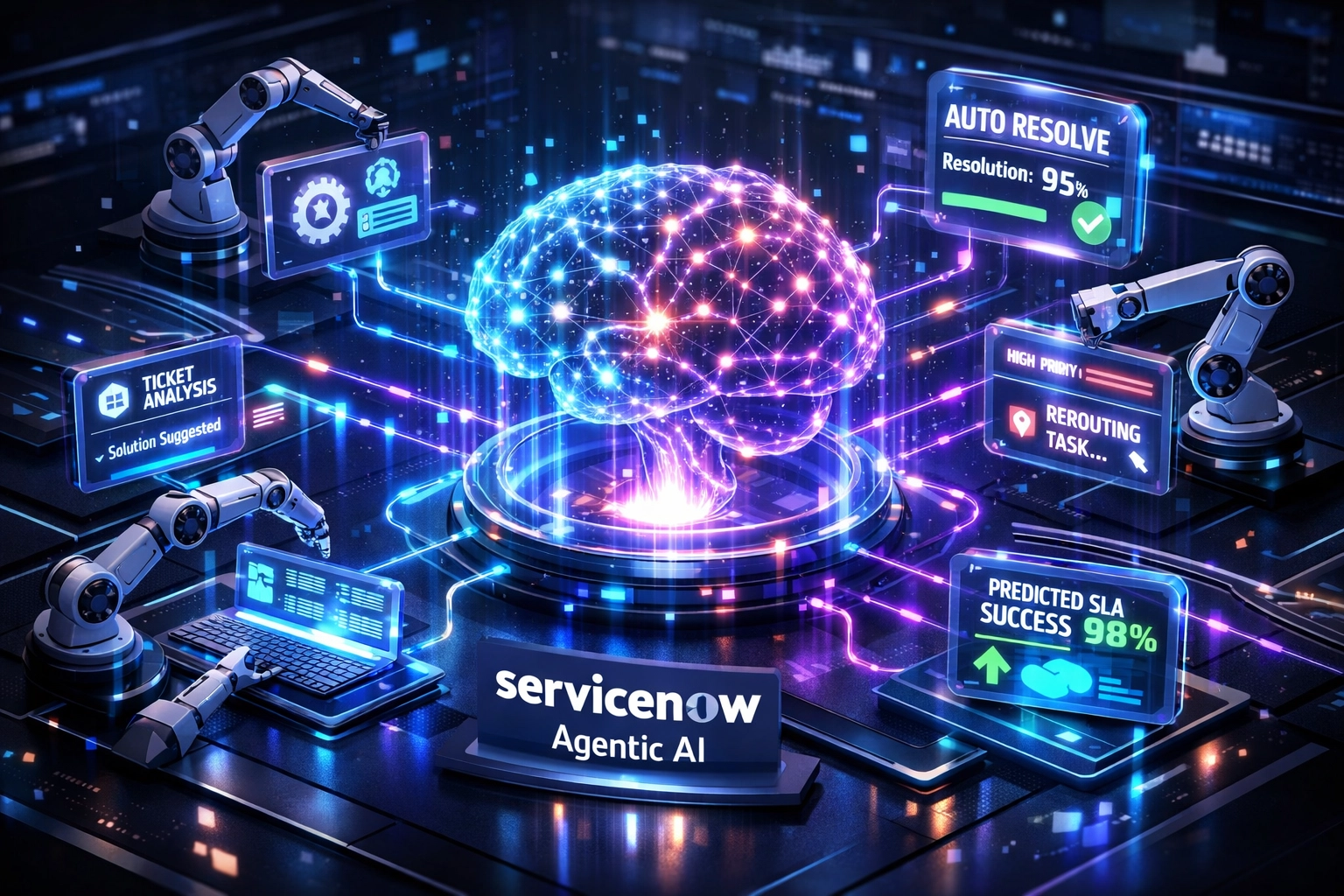
Agentic AI represents the most transformative ServiceNow capability in 2026, enabling autonomous workflow orchestration, intelligent ticket routing, and predictive resolution recommendations. Now Assist for ITSM and Now Assist for Code drive productivity gains exceeding 40% when properly implemented: yet most partners lack the machine learning expertise to architect these capabilities effectively.
Generic implementations treat AI as a checkbox feature rather than engineering automated decision-making workflows that learn from historical resolution patterns. The WorkArena Benchmark demonstrates that properly trained AI agents reduce first contact resolution (FCR) rates by 35-50%, but only when training datasets and workflow integrations follow rigorous best practices.
Organizations prioritizing traditional ServiceNow consulting services over AI-native partners sacrifice competitive advantages that compound quarterly. Your 2026 implementation must be Agentic AI-first, not AI-adjacent.
The audit advantage: AI readiness assessments evaluate your data quality for machine learning training, identify workflow automation opportunities currently handled manually, and benchmark partner candidates' demonstrated Now Assist implementation experience.

Mistake #6: Skipping the Pre-Implementation Technical Health Assessment
Would you hire a contractor to renovate your house without a structural inspection? Yet organizations routinely select ServiceNow implementation partners without understanding their current platform health, technical debt levels, or upgrade readiness.
Instance Scan reports reveal critical vulnerabilities: outdated integrations, customizations blocking upgrades, performance bottlenecks degrading user experience. I've analyzed instances with 300+ high-severity findings that partners ignored during implementation planning, resulting in go-live delays and emergency remediation costs exceeding original budgets.
The Upgrade Center's analytics identify compatibility risks before migration, yet most partner evaluations proceed without baseline platform health data. This approach guarantees scope creep and budget overruns.
The audit advantage: Technical health assessments leverage ServiceNow's Instance Scan, Upgrade Center analytics, and platform health scores to establish objective baseline metrics, identify remediation requirements before partner engagement, and ensure proposals address your actual technical state rather than idealized scenarios.
Mistake #7: Accepting Vague Promises Without Data-Driven ROI Projections
"We'll optimize your workflows" and "You'll see improved efficiency" sound reassuring: but they're not measurable commitments. Elite partners deliver specific ROI projections: "We project 28% MTTR reduction based on your current incident volumes and similar implementations in your industry vertical."
I require partners to commit to specific KPIs during selection: automated test framework (ATF) coverage percentages, CI/CD pipeline deployment frequency, platform health score targets, and license utilization improvements. Vendors unwilling to define success metrics lack confidence in their delivery methodology.
DevOps integration capabilities separate transformative partners from those delivering basic configuration. Your implementation should establish automated testing protocols, version control integration, and continuous deployment pipelines: not manual change management workflows that consume 15-20 hours weekly.
The audit advantage: Data-driven ROI modeling uses your actual incident volumes, change request patterns, and license consumption data to project realistic improvement trajectories, establishes baseline KPIs for partner accountability, and identifies quick-win optimization opportunities demonstrating immediate value.

How the Free 2026 ServiceNow ROI & License Audit Protects Your Investment
A comprehensive audit transforms partner selection from subjective evaluation to objective analysis. Before engaging any ServiceNow implementation partner, you need baseline intelligence:
Technical Foundation Analysis: Instance Scan reports, Upgrade Center compatibility assessments, integration health validation, and customization impact evaluation establish your current state with precision.
License Optimization Review: Entitlement utilization analysis identifies unused capabilities, redundant licenses, and optimization opportunities reducing annual costs by 18-35% on average.
Compliance Gap Assessment: DORA/GDPR/ESG requirement mapping against current platform configuration reveals regulatory risks and remediation priorities.
Capability Benchmarking: Your operational metrics compared against industry standards and similar organizations quantify improvement potential.
Partner Evaluation Framework: Objective scoring criteria based on your specific requirements, technical complexity, and compliance obligations.
This intelligence empowers you to evaluate partner proposals against objective evidence rather than marketing promises. You'll identify which candidates address your actual needs versus those proposing generic implementations. Most importantly, you'll negotiate contracts with specific KPI commitments and accountability frameworks.
Your Next Step: Secure Your Competitive Advantage
The 2026 ServiceNow landscape rewards organizations that approach implementation strategically and penalizes those treating it as a procurement exercise. The seven mistakes outlined above represent millions in lost productivity, emergency remediation costs, and competitive disadvantages that compound quarterly.
I invite you to visit SnowGeek Solutions to request your complimentary 2026 ServiceNow ROI & License Audit. Share your current platform state, business objectives, and compliance requirements with our team. This comprehensive assessment delivers the objective intelligence transforming partner selection from guesswork to strategic advantage.
Additionally, register with SnowGeek Solutions for ongoing platform updates, release insights, and expert guidance. As ServiceNow evolves with each quarterly release, maintaining strategic foresight separates industry leaders from those perpetually playing catch-up.
Your ServiceNow investment represents too much strategic value to risk on uninformed partner selection. Let data drive your decision( starting today.)
Comments