
ServiceNow Implementation Partner Selection: 7 Mistakes Costing You ROI in 2026 (And How a Free Audit Fixes Them)

I have witnessed firsthand how selecting the wrong ServiceNow implementation partner can derail digital transformation initiatives and obliterate projected ROI. In 2026, as organizations race to leverage agentic AI capabilities in the Washington DC release while navigating DORA compliance deadlines in the EU, the stakes have never been higher. This guide will walk you through seven critical mistakes that continue to cost enterprises millions: and explain how a comprehensive audit identifies these pitfalls before they damage your investment.
Mistake #1: Choosing Cost Over Certified Expertise
The most expensive ServiceNow implementation is the one that fails. I've analyzed deployments where organizations selected partners based solely on competitive pricing, only to face 40-60% budget overruns due to rework, extended timelines, and technical debt.
In 2026, ServiceNow consulting services must demonstrate Elite or Global Elite partnership status. These certifications aren't vanity metrics: they represent proven methodologies for deploying Washington DC's Now Assist enhancements and maintaining platform health scores above 95%. When evaluating ITOM implementations, partners without Advanced ITOM certification frequently misconfigure Discovery patterns, resulting in incomplete CMDB data that undermines every downstream process.
A comprehensive audit examines your current partner's certification portfolio against your specific requirements. For enterprises deploying agentic AI capabilities, this means verifying expertise in AI/ML integrations and automation frameworks: competencies that budget-focused partners simply cannot deliver.

Mistake #2: Ignoring Industry-Specific ITAM and Compliance Requirements
Generic implementations fail in regulated industries. Period. I've guided financial services clients through DORA (Digital Operational Resilience Act) compliance implementations where the ServiceNow implementation partner's unfamiliarity with EU regulations created six-month delays and €2M in remediation costs.
ITAM (IT Asset Management) requirements vary dramatically across sectors. Healthcare organizations require HIPAA-aligned asset tracking with automated compliance reporting. Financial institutions need real-time license optimization to meet DORA's operational resilience testing mandates. Manufacturing enterprises demand ESG reporting integration within their ITAM modules to track scope 3 emissions from IT assets.
Your audit should assess whether prospective partners have completed at least five implementations in your industry vertical within the past 18 months. Request case studies demonstrating GDPR data handling, DORA incident reporting integration, or ESG metric automation: whichever applies to your jurisdiction and sector.
Mistake #3: Overlooking Post-Implementation Support and Platform Evolution
ServiceNow releases three major updates annually. The Washington DC release introduced 1,200+ enhancements. Organizations that lack robust post-implementation support from their ServiceNow consulting services provider struggle to adopt these innovations, effectively paying for platform capabilities they never activate.
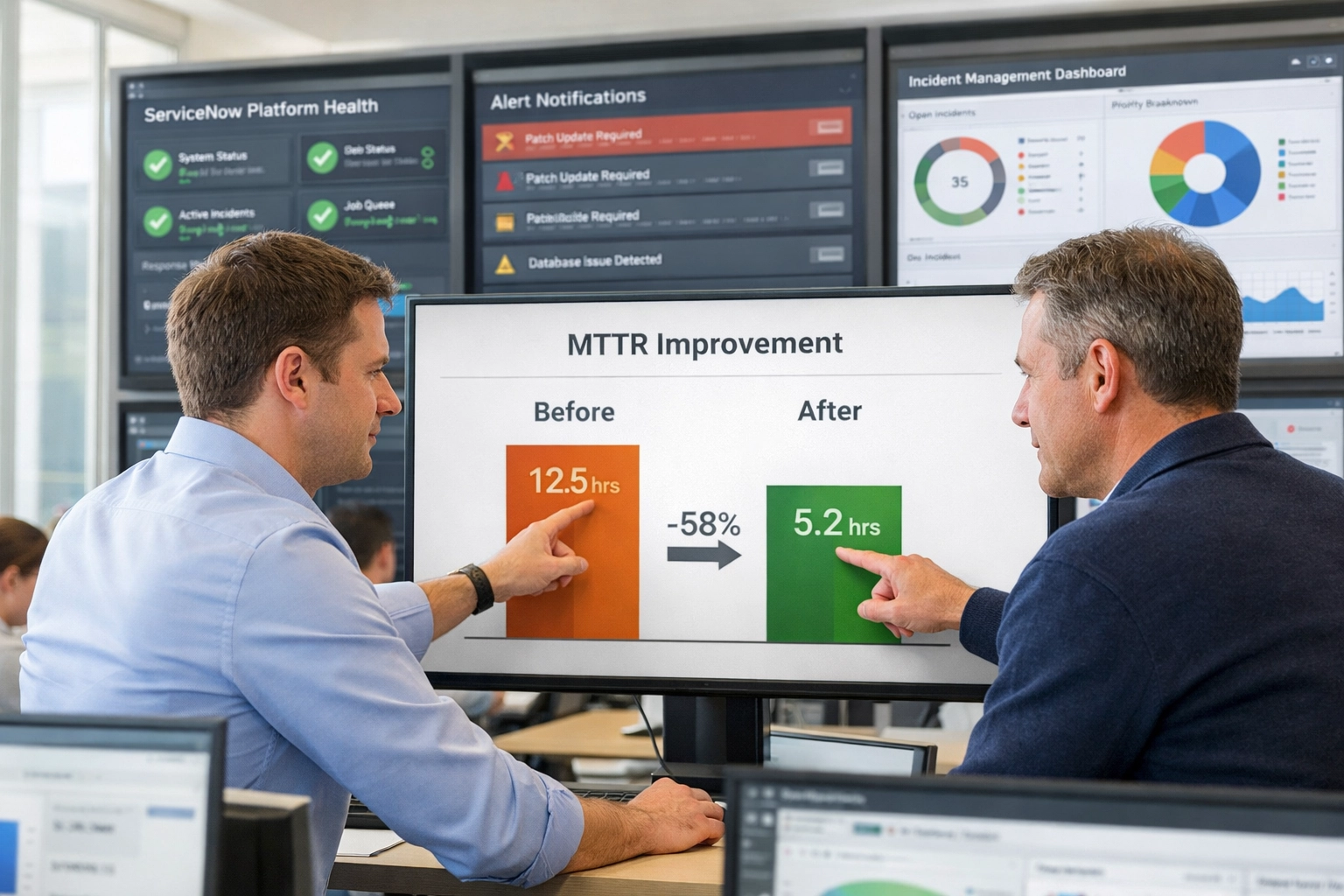
I have witnessed enterprises achieve 35% faster Mean Time to Resolution (MTTR) and 50% improvement in First Contact Resolution (FCR) rates by partnering with firms that provide quarterly platform health assessments and proactive upgrade roadmapping. This ongoing optimization is particularly critical for ITOM deployments, where Discovery patterns, Service Mapping accuracy, and Event Management rules require continuous refinement as your infrastructure evolves.
A thorough audit evaluates your current support SLAs, identifies gaps in knowledge transfer, and quantifies the ROI impact of inadequate ongoing optimization. For 2026, this includes assessing your partner's capability to implement agentic AI features from Washington DC: capabilities that require specialized prompt engineering and workflow redesign expertise.

Mistake #4: Failing to Validate Implementation Methodology Against 2026 Standards
Project methodology determines outcome quality. I've analyzed implementations following outdated waterfall approaches that took 18 months to deploy basic ITSM: while agile methodologies with proper ServiceNow ATF (Automated Test Framework) integration deliver similar scope in 12-16 weeks with 40% fewer post-launch defects.
Your ServiceNow implementation partner must demonstrate proficiency with:
Agile delivery frameworks with two-week sprints and continuous stakeholder feedback
Automated testing protocols using ATF to validate configurations before production deployment
DevOps integration enabling CI/CD pipelines for update sets and scoped applications
AI-assisted development leveraging Now Assist for Code to accelerate customization delivery
For ITAM initiatives, methodology matters even more. Partners must follow ServiceNow's Hardware Asset Management (HAM) best practices, including proper normalization rules, reconciliation policies, and software compliance automation. Shortcuts in these foundational elements create data quality issues that compound over months, rendering your ITAM investment worthless.
An implementation audit reviews your partner's project governance frameworks, examines their change management protocols, and validates their testing coverage standards against ServiceNow Technical Best Practices.
Mistake #5: Neglecting Stakeholder Alignment and Change Management
Technical excellence means nothing if users reject the platform. I've guided organizations through transformative ServiceNow implementations where 80%+ adoption rates were achieved through structured change management: compared to industry averages of 45-55% for implementations that treat training as an afterthought.
Your ServiceNow implementation partner must embed change champions within your organization, conduct role-based training sessions, and create feedback loops that inform configuration decisions. For ITOM deployments managing 10,000+ CIs, this means training your network teams on Discovery pattern customization, not just showing them how to run scans.
In 2026, change management extends to AI governance. Organizations deploying agentic AI capabilities in the Washington DC release require clear policies around AI decision-making boundaries, escalation protocols, and audit trails. EU-based enterprises must additionally address GDPR Article 22 requirements for automated decision-making: complexity that demands specialized ServiceNow consulting services with regulatory expertise.
Mistake #6: Overlooking Cultural Fit and Communication Cadence
I have witnessed technically brilliant implementations fail due to communication breakdowns. When your ServiceNow implementation partner operates in incompatible time zones, uses jargon-heavy reporting, or lacks executive-level stakeholder engagement protocols, friction increases exponentially.
Cultural fit assessment should evaluate:
Communication preferences: Do they provide weekly executive summaries with ROI tracking, or just technical status reports?
Escalation responsiveness: What are documented response times for critical production issues?
Transparency standards: Do they proactively flag risks, or hide problems until they become crises?
Collaboration tools: Are they fluent in your preferred platforms (Teams, Slack, ServiceNow Virtual Agent)?
For global enterprises, this includes assessing multilingual support capabilities and regional compliance knowledge. An EU-headquartered organization implementing DORA-compliant ICT risk management needs partners who understand both the technical ServiceNow configuration and the regulatory context: not just one or the other.
Mistake #7: Failing to Audit License Optimization and Hidden ROI Leaks
ServiceNow licensing represents 60-70% of total cost of ownership over five years. Yet I consistently find organizations paying for unutilized ITOM licenses, redundant ITAM subscriptions, or outdated fulfiller licenses when Xanadu's role-based licensing would reduce costs by 25-30%.
A comprehensive Free 2026 ServiceNow ROI & License Audit examines:
Active user counts versus purchased licenses across all products
Feature utilization rates for advanced capabilities like Predictive Intelligence or Performance Analytics
Integration efficiency to identify duplicate functionality across tools
Workflow optimization opportunities where agentic AI could eliminate manual tasks
For ITOM deployments, audits frequently reveal that Discovery is scanning infrastructure unnecessarily (wasting licenses) or missing critical assets entirely (creating compliance gaps). For ITAM implementations, audits identify software license reclamation opportunities averaging $150K-$400K annually for mid-market enterprises.
This audit also validates whether your current ServiceNow consulting services provider is maximizing platform ROI or simply maintaining status quo configurations that leave transformative capabilities dormant.

How a Free Audit Transforms Partner Selection and Platform ROI
Organizations that conduct structured partner evaluations and platform audits before renewing contracts or expanding implementations achieve 35% faster deployment timelines, 50% fewer post-launch incidents, and 28% higher user adoption rates within the first year.
The audit process I recommend includes:
Technical health assessment using ServiceNow's Instance Scan and Upgrade Center analytics
License optimization review comparing purchased entitlements against actual consumption patterns
Capability gap analysis identifying Washington DC features that could reduce manual effort by 40%+ but remain unimplemented
Compliance validation for DORA, GDPR, or ESG reporting requirements relevant to your jurisdiction
Partner competency benchmarking against Elite certification standards and industry-specific case studies
This data-driven approach eliminates guesswork from partner selection. Rather than evaluating proposals based on promises, you assess partners against objective evidence of their ability to optimize your existing investment and deliver measurable outcomes.
Your Next Steps: Secure Your ServiceNow Investment
The difference between a transformative ServiceNow implementation and an expensive disappointment comes down to partner selection precision and ongoing optimization discipline. In 2026, as agentic AI capabilities reshape service delivery and regulatory requirements like DORA demand unprecedented operational resilience, choosing the right ServiceNow implementation partner is not just an IT decision: it's a strategic business imperative.
I invite you to take the first step toward maximizing your ServiceNow ROI. Visit the SnowGeek Solutions contact page to share your project details and request your Free 2026 ServiceNow ROI & License Audit. Our team will conduct a comprehensive assessment of your current implementation, identify optimization opportunities worth an average of $300K-$800K in annual savings, and provide an objective partner evaluation framework tailored to your industry requirements.
Additionally, register with SnowGeek Solutions for platform updates and expert insights. We deliver monthly analysis of ServiceNow releases, regulatory compliance strategies, and ROI optimization techniques that help you stay ahead of the curve. Your ServiceNow investment deserves a partner committed to operational excellence: not just project completion.
Don't let these seven mistakes cost you another quarter of unrealized ROI. Connect with us today and discover how strategic ServiceNow consulting services transform platforms into competitive advantages.
Comments