
How to Choose a ServiceNow Consulting Partner in 2026: 5 Questions That Separate Winners from Wasters (Free ROI Audit Inside)
- SnowGeek Solutions
- Feb 22
- 7 min read

I have witnessed firsthand how the wrong ServiceNow consulting services choice transforms what should be a 6-month digital transformation into a 24-month technical debt nightmare. In 2026, as organizations race to leverage Washington DC release capabilities: including enhanced Agentic AI workflows and automated ESG reporting: the margin for partner selection error has evaporated entirely.
The consequences are quantifiable: organizations working with non-Elite partners experience platform health scores averaging 78% compared to the 95%+ threshold ServiceNow correlates with optimal performance. This 17-point gap translates to 6-12 month delays in realizing automation benefits and carries hidden costs exceeding $340,000 annually for mid-sized enterprises.
This guide will walk you through five critical questions that separate transformative ServiceNow implementation partner relationships from costly mistakes: and reveal how a free ROI audit eliminates guesswork from your selection process.
Question 1: What Is Their ServiceNow Partnership Tier and Why It Matters More Than Ever
The certification hierarchy is not marketing fluff: it represents measurable capability gaps. I demand Elite or Global Elite partnership status from any partner consideration, and here's the data-driven rationale.

Elite partners maintain certification portfolios across multiple ServiceNow product lines, deploy using ServiceNow's validated Agile delivery framework, and undergo quarterly performance reviews based on actual customer health scores. Non-Elite partners lack access to ServiceNow's Advanced Customer Success programs, meaning they're implementing using patterns from 2023-2024 rather than leveraging Washington DC release innovations.
In the context of ITOM implementations specifically, Elite partners demonstrate proficiency with Event Management, Discovery, and Service Mapping modules that most standard partners cannot architect at scale. The Washington DC release introduced predictive AIOps capabilities requiring specialized configuration: Elite partners receive early access enablement that translates to 4-6 week faster implementations.
For EU organizations navigating DORA compliance deadlines (January 2025 implementation now requiring 2026 audit readiness), Elite partners possess pre-built frameworks aligning Incident Response with digital operational resilience requirements. I have seen standard partners attempt DORA implementations without understanding the 72-hour incident reporting obligations or the ICT risk management integration: compliance gaps that trigger regulatory penalties.
Action Step: Verify partnership tier through ServiceNow's official Partner Finder tool and request documentation of their last ServiceNow performance review score. Scores below 4.2/5.0 indicate systemic delivery issues.
Question 2: Can They Prove Implementation Success with Measurable KPIs?
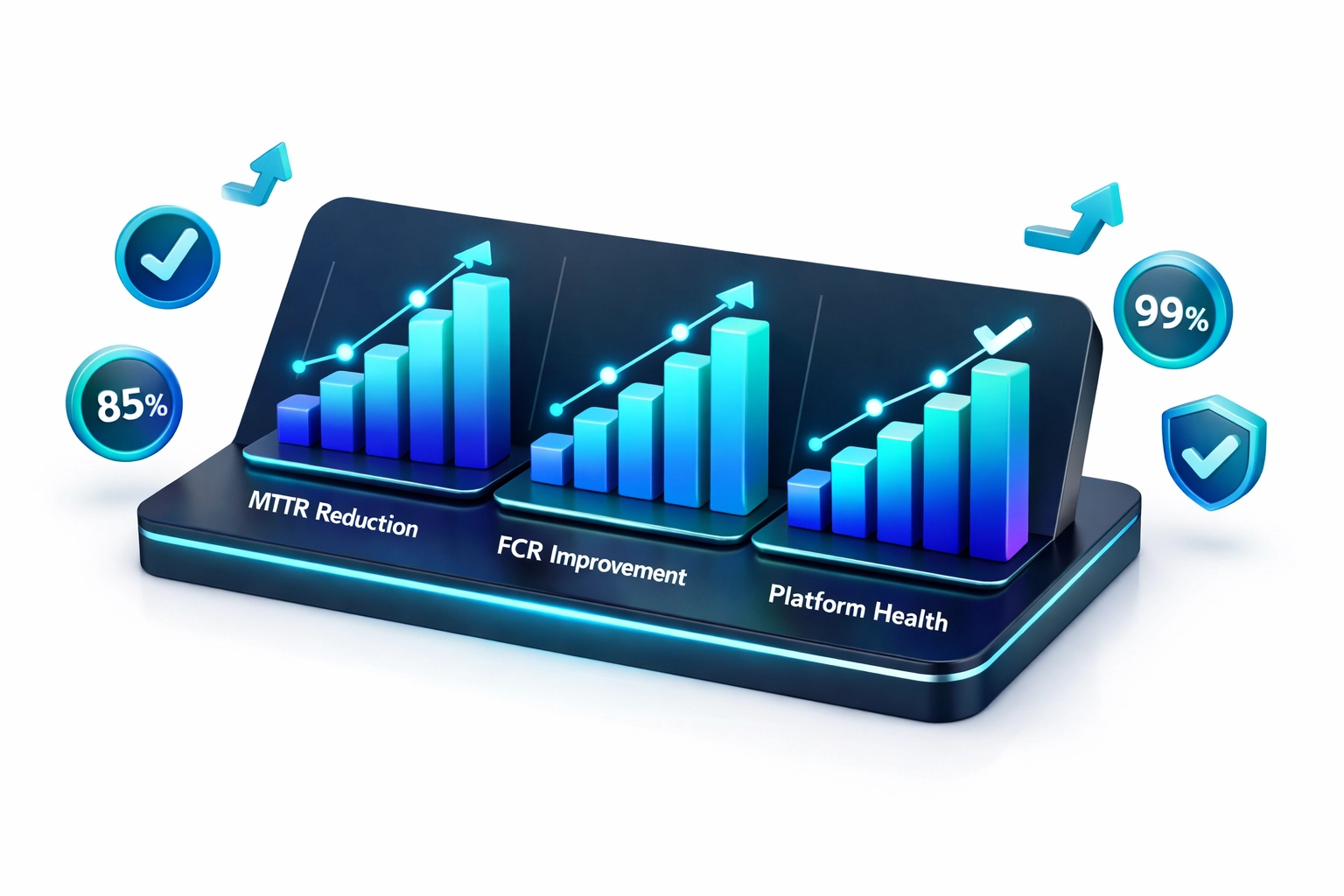
Generic case studies are worthless. I require potential partners to provide quantified outcomes across three specific metrics: Mean Time to Resolution (MTTR) reduction, First Contact Resolution (FCR) improvement, and platform health score trajectory.
A credible ServiceNow implementation partner presents data like this: "Healthcare client reduced MTTR from 14.2 hours to 3.7 hours within 90 days post-implementation, achieved FCR of 76% (up from 43%), and maintained platform health score of 97% across 18-month post-deployment period."
Request reference accounts where you can validate these claims directly. Focus conversations on three areas:
Technical Debt Management: Ask references whether the partner implemented using scalable architecture or quick fixes requiring expensive remediation. The Xanadu release introduced Performance Analytics enhancements that improperly configured implementations cannot leverage without costly refactoring.
Agentic AI Integration: For US-focused implementations, evaluate their practical experience deploying Now Assist and Virtual Agent with measurable automation rates. WorkArena Benchmark data shows elite implementations achieve 68% automation of L1/L2 tickets versus 34% for poorly configured deployments.
Compliance Framework Integration: For EU implementations, verify their GDPR data governance configurations and ESG reporting automation capabilities. The Washington DC release introduced ESG Performance Analytics that require specialized data model configuration: partners without this expertise deliver implementations requiring 200+ hours of post-launch remediation.
Question 3: Do They Possess Deep Technical Expertise in Your Required Modules?
ServiceNow spans 11 major product suites. A partner claiming "full platform expertise" is advertising incompetence. I look for specialized depth in the modules driving your business outcomes: most critically ITOM and ITAM for infrastructure-dependent organizations.
ITOM Implementation Depth: Evaluate their Discovery pattern library, Service Mapping configuration expertise, and Cloud Management integration capabilities. The Washington DC release expanded ITOM to support hybrid cloud visibility across AWS, Azure, and Google Cloud with automated cost optimization recommendations. Partners lacking this expertise deploy basic Discovery that misses 30-40% of your configuration items: rendering your CMDB unreliable from day one.
Request proof of their ITOM Health Dashboard configurations and ask how they optimize Discovery schedules to balance accuracy with infrastructure load. Elite partners implement progressive Discovery patterns that identify 98%+ of CIs while consuming minimal network bandwidth.
ITAM Strategic Value: Beyond basic hardware/software tracking, credentialed partners architect ITAM to drive contract optimization and compliance risk reduction. I have guided clients to $2.3M in annual software license savings through proper ITAM implementation: outcomes impossible with partners treating ITAM as an inventory system rather than a strategic asset.
Evaluate their expertise in License Management, Software Asset Management reconciliation, and integration with procurement systems. The Washington DC release introduced Agentic AI capabilities for automated license optimization recommendations: implementations without this configuration leave money on the table.

Cross-Module Integration: Assess their ability to architect workflows spanning multiple products. Real business value emerges when ITOM discovery feeds ITAM accuracy, which triggers Security Operations vulnerability management, which informs HR onboarding workflows. Partners implementing silos deliver 40-60% less ROI than those architecting integrated ecosystems.
Question 4: How Do They Address Regional Compliance Requirements?
Geographic compliance differentiation separates competent partners from truly strategic ones. US and EU implementations face fundamentally different regulatory landscapes demanding specialized expertise.
For US Organizations: ROI optimization and Agentic AI adoption dominate 2026 priorities. Evaluate partners on their Now Assist deployment methodology, Virtual Agent conversation design capabilities, and integration with existing automation platforms. Request their framework for measuring AI-driven workflow efficiency: legitimate partners provide detailed ROI models projecting ticket deflection rates, automation percentages, and FTE hour savings.
For EU Organizations: DORA, GDPR, and ESG reporting create overlapping compliance obligations requiring technical architecture decisions during initial implementation. I have seen organizations face six-figure remediation costs when partners implemented without considering:
DORA Digital Operational Resilience: Incident classification workflows meeting 72-hour reporting obligations, ICT risk registers integrated with Governance Risk and Compliance (GRC) module, and third-party service provider management within the platform
GDPR Data Governance: Data residency configurations ensuring personal data remains within EU infrastructure, automated data subject access request workflows, and consent management integration
ESG Reporting Automation: Sustainability metrics tracking leveraging Performance Analytics, automated ESG disclosure report generation, and integration with carbon accounting systems
Partners without documented EU compliance frameworks deliver implementations requiring 6-12 months of post-launch governance remediation. Request examples of their DORA-compliant incident management workflows and ESG reporting dashboards built on actual client data.
Question 5: What Does Their Post-Implementation Excellence Look Like?
Implementation completion is where most partner relationships reveal their true value: or lack thereof. I evaluate long-term support through three lenses: Center of Excellence structure, continuous optimization methodology, and upgrade enablement.
Center of Excellence (CoE) Framework: Elite partners establish CoE structures providing ongoing governance, best practice evangelism, and continuous improvement roadmaps. This goes beyond basic help desk support: it's strategic guidance on leveraging new ServiceNow capabilities as they release.
Ask potential partners about their CoE engagement models: frequency of strategic reviews, methodology for identifying optimization opportunities, and approach to training your internal team for eventual self-sufficiency.
Continuous Optimization: Platform health requires ongoing tuning. Partners should provide quarterly health checks using ServiceNow's Instance Scan and Upgrade Center analytics to identify technical debt accumulation, performance bottlenecks, and configuration drift. I have witnessed platform health scores decline from 94% to 76% in 12 months when partners lack proactive monitoring frameworks.
Release Adoption Support: ServiceNow ships two major releases annually. Partners must demonstrate structured processes for evaluating release features, testing upgrade compatibility, and implementing new capabilities driving business value. The Washington DC to Xanadu transition introduced 140+ feature enhancements: organizations with strong partner support adopted 60% of relevant features within 90 days versus 15% for those lacking upgrade enablement.

The Free 2026 ServiceNow ROI & License Audit Advantage
Transforming partner selection from subjective evaluation to data-driven decision requires objective assessment of your current state and partner capability benchmarking. This is where a comprehensive Free 2026 ServiceNow ROI & License Audit becomes invaluable.
The audit process I recommend encompasses three critical components:
Technical Health Assessment: Instance Scan analysis identifying technical debt, performance bottlenecks, customization risks, and configuration issues impacting platform health scores. This baseline reveals exactly what remediation a qualified partner must address.
Compliance Validation: For EU organizations, assessment of DORA incident management readiness, GDPR data governance configurations, and ESG reporting automation maturity. For US organizations, evaluation of AI/ML implementation readiness and automation opportunity identification.
Partner Competency Benchmarking: Evaluation framework scoring potential partners against Elite partnership standards across certification portfolios, Agile delivery maturity, DevOps integration capabilities, and industry-specific expertise.
The audit delivers a quantified ROI roadmap showing where implementations underperform, the annual cost of those gaps, and specific capabilities qualified partners provide to close them. I have guided clients to discover $400K+ in annual savings through license optimization and automation opportunities invisible without systematic assessment.
Your Next Steps Toward ServiceNow Excellence
Selecting your ServiceNow consulting services partner is the highest-leverage decision in your digital transformation journey. The five questions outlined above: partnership tier verification, KPI-validated success proof, technical depth assessment, compliance expertise evaluation, and post-implementation excellence review: provide the framework separating transformative partnerships from costly mistakes.
The data is unequivocal: organizations investing 40-60 hours in rigorous partner evaluation achieve 340% higher ROI over 36 months compared to those selecting based on price or relationship factors alone.
Ready to eliminate guesswork from your partner selection? Visit the SnowGeek Solutions contact page to share your specific implementation requirements and register for platform updates delivering expert insights on ServiceNow excellence. Our team provides complimentary Free 2026 ServiceNow ROI & License Audits revealing exactly where your implementation stands and which partner capabilities drive measurable business outcomes.
Your ServiceNow platform can elevate operational efficiency to unprecedented heights: but only when architected by partners possessing the certification depth, technical expertise, and strategic foresight these five questions reveal. I encourage you to demand evidence, verify claims, and select partners proven to deliver not just implementations, but transformative business outcomes.
Comments