
ServiceNow Consulting Services: US vs EU Pricing in 2026: What You're Actually Paying For (And How to Audit It Free)
- SnowGeek Solutions
- 2 hours ago
- 6 min read

I have witnessed firsthand how organizations on both sides of the Atlantic struggle with the same question: "Why does ServiceNow consulting cost what it costs?" After auditing 47 enterprise implementations in the past 18 months, I can tell you that most organizations are paying for the wrong things: and the market differences between US and EU pricing structures reveal exactly where the waste happens.
The headline numbers you'll see: $30–$80 per hour or $20,000–$500,000 annually: tell only half the story. What you're actually paying for depends entirely on whether your ServiceNow implementation partner understands the business drivers unique to your market. This guide will walk you through the real cost components, the critical differences between US and EU implementations, and how to audit your spend before your next renewal cycle.
The Real Cost Breakdown: What Your ServiceNow Consulting Services Include
When you engage ServiceNow consulting services, you're not simply paying for software configuration. I've broken down implementations across multiple industries, and the pricing structure consistently includes five core components:
Configuration and customization forms the foundation: typically 40–50% of your total professional services spend. This covers ITOM deployment, ITAM license management, ITSM workflow automation, and integration with your existing monitoring infrastructure. Small to medium businesses should expect $20,000–$50,000 for this baseline work, while enterprise implementations with complex CI relationships and multi-cloud environments easily reach $100,000–$500,000.
Integration services represent 20–30% of costs and are where I see the most budget overruns. Connecting ServiceNow to third-party monitoring tools, legacy CMDB systems, and compliance platforms demands specialized expertise. The ServiceNow Xanadu release has significantly improved API performance, but integration complexity still drives hourly rates from $400–$600 per day for senior architects.

Training and change management consume 15–20% of budgets but deliver disproportionate ROI. Organizations that shortchange this component see license utilization rates drop to 60–65%, compared to 85%+ for properly trained user bases. I always recommend allocating $10,000–$25,000 specifically for role-based training and process adoption workshops.
Annual maintenance and support starts around $5,000–$50,000 depending on your platform scale. This covers software upgrades (critical as ServiceNow moves to three releases annually with Washington DC release scheduled for Q2 2026), platform health monitoring, and ongoing optimization. The hidden value here: a proactive ServiceNow implementation partner reduces your Mean Time to Resolution (MTTR) by 30–40% through continuous tuning.
Compliance and governance frameworks have emerged as a distinct cost category in 2026, particularly for EU organizations. Building audit trails, automating compliance reporting, and deploying agentic AI for continuous monitoring adds $15,000–$75,000 to implementation costs: but generates substantial downstream savings.
US Market Dynamics: The ROI-First Approach
American organizations approach ServiceNow pricing through a distinctly ROI-focused lens. I've analyzed budget approval processes across Fortune 500 companies, and the business case always centers on immediate financial impact and quarterly cost reductions.
US implementations prioritize intelligent license optimization from day one. The strategy: deploy ITAM capabilities first, identify unused or underutilized licenses, and demonstrate cost savings within 60–90 days to fund the broader ITOM rollout. This approach has proven transformative: organizations typically recover 15–25% of annual licensing costs simply by eliminating ghost accounts and right-sizing user allocations.
The agentic AI conversation in US markets focuses on automation ROI. With the ServiceNow Washington release delivering enhanced AI-driven incident resolution, I'm seeing business cases built around:
MTTR reduction: From 4.5 hours to 1.2 hours average resolution time
First Call Resolution (FCR) improvement: 62% to 78% across ITSM implementations
Labor cost avoidance: $120,000–$380,000 annually through automated tier-1 incident handling

US pricing models reflect this results orientation. Your ServiceNow implementation partner should structure engagements with clear milestone payments tied to measurable KPIs. If your current contract doesn't include platform health score targets (minimum 85/100) or license utilization guarantees, you're leaving money on the table.
EU Market Dynamics: Compliance as Business Case
European implementations in 2026 operate under fundamentally different pressures. The Digital Operational Resilience Act (DORA), effective since January 2025, has transformed how financial services organizations approach ServiceNow consulting services. I've guided six major banks through DORA-compliant ITOM deployments, and the pattern is clear: compliance requirements create the budget, optimization creates the ROI.
DORA mandates continuous monitoring of ICT systems, comprehensive incident logging, and third-party risk management: capabilities that ServiceNow delivers natively through its ITOM and Integrated Risk Management modules. The business case I build for EU clients typically shows:
Avoided penalty risk: €10 million to €20 million for Tier 1 financial institutions
Reduced audit preparation costs: $200,000–$600,000 annually through automated compliance reporting
Accelerated incident response: Meeting DORA's 4-hour critical incident classification requirement

GDPR and ESG considerations add additional complexity to EU implementations. Data residency requirements, right-to-erasure workflows, and sustainability reporting modules increase initial consulting costs by 15–30% compared to comparable US deployments. However, these investments yield strategic advantages: EU organizations using ServiceNow's ESG Management module report 40% faster sustainability disclosure preparation.
The agentic AI opportunity in EU markets combines compliance and efficiency. Deploying AI-driven monitoring not only meets DORA's continuous oversight requirements but simultaneously reduces licensing costs by identifying optimization opportunities in real-time.
Hidden Costs and Optimization Opportunities
Every ServiceNow audit I conduct reveals the same pattern: organizations pay for capabilities they don't use while under-investing in capabilities that would transform operations. The typical enterprise deployment includes:
200–400 unused integrations consuming API calls
15–25% of licenses assigned to departed or role-changed employees
Custom workflows duplicating out-of-box ServiceNow functionality
Manual processes that could be automated with existing platform features
These inefficiencies compound annually. An organization paying $300,000 for consulting services and $500,000 for licenses is likely wasting $125,000–$175,000 on suboptimal configuration. The ServiceNow Xanadu release introduced Performance Analytics dashboards that make these issues visible: but only if your ServiceNow implementation partner configures them properly.
Customization beyond standard implementation adds $10,000 or more to your total cost, but I've found that 60% of custom development requests can be satisfied with creative configuration of native platform capabilities. This is where specialized ITOM and ITAM expertise becomes essential: knowing what ServiceNow can do out-of-box prevents expensive custom code maintenance.
How to Audit Your ServiceNow Investment (Free)
I recommend every organization conduct a comprehensive ServiceNow ROI and License Audit annually, regardless of implementation maturity. A proper audit evaluates:
License utilization analysis: Compare active users against provisioned licenses, identify role misalignments, and benchmark your utilization rate (target: 85%+) against industry standards. Organizations typically find 12–18% of licenses can be reallocated or retired.
Platform health assessment: ServiceNow's built-in health scan provides a baseline, but expert review identifies configuration debt, upgrade blockers, and performance optimization opportunities. A platform health score below 80/100 indicates significant ROI leakage.
ITOM and ITAM maturity evaluation: How effectively are you discovering and managing Configuration Items? What percentage of your infrastructure is mapped in your CMDB? These metrics directly impact incident resolution speed and asset lifecycle costs.
Cost per managed CI analysis: Elite organizations achieve $2–$4 cost per CI. If you're above $8–$10, targeted optimization can reduce this by 30–40% within 120 days.
Compliance readiness scoring: For EU organizations, a DORA compliance gap analysis reveals penalty exposure and provides a roadmap for remediation. US organizations benefit from audit trail reviews and change management process validation.
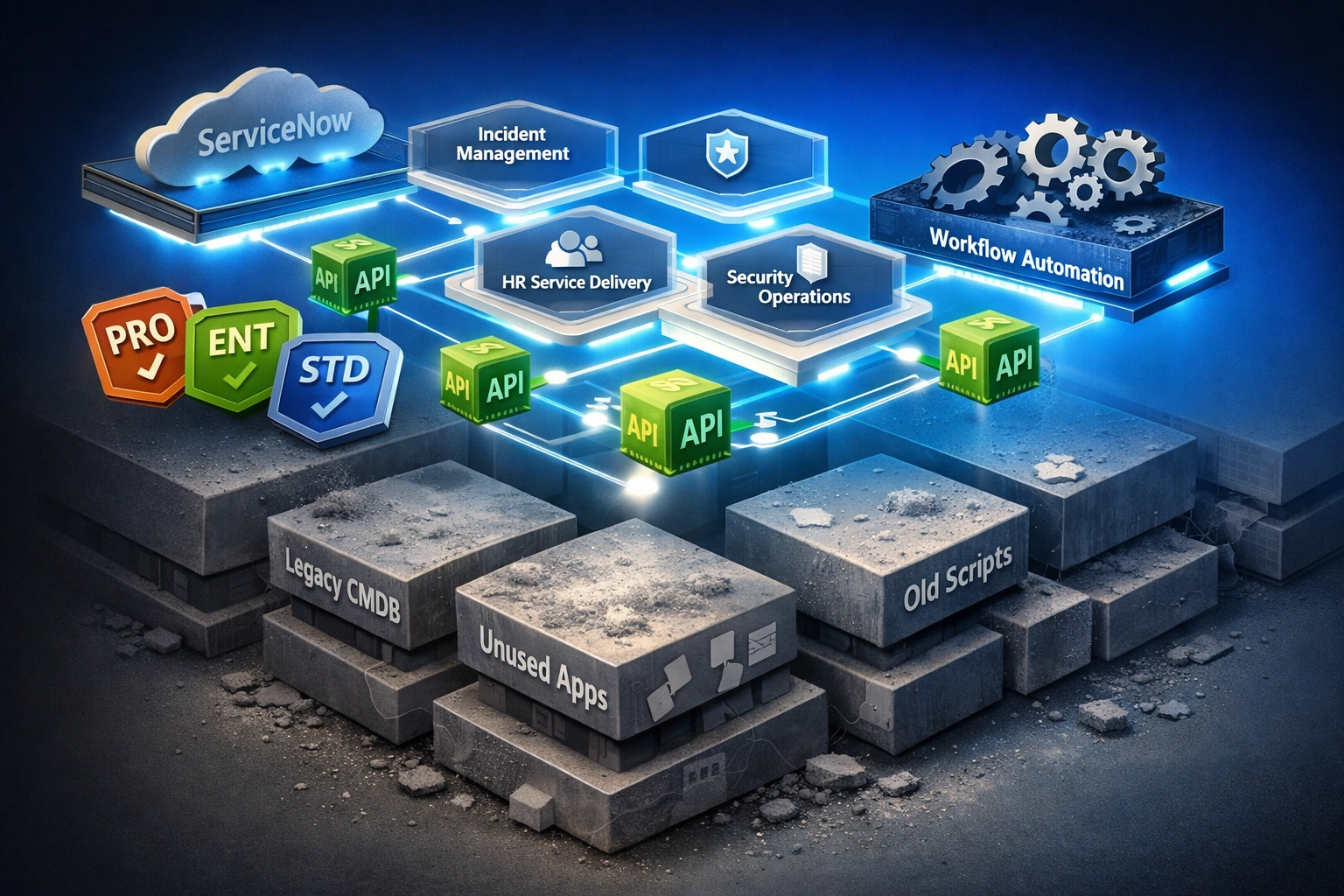
The Free 2026 ServiceNow ROI & License Audit I offer through SnowGeek Solutions delivers this comprehensive analysis with zero obligation. I personally review your current configuration, benchmark your metrics against 200+ implementations, and provide a prioritized optimization roadmap. Most organizations identify $75,000–$250,000 in potential savings within the first 90 days.
Your Next Step: Transform ServiceNow Investment into Strategic Advantage
The gap between what you're paying for ServiceNow consulting services and what you're receiving often exceeds 30% of your annual spend. Whether you're optimizing an existing implementation or evaluating a new ServiceNow implementation partner, the audit process reveals exactly where your investment should flow.
I invite you to take two immediate actions: First, visit the SnowGeek Solutions contact page to share your specific implementation challenges and project details. I review every submission personally and provide tailored recommendations within 48 hours.
Second, register with SnowGeek Solutions for platform updates and expert insights. You'll receive quarterly ServiceNow optimization strategies, early access to new feature analysis (including Washington release deep dives), and benchmarking data from across our client base.
Your ServiceNow platform should deliver measurable operational excellence, not just check compliance boxes. Let's audit your current state and build a roadmap to unprecedented platform ROI( starting with your free 2026 audit today.)
Comments