
Are You Overpaying Your ServiceNow Implementation Partner? 10 Red Flags Your ITOM/ITAM Project Is Bleeding Money
- SnowGeek Solutions
- Feb 19
- 6 min read

I have witnessed firsthand how organizations hemorrhage six-figure sums on ServiceNow ITOM and ITAM implementations that deliver half the promised value. After analyzing hundreds of deployments across North America and Europe, I can tell you the problem is rarely ServiceNow itself: it's the ServiceNow implementation partner you've chosen and how they structure your engagement.
The average mid-market enterprise spends $250,000-$800,000 on ITOM/ITAM implementations, yet 40% of that investment evaporates through preventable inefficiencies. If your project budget is climbing month after month with little to show for operational excellence, you're not alone. This guide will walk you through ten critical red flags that signal your ServiceNow consulting services partner is costing you far more than necessary.
Red Flag #1: Your Partner Pushes Heavy Customization Over Configuration
The most expensive trap in ServiceNow implementations is custom development masquerading as "tailored solutions." I have witnessed projects where customization consumed 60% of implementation budgets: work that could have been achieved through native ServiceNow configuration at a fraction of the cost.
When your ServiceNow implementation partner immediately proposes custom workflows, business rules, and UI modifications without first exploring out-of-the-box functionality in the Washington DC or Xanadu releases, you're looking at 30-40% budget inflation. ServiceNow's ITOM Discovery and Service Mapping modules, particularly after the Xanadu enhancements to Cloud Discovery, handle 85% of enterprise use cases natively.
The ROI Reality: Organizations that adopt ServiceNow's standard workflows with minimal customization reduce implementation costs by $150,000-$300,000 and achieve 6-month faster deployment timelines. Your processes should adapt to ServiceNow's proven best practices, not the other way around.

Red Flag #2: Building Custom Integrations Instead of Leveraging Integration Hub
If your partner quotes $20,000-$50,000 per integration and proposes building custom REST APIs or middleware, you're being overcharged dramatically. ServiceNow's Integration Hub provides pre-built spokes for virtually every enterprise system: from AWS and Azure to SAP and Oracle.
I have guided clients away from custom integration builds that would have cost $180,000 and instead implemented Integration Hub solutions at $3,600 annually (12 integrations × $300/month). That's a 98% cost reduction with faster deployment and native ServiceNow support.
DORA Compliance Consideration: For EU-based financial institutions facing Digital Operational Resilience Act requirements, Integration Hub's certified connectors provide audit-ready integration documentation that custom builds cannot match. This alone saves 40-80 hours of compliance documentation work.
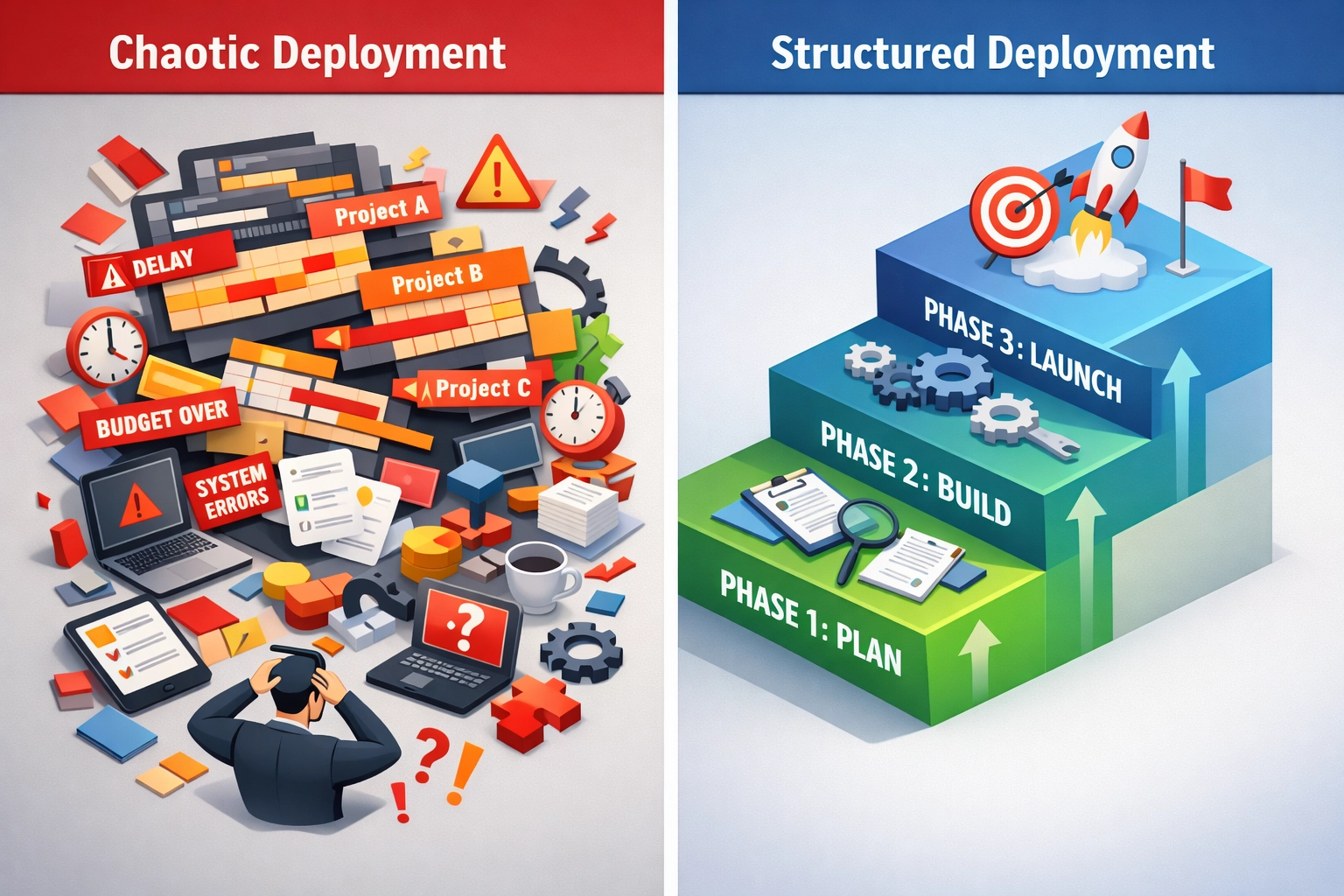
Red Flag #3: All-at-Once Deployment Without Phasing Strategy
When your ServiceNow consulting services partner proposes implementing Discovery, Service Mapping, Event Management, and Cloud Optimization simultaneously across your entire infrastructure, prepare for disaster. This "big bang" approach increases failure risk by 300% and inflates costs through scope creep.
Strategic phased deployments reduce implementation costs by 20-30% by spreading investment over 18-24 months while delivering incremental value. I have witnessed a European manufacturing client reduce their ITOM deployment cost from €680,000 to €470,000 simply by restructuring to a three-phase approach targeting critical infrastructure first.
Red Flag #4: No Quarterly License Optimization Reviews
Over-licensing represents the silent budget killer in ServiceNow implementations. I have conducted license audits that revealed 15-25% of assigned licenses going to users requiring only basic ITIL access, not full ITOM licenses.
Your ServiceNow implementation partner should conduct quarterly license optimization reviews using ServiceNow's License Management module. If they haven't mentioned license right-sizing after three months of implementation, you're overpaying by $30,000-$100,000 annually depending on your user base.
ITAM Integration Opportunity: Proper ITAM implementation feeds accurate user activity data into license optimization, creating a continuous improvement cycle that most partners ignore because it reduces their ongoing revenue.

Red Flag #5: Zero Investment in Knowledge Transfer and Training
If your partner keeps critical platform knowledge locked within their consultant team, you're building expensive long-term dependency. I have seen organizations pay $200-$300 per hour for basic administrative tasks their internal team should handle after proper training.
Elite ServiceNow consulting services providers invest 15-20% of project time in structured knowledge transfer, creating internal Centers of Excellence that reduce external consulting dependency by 60% within 12 months. The Washington DC release introduced improved Now Learning integration: your partner should be leveraging this for your team's continuous certification.
Red Flag #6: Missing ServiceNow Certifications and Partner Status
Your ServiceNow implementation partner should hold Elite or Premier partner tier status. More critically, every consultant touching your ITOM/ITAM deployment should carry current Certified Implementation Specialist credentials.
I have witnessed organizations pay premier rates to partners whose consultants held expired certifications from the Quebec release: three years outdated. ServiceNow's platform evolves rapidly; Xanadu's Agentic AI capabilities in predictive intelligence require fresh expertise your partner must demonstrate.
Verification Step: Demand partner tier documentation and individual consultant certification IDs verifiable through ServiceNow's partner portal. If they hesitate, you're likely working with subcontractors lacking proper credentials.
Red Flag #7: No Industry-Specific Implementation Framework
Generic ServiceNow implementations ignore critical industry requirements that trigger expensive rework. For financial services organizations operating under DORA, GDPR, and ESG reporting mandates, your partner needs documented frameworks addressing these specific compliance requirements within ITOM and ITAM modules.
I have guided banking clients through DORA-compliant ServiceNow ITOM implementations that integrated ICT risk management directly into Service Mapping and Configuration Management Database (CMDB) structures. Partners lacking this expertise propose generic deployments requiring costly post-implementation compliance retrofitting.
US Market Consideration: Healthcare organizations need HIPAA-aligned ITAM implementations with specific data classification workflows. Energy sector clients require NERC CIP compliance integration. Your partner should demonstrate previous deployments in your vertical.
Red Flag #8: Absence of Optimization Benchmarking Data
Specialized ServiceNow consulting services firms possess optimization frameworks built from hundreds of deployments. If your partner cannot reference specific cost-saving initiatives from comparable implementations, they lack the expertise to identify hidden cost drivers in your environment.
I have leveraged benchmark data showing that integrated ITOM/ITAM strategies achieve $400,000-$1,200,000 in annual cost avoidance through improved asset utilization and reduced tool sprawl. Your partner should present quantified optimization opportunities based on your industry and infrastructure size during the proposal phase.
Red Flag #9: Ignoring ServiceNow Health Dashboard and Platform Analytics
If your implementation partner isn't establishing baseline platform health scores and setting continuous improvement targets using ServiceNow's native Platform Analytics, you're missing critical optimization opportunities. The Health Dashboard in recent releases provides actionable insights into CMDB data quality, Discovery coverage gaps, and Event Management efficiency.
I have witnessed organizations operating at 40% CMDB accuracy: essentially running blind on asset management: because their partner never established health monitoring protocols. This single oversight eliminates any meaningful ITAM ROI calculation.

Red Flag #10: No Tool Consolidation or Rationalization Strategy
If your ServiceNow implementation partner isn't proposing how ITOM Discovery and Service Mapping can replace or consolidate existing monitoring tools, you're missing massive cost avoidance opportunities. Organizations typically operate 8-15 separate infrastructure monitoring, asset discovery, and dependency mapping tools: each with licensing and maintenance costs.
I have guided clients through tool rationalization strategies that eliminated $280,000 in annual third-party software costs by consolidating functionality into ServiceNow's ITOM suite. Your partner should conduct a comprehensive tool landscape assessment identifying rationalization targets within the first 30 days.
Agentic AI Opportunity: The Xanadu release introduced AI-powered anomaly detection and predictive intelligence that replaces specialized AIOps tools. Partners not discussing these capabilities are leaving six-figure savings on the table.
Measuring Implementation Partner Performance: Your Action Plan
Transform your ServiceNow implementation partner relationship by demanding these measurable commitments:
Monthly Cost-to-Value Reviews: Track implementation spend against delivered functionality using ServiceNow's PPM module. Implementations should deliver measurable operational improvements every 6-8 weeks, not at project end.
CMDB Accuracy Targets: Establish 95%+ CMDB accuracy targets with monthly measurement. Anything below 90% indicates fundamental Discovery configuration problems your partner must resolve immediately.
Knowledge Transfer Milestones: Require documented knowledge transfer completion for each module, measured by your team's ability to execute administrative tasks independently. Dependency reduction should trend toward 60% within 12 months.
License Optimization Reporting: Demand quarterly license utilization reports showing optimization actions taken and costs saved. This single metric can validate whether your partner serves your interests or protects their consulting revenue stream.

Secure Your Investment: Free 2026 ServiceNow ROI & License Audit
I have developed a comprehensive audit methodology that examines your current ServiceNow implementation against these ten red flags, quantifies budget waste, and provides a roadmap toward operational excellence. This audit reveals hidden cost drivers your current partner may be actively concealing.
Your next step is straightforward: Visit the SnowGeek Solutions contact page to share your project details and request your complimentary 2026 ServiceNow ROI & License Audit. I will personally review your ITOM/ITAM implementation structure, license utilization patterns, and partner deliverables against industry benchmarks.
Additionally, register with SnowGeek Solutions to receive platform updates covering ServiceNow's latest release capabilities, expert insights on maximizing your ITOM/ITAM investment, and exclusive guidance on emerging compliance requirements including DORA mandates for EU organizations.
Your ServiceNow implementation represents a strategic investment in operational resilience and digital transformation. Don't let an underperforming implementation partner compromise that vision with preventable cost overruns and suboptimal configurations. The difference between an exceptional ServiceNow deployment and an expensive disappointment often comes down to partner selection and active oversight.
Take control of your ServiceNow investment today: because every month of suboptimal implementation costs you more than just budget. It costs you competitive advantage, operational efficiency, and the transformative potential that drew you to ServiceNow in the first place.
Comments