
Are You Making These 7 Common ITOM Mistakes? Free 2026 ServiceNow ROI Audit Reveals Hidden Costs
- SnowGeek Solutions
- Feb 22
- 5 min read

I have witnessed firsthand how organizations invest millions in ServiceNow ITOM implementations only to sabotage their own success through seven preventable mistakes. These aren't minor configuration oversights: they're architectural failures that create cascading technical debt and obliterate ROI before your first Service Mapping workflow even completes.
After conducting hundreds of ServiceNow ROI audits throughout 2025, I've identified a consistent pattern: companies achieving less than 12% ROI after 24 months invariably commit the same critical errors. The organizations reaching 40-60% ROI? They avoid these pitfalls entirely.
Mistake #1: Operating in the CMDB "Catastrophic Zone"
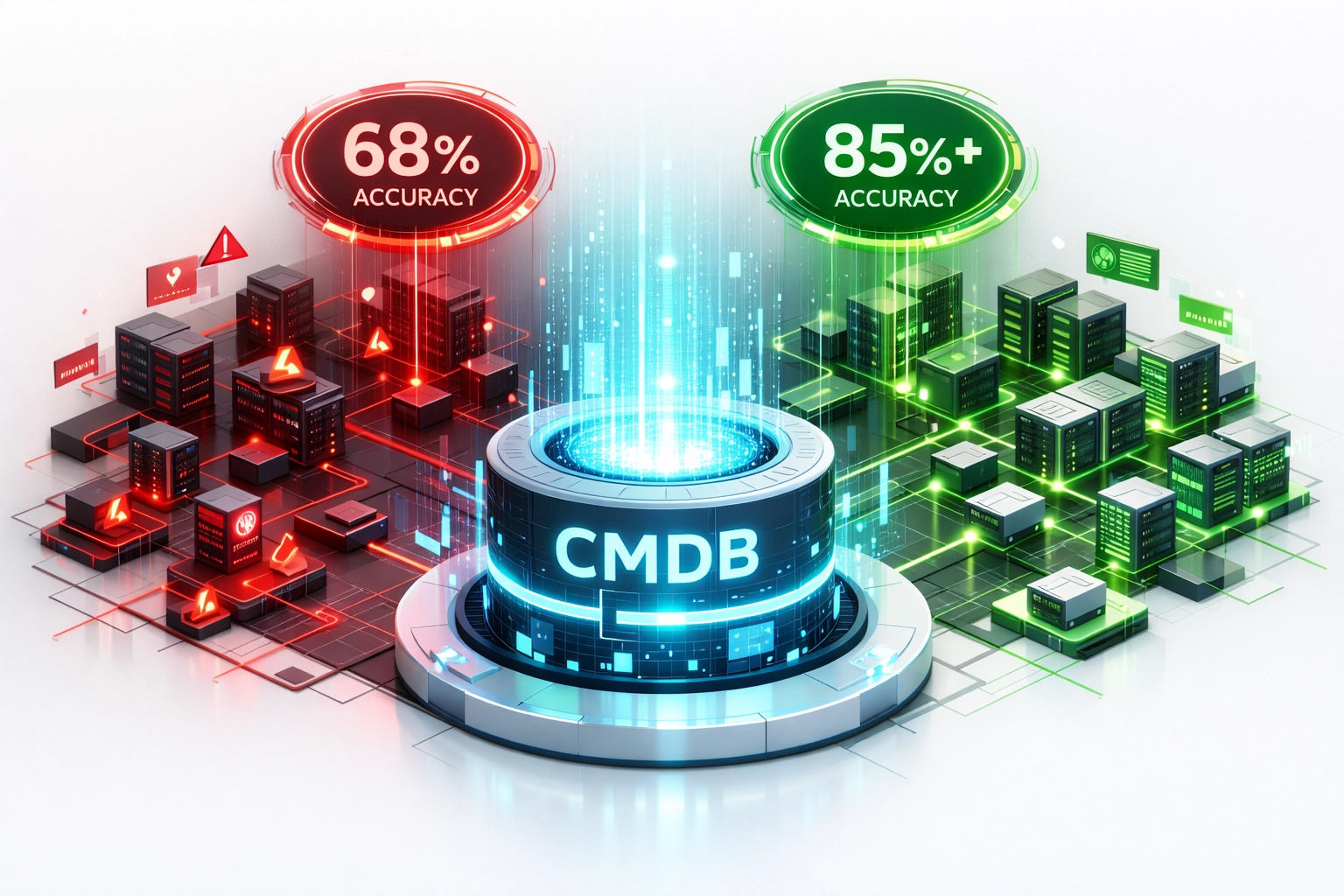
Your CMDB accuracy sits at 68%. Leadership considers this "acceptable." I consider it catastrophic.
CMDB accuracy between 60-75% represents what I call the failure threshold for AI-driven automation. At this level, your automated workflows become fundamentally unreliable: incident routing sends tickets to the wrong teams, change management misses critical dependencies, and your asset reports display phantom devices that haven't existed for eighteen months.
The ServiceNow Washington release introduced enhanced anomaly detection capabilities that automatically flag CMDB inconsistencies. Yet most implementations never activate these features because teams assume their data quality exceeds the threshold requiring intervention.
I've analyzed the numbers: organizations must push CMDB accuracy above 85% using enhanced Service Mapping and automated validation rules to achieve genuine operational transformation. Below this threshold, your ITOM investment becomes an expensive data collection exercise rather than a transformation engine.
The ROI impact? Every 10-percentage-point improvement in CMDB accuracy correlates with a 15% reduction in Mean Time to Resolution (MTTR). For a mid-market enterprise, this translates to $280K-$520K in annual efficiency gains.
Mistake #2: Building Strategy on Phantom Confidence
Your Discovery covers 63% of your actual IT estate. You don't realize it covers only 63% because Discovery successfully scans what you've credentialed: creating the illusion of complete visibility.
This stems from incomplete credential coverage. Windows domain credentials work perfectly while network device credentials remain outdated from a 2023 audit, and your cloud infrastructure credentials? Those expired when your AWS administrator left in November.
Each gap represents invisible applications and dependencies that compromise your entire ITOM strategy. Your service models show clean dependency chains: except they're missing the legacy Oracle database that three critical applications actually depend on.
I recommend implementing a quarterly Discovery Coverage Assessment using the Xanadu release's improved cloud discovery capabilities combined with network scanning validation. This reveals the delta between perceived and actual infrastructure visibility.
Mistake #3: Treating ITOM and ITAM as Divorced Domains
Organizations implement ITOM for operational visibility and ITAM for license compliance, then fail to integrate the two domains. This represents one of the most expensive architectural oversights I encounter during ServiceNow consulting services engagements.

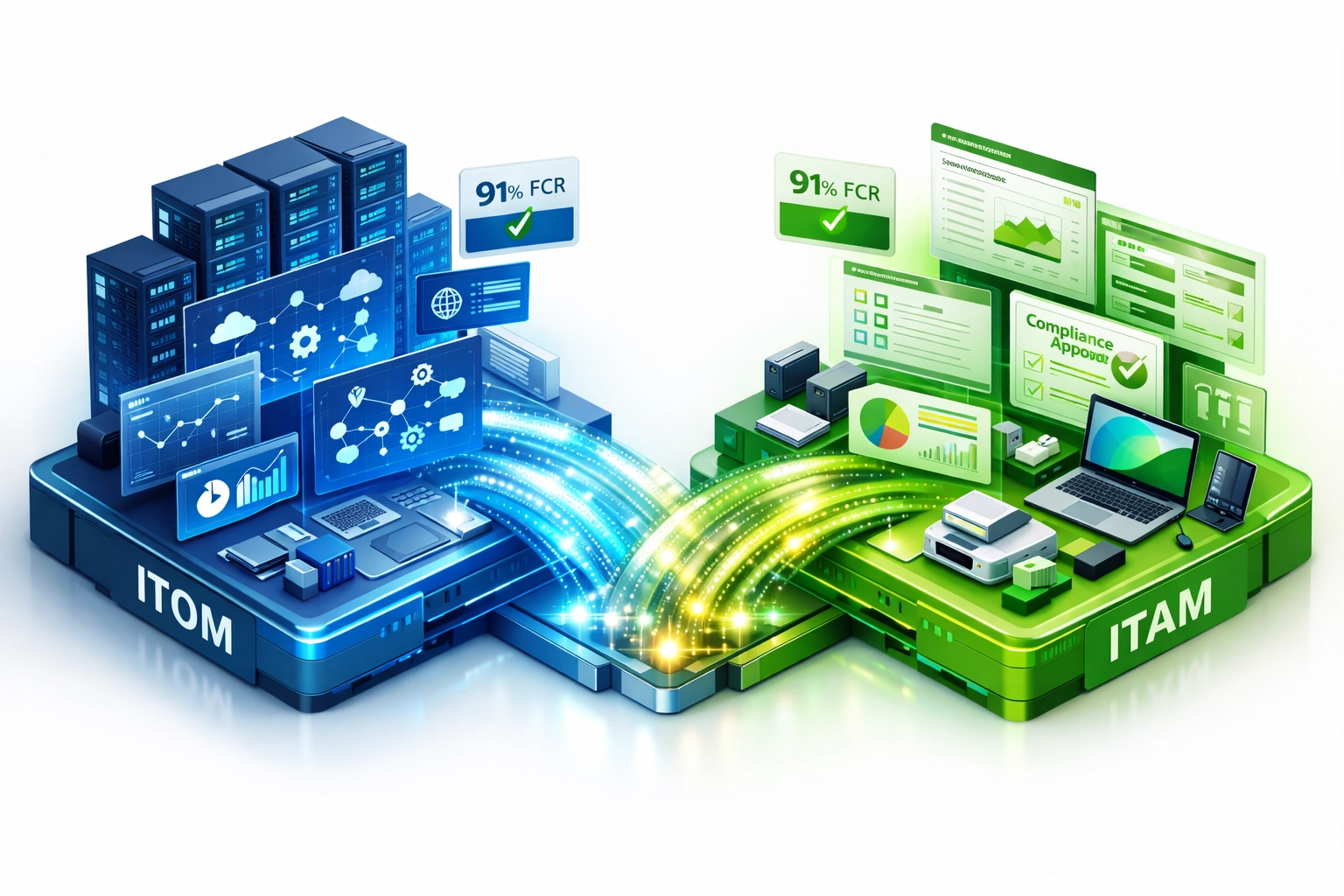
Proper ITOM-ITAM integration delivers First Call Resolution (FCR) rates of 91% compared to 68% without integration: a 23-percentage-point improvement translating to $400K-$800K in annual ROI for mid-market enterprises.
When your incident management system can instantly access accurate asset relationships, software deployment status, and license entitlements from your ITAM database, resolution velocity increases exponentially. Support engineers stop guessing which software version runs on which server and start resolving incidents with precision.
The integration requires deliberate architectural planning during your ServiceNow implementation partner selection process. Partners without specialized ITOM and ITAM expertise treat these as separate workstreams, creating integration gaps that persist for years.
Mistake #4: Neglecting Change Management Architecture
Organizations implement Discovery and Service Mapping but fail to leverage CMDB capabilities for automated change risk scoring. The Washington release can automate 80% of this process through intelligent dependency analysis, yet most implementations still rely on manual risk assessments.
I've observed structured change management architecture increase Change Success Rates from industry averages of 85% to best-in-class levels exceeding 95%. This 10-percentage-point improvement prevents approximately 150-200 failed changes annually for enterprises managing 2,000+ changes per year.
Each prevented failure saves 8-12 hours of emergency remediation work, incident investigation, and stakeholder communication. Calculate the ROI: 175 prevented failures × 10 hours average remediation × $150 blended labor rate = $262,500 in annual avoided costs.
Mistake #5: Architectural Decisions Creating Compounding Technical Debt
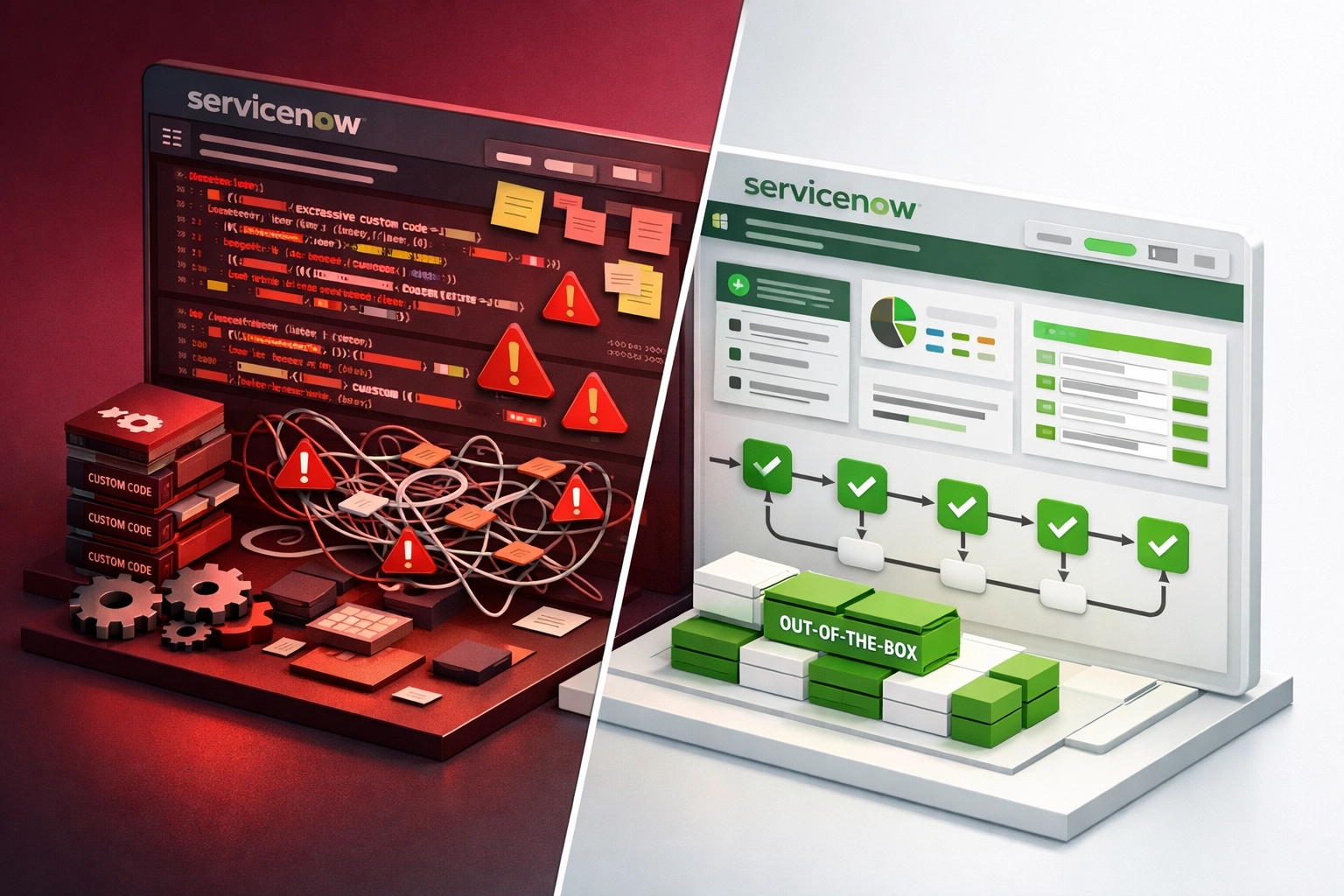
Teams build custom discovery patterns instead of leveraging out-of-the-box capabilities. They create parallel CMDB systems "just for network devices." They customize core workflows to match legacy processes rather than adopting ServiceNow best practices.
Each decision seems pragmatic during implementation. Eighteen months later, these choices compound into architectural quicksand. Every ServiceNow release requires additional testing. Upgrade cycles extend from weeks to months. Consulting costs escalate because your instance has become a bespoke application requiring specialized knowledge transfer.
I quantified this impact during a recent audit: an organization with 40% platform customization spent $340K annually on upgrade testing and validation compared to $85K for an equivalent organization following configuration-over-customization principles. The $255K annual delta represents pure technical debt servicing costs.
Mistake #6: Over-Customization Without Governance
Every customization should require documented business justification and technical alternatives analysis. Did you evaluate whether configuration, IntegrationHub connectors, or native capabilities could solve the problem without custom code?
Most organizations lack this governance framework. Developers customize because customization is faster than learning whether Washington release features already solve the requirement. Six months later, you discover the Xanadu release introduced exactly the capability you custom-built: except now you're maintaining technical debt instead of leveraging platform innovation.
The governance solution: implement a three-tier approval process for customizations based on platform impact. Configuration changes require team lead approval. Script modifications require architectural review. Core table schema changes require executive sponsorship with ROI justification.
Mistake #7: The Hidden Cost of Wrong Partner Selection
Here's the data point that transforms everything: 73% of companies select their ServiceNow implementation partner based on price or brand recognition rather than specialized ITOM expertise.
Organizations engaging the wrong partners experience that 12% ROI after 24 months I mentioned earlier. Those selecting partners with deep ITOM specialization recognize architectural blind spots during discovery and avoid the $340K-$2.1M in unrealized annual value.
Your ServiceNow implementation partner determines whether you build a scalable ITOM architecture or an expensive technical debt generator. Partners without specialized ITOM expertise miss critical integration points between Discovery, Service Mapping, Event Management, and Cloud Management. They implement components rather than architecting solutions.
I've conducted competitive assessments comparing partner deliverables. Specialized partners deliver architectures achieving 85%+ CMDB accuracy within six months. Generalist partners deliver 65-70% accuracy requiring 12-18 months of remediation: if organizations invest in remediation at all.
The Underlying Issue: ITOM as Operating Model
These seven mistakes share a common root cause: organizations treat ITOM as a technical implementation rather than an operating model requiring architectural rigor.
ITOM isn't a tool you install. It's an operational framework that fundamentally transforms how IT understands, manages, and optimizes infrastructure. This demands specialized ServiceNow consulting services with proven ITOM architecture expertise, not generalist system integrators executing standard implementation playbooks.
Your Next Step: The 2026 ServiceNow ROI & License Audit
I've designed a comprehensive ROI and License Audit specifically addressing these seven failure patterns. This assessment quantifies your current ITOM maturity, identifies hidden cost drivers, and provides a roadmap for maximizing your ServiceNow investment throughout 2026.
The audit examines CMDB accuracy metrics, Discovery coverage gaps, ITOM-ITAM integration effectiveness, change management automation levels, technical debt quantification, customization governance maturity, and partner selection ROI impact.
Here's what I recommend: Visit the SnowGeek Solutions contact page to share your specific ITOM challenges and request your complimentary 2026 ServiceNow ROI & License Audit. Additionally, register with SnowGeek Solutions to receive platform updates, release-specific optimization strategies, and expert insights that help you avoid these costly mistakes.
The organizations achieving transformative ITOM ROI don't stumble upon success: they architect it deliberately with specialized expertise guiding every decision. Your next step determines whether your 2026 ITOM investment becomes a success story or a cautionary tale.
Comments