
Are You Making These 5 ITOM Mistakes That Cost Companies $2M+ in 2026? (Free ServiceNow ROI Audit)
- SnowGeek Solutions
- Feb 27
- 5 min read

I have witnessed firsthand how IT Operations Management (ITOM) mistakes can hemorrhage millions from enterprise budgets. Throughout 2026, organizations continue making the same preventable errors during ServiceNow implementations: errors that compound into staggering financial losses. The pattern is clear: companies that skip proper planning with an experienced ServiceNow implementation partner end up paying the price in operational inefficiency, platform instability, and missed ROI targets.
Let me walk you through the five most devastating ITOM mistakes I've seen this year: and more importantly, how to avoid them.
Mistake #1: Wrong MID Server Placement Creates Discovery Disasters
The single most expensive mistake I see organizations make involves deploying a lone Management Instrumentation Database (MID) server to scan their entire infrastructure. This architectural shortcut creates high latency, intermittent scheduling failures, and discovery results so inconsistent they're practically useless.

I recently worked with a global manufacturing client who deployed one MID server in their primary data center and attempted to scan cloud VMs via VPN. Their discovery scans took 18+ hours to complete, with 40% failure rates on cloud assets. After we repositioned one MID per virtual network zone: following ServiceNow's Washington DC release best practices: scan times dropped to 2.3 hours with 97% success rates.
The Fix: Deploy MIDs close to their target systems, one per network zone. Align discovery schedules to each MID's reachable scope, and configure proper firewall rules. This architectural approach reduces Mean Time To Resolution (MTTR) by eliminating discovery blind spots that cause incident escalations.
Mistake #2: Weak CMDB Identification Rules Destroy Data Integrity
Poor Identification and Reconciliation Engine (IRE) strategy leads to Configuration Items (CIs) constantly changing attributes, with multiple data sources overwriting each other in an endless data war. I've measured CMDB inaccuracy rates as high as 42% in organizations that neglected proper identification rules during their ServiceNow consulting services engagement.
The business impact is severe. When your CMDB can't reliably track relationships between applications and infrastructure, automated workflows break. Incident routing fails. Service impact analysis becomes guesswork. One financial services client I advised experienced a 23% spike in MTTR post-go-live specifically because their CMDB data quality undermined every automation they'd built.
The Fix: Lock down authoritative sources per class and field with strict governance on write permissions. Define clear reconciliation priorities before you import the first CI. Your ServiceNow implementation partner should establish data stewardship roles that maintain these rules as your environment evolves. In the Xanadu release, ServiceNow enhanced CMDB Health monitoring: use those native capabilities to track accuracy KPIs weekly.

Mistake #3: Alert-to-Incident Automation That Overwhelms Teams
I cannot overstate how many ITOM implementations I've seen where poorly configured alert-to-incident automation destroys platform trust. Teams create direct mappings from every monitoring alert to incident creation, then wonder why L1 support drowns in 4,000+ incidents monthly: 90% of which are noise.
One retail client generated incidents every five minutes from CPU spike alerts because they never implemented correlation logic or time-window thresholds. Their Service Desk abandoned the platform within three weeks. The cost? $340K in wasted licensing during the first year, plus immeasurable damage to user adoption.
The Fix: Decouple alerts from incidents using Event Management correlation rules. Set impact, priority, and time-window criteria before incident creation. Implement threshold-based logic that distinguishes between transient spikes and sustained degradation. This approach: central to modern ITOM strategy: can reduce incident volume by 65% while actually improving response times for genuine issues.
Mistake #4: Platform Performance Collapse from Unmanaged ITOM Data
Heavy ITOM tables are platform killers. Unmanaged retention of alerts, events, and discovery data causes slow list loads, extended ECC queue processing times, and reporting that times out before generating results. I've seen enterprise instances grind to a halt because teams treated ITOM data retention as a "figure it out later" problem.

The financial impact extends beyond poor user experience. Platform performance issues trigger costly emergency optimization projects, often requiring expensive off-hours maintenance windows and consulting services to remediate. One telecommunications client spent $180K on emergency performance tuning that could have been avoided with proper retention policies from day one.
The Fix: Implement retention and archiving policies during your initial ITOM deployment, not after performance degrades. Archive events older than 90 days to secondary storage. Establish proper indexing on frequently queried tables. Monitor platform health scores weekly using ServiceNow's built-in Analytics. Your ServiceNow consulting services team should include database administrators who understand table rotation strategies for high-volume ITOM tables.
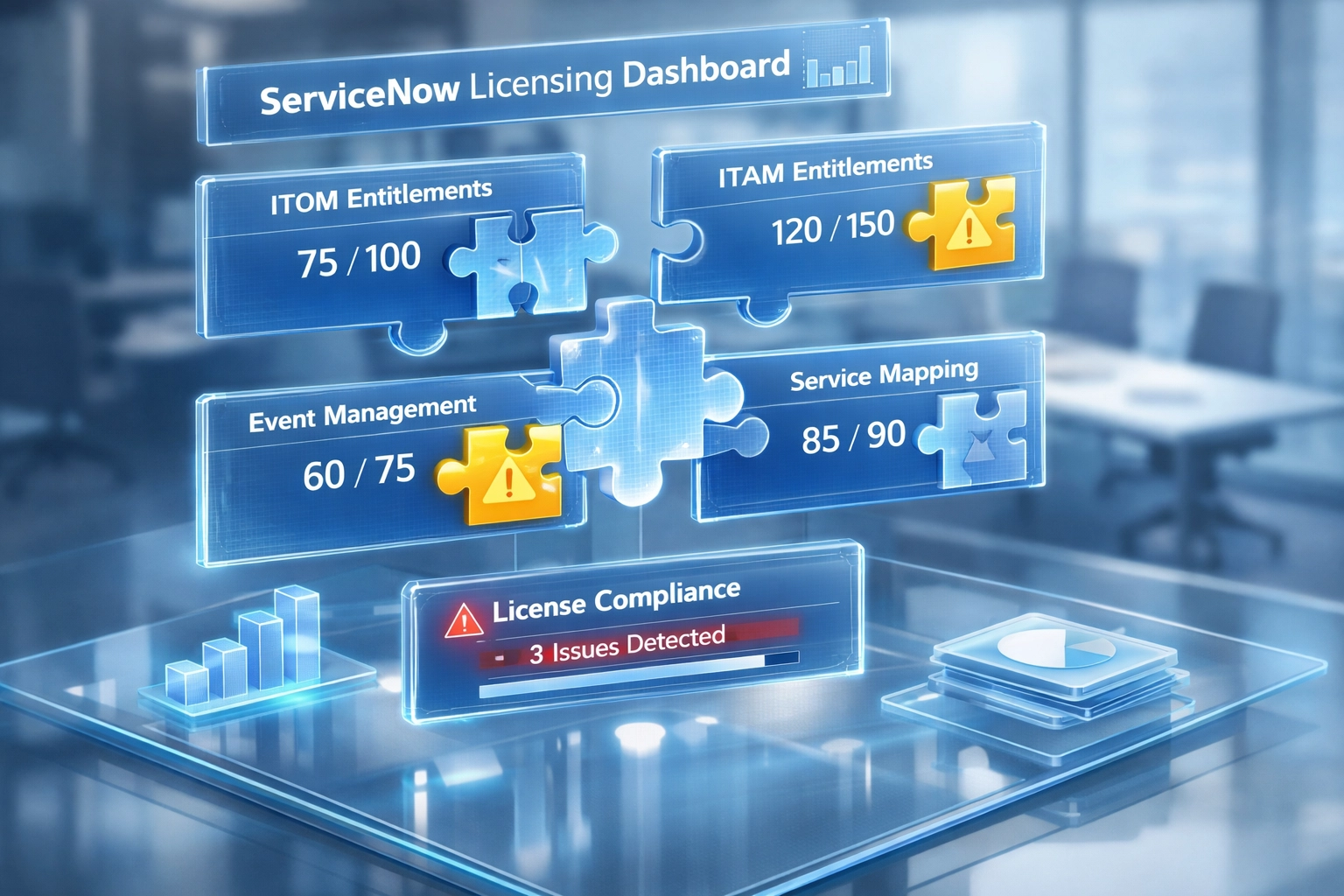
Mistake #5: Licensing Misalignment That Cripples Functionality
This mistake surfaces months into implementation when teams discover expected features aren't available due to licensing constraints they never confirmed. I call these "budget ambush moments": discovering that Service Mapping, Event Management correlation, AIOps capabilities, or Health Level Aggregation require separate entitlements that weren't budgeted.
The compounding cost is brutal. Organizations either operate with degraded functionality (losing the ROI they projected) or scramble to purchase additional licensing mid-project (destroying budget projections and timeline commitments). Either scenario represents failure.
The Fix: Map all required entitlements before design completion. Your requirements should explicitly list Discovery scope, Event Management needs, AIOps use cases, Service Mapping depth, and Digital Employee Experience monitoring. Work with your ServiceNow implementation partner to validate licensing against your technical architecture. Request a comprehensive entitlement audit that includes ITOM, ITAM, and any adjacent platform capabilities you'll leverage.

The $2M+ Reality: How These Mistakes Compound
Here's what I've learned analyzing dozens of ITOM implementations: these mistakes don't occur in isolation. They compound. Poor MID placement feeds CMDB inaccuracy. Weak identification rules undermine automation. Alert noise overwhelms teams already struggling with performance issues. Licensing gaps prevent teams from implementing the solutions they desperately need.
The cumulative financial impact breaks down as follows:
Operational inefficiency: 18-25% increase in MTTR translates to $450K-$680K annually in lost productivity for a 2,000-employee organization
Platform remediation: Emergency optimization and rework averages $280K-$420K per major incident
Licensing waste: Unused or incorrectly scoped licensing represents $340K-$580K in sunk costs
Lost automation ROI: Failed ITOM deployments forfeit $520K-$840K in projected efficiency gains
Total conservative estimate: $1.59M to $2.52M per failed implementation.
Your Next Step: Free 2026 ServiceNow ROI & License Audit
If you're planning ITOM deployment or struggling with an existing implementation, I strongly encourage you to take action before these mistakes compound further. SnowGeek Solutions offers a comprehensive Free 2026 ServiceNow ROI & License Audit designed specifically for organizations navigating ITOM complexity.
During this audit, our team will:
✓ Evaluate your current ITOM architecture against Washington DC release best practices ✓ Identify licensing gaps and optimization opportunities ✓ Benchmark your CMDB health against industry standards ✓ Assess MID server placement and discovery configuration ✓ Calculate your projected vs. actual ROI with detailed variance analysis
This isn't generic consulting: it's specialized expertise from a ServiceNow implementation partner that lives and breathes ITOM excellence. Visit the SnowGeek Solutions contact page to share your project details and schedule your audit.
Additionally, I recommend registering with SnowGeek Solutions for platform updates and expert insights. Our team publishes weekly technical guidance on ITOM optimization, ITAM integration, and emerging ServiceNow capabilities that can transform your operations.
The Bottom Line
ITOM mistakes are preventable, but only with proper planning, experienced guidance, and architectural rigor from the start. The organizations achieving exceptional ROI from ServiceNow: those reducing operational costs by 40%+ while improving service quality: share one characteristic: they partnered with ServiceNow consulting services that understood these pitfalls and engineered around them proactively.
Don't let your organization become another cautionary tale of preventable ITOM failure. The path to operational excellence starts with recognizing these mistakes and taking decisive action to avoid them. Your infrastructure, your team, and your budget will thank you.
Comments