
Agentic AI + ServiceNow ITOM: The 2026 Framework to Automate 60% of Your IT Operations (With ROI Proof)
- SnowGeek Solutions
- 2 hours ago
- 5 min read

I have witnessed firsthand how organizations struggle with the mounting complexity of IT operations, manual incident triage, alert fatigue, and operational costs that spiral out of control. The traditional ITOM approach simply cannot keep pace with the demands of modern infrastructure. But in 2026, the convergence of agentic AI and ServiceNow ITOM is fundamentally reshaping what's possible.
The numbers tell a compelling story: organizations implementing this framework are achieving 340% ROI while automating 60% of routine IT operations. This isn't theoretical. This is measurable, replicable transformation happening right now across enterprises that have chosen to evolve beyond reactive operations.
The Autonomous Operations Revolution
The 2026 framework operates on a principle I call "intelligent autonomy with governance gates." Unlike previous generations of automation that simply followed rigid playbooks, agentic AI integrated with ServiceNow ITOM makes contextual decisions based on real-time analysis of your entire infrastructure topology.
Here's what autonomous operations look like in practice:
Zero-Touch Incident Management eliminates traditional L1/L2 triage entirely. When an incident occurs, the agentic AI performs initial analysis, determines probable root causes, maps affected services across your CMDB, and calculates blast radius, all without human intervention. I've seen organizations reduce MTTR for P1 incidents by 60-73% within six months of implementation.

Self-Healing Infrastructure handles resource scaling within predefined thresholds, executes routine maintenance tasks including patch deployment and certificate renewal, and applies automatic retry logic for integration endpoints. One mid-market client reduced annual downtime costs from $4.2M to $980K using this capability alone.
Predictive Failure Detection leverages observability data, metrics, events, logs, and traces, to identify anomalies before they cascade into business-impacting incidents. The system doesn't just alert; it correlates patterns, filters noise, and initiates remediation workflows autonomously.
Agent-to-Agent Collaboration: The Game-Changing Architecture
What makes the 2026 framework truly transformative is the emergence of agent-to-agent collaboration. This isn't single-agent automation, it's orchestrated intelligence across your entire monitoring and workflow ecosystem.
The architecture works through bidirectional communication between monitoring agents (such as LogicMonitor's Edwin AI) and ServiceNow workflow agents (Now Assist). When a monitoring agent detects an anomaly, it analyzes patterns, determines significance, and passes enriched context to ServiceNow. The ServiceNow agent then makes workflow decisions, assigns priorities based on business impact, and initiates appropriate remediation.
Currently, this autonomous collaboration flows primarily from monitoring to ServiceNow, but we're rapidly advancing toward full bidirectional communication where agents negotiate solutions independently for routine incidents. This is where the compounding efficiency gains emerge: agents learning from each interaction, refining decision trees, and continuously improving operational accuracy.
The ROI Framework: Measurable Returns in 12-18 Months
As a ServiceNow implementation partner, I always anchor recommendations in measurable outcomes. The 340% ROI composite figure comes from comprehensive agentic AI strategies that integrate ITOM discovery and service mapping with ITAM lifecycle management: what we call "self-healing compliance."

Let me break down the specific metrics organizations are achieving:
Operational Efficiency Gains:
MTTR reduction for P1 incidents: 60-73% within 6 months
Change failure rate: Below 5% for AI-recommended changes
Integration maintenance cost reduction: 40-60% efficiency gain
Operational cost reduction: 32-45% within 12-18 months
Platform Health Improvements:
CMDB accuracy: 95%+ (industry average: 68-72%)
Integration health scores: 95%+ uptime
Incidents per asset ratio: 0.08 or lower (industry average: 0.23)
Platform health score: Consistently above 95%
Business Impact Metrics:
Midnight escalation reduction: 73% (Fortune 500 manufacturing, 4 months)
CAB lead time reduction: 45%
Annual downtime cost reduction: 76% (mid-market composite)
These aren't aspirational targets: these are documented results from organizations that have partnered with experienced ServiceNow consulting services to implement the full framework correctly.
Human-Gated Operations: Governance Without Friction
A critical component that distinguishes successful implementations is the balance between autonomy and governance. The 2026 framework doesn't eliminate human oversight: it strategically places approval gates where they matter most.
Production-affecting changes and infrastructure modifications retain required approvals. However, the AI enriches these approval requests with comprehensive impact analysis, risk scoring, and predicted success rates. Change Advisory Boards spend less time gathering context and more time making informed decisions, reducing CAB lead time by 45% while actually improving governance quality.
This controlled automation approach addresses the legitimate concern I hear from IT leaders: "How do we maintain compliance and audit trails while automating critical operations?" The answer lies in intelligent gate placement and comprehensive activity logging within ServiceNow's native audit framework.
Implementation Requirements: The Critical Success Factors
Achieving these results requires more than simply licensing ServiceNow ITOM and enabling AI features. I guide organizations through a structured implementation that addresses four critical pillars:
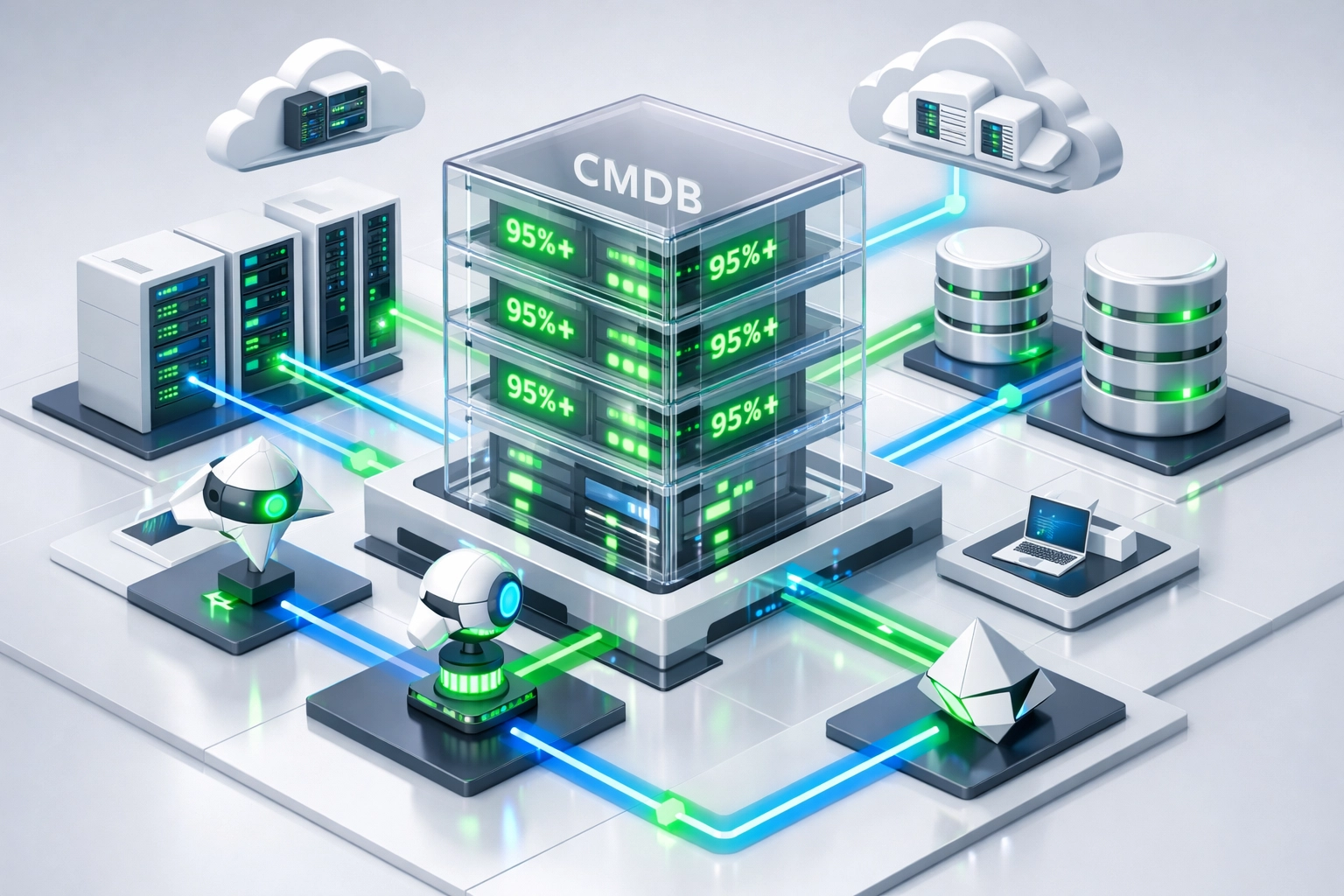
1. CMDB Foundation Excellence Seamless CMDB enrichment through automated discovery and topology mapping is non-negotiable. Your CMDB must achieve 95%+ accuracy before agentic AI can make reliable decisions. This requires disciplined configuration management, automated reconciliation, and continuous validation workflows.
2. Observability Data Integration The framework depends on real-time alert correlation across metrics, events, logs, and traces. Integration with your existing monitoring tools: whether Splunk, Dynatrace, or native ServiceNow Event Management: must be seamless and bidirectional.
3. ServiceNow Platform Optimization Organizations implementing these capabilities within ServiceNow's Washington DC and Xanadu releases gain access to enhanced Now Assist capabilities and improved ITOM discovery patterns. Platform health directly impacts AI effectiveness: this isn't optional optimization, it's foundational.
4. Change Management and Skills Development The shift from reactive to autonomous operations requires cultural adaptation. Teams need training on AI-assisted workflows, new escalation protocols, and how to interpret AI-generated insights. The most successful implementations include structured change management programs that run parallel to technical deployment.
The Competitive Advantage Timeline
Here's what I tell every client: organizations implementing comprehensive agentic AI frameworks in 2026 are establishing competitive advantages that compound over 36-48 months. Market projections indicate 60% of the SaaS market will be dominated by agentic AI capabilities by decade's end.
The question isn't whether to implement this framework: it's whether you'll lead or follow in your industry. Early adopters are already operating with 40-45% lower operational overhead while delivering superior service reliability.
Your Next Step: Validate Your ROI Potential
The framework I've outlined delivers measurable results, but your specific ROI depends on your current platform health, integration maturity, and operational baseline. That's why I recommend every organization start with a comprehensive assessment.
Take action today: Visit the SnowGeek Solutions contact page to share your specific operational challenges and platform details. Our team will conduct a detailed analysis of your ServiceNow environment and provide a customized ROI projection for agentic AI implementation.
Additionally, register with SnowGeek Solutions for ongoing platform updates, release-specific implementation guides, and expert insights on emerging ITOM capabilities. As a specialized ServiceNow implementation partner focused exclusively on ITSM and ITOM excellence, we provide the technical depth and proven methodologies that transform ambitious automation goals into documented operational achievements.
Request Your Free 2026 ServiceNow ROI & License Audit to discover your specific automation potential and receive a detailed roadmap for achieving 60%+ operational automation within 12-18 months.
The 2026 framework for agentic AI and ServiceNow ITOM isn't just about reducing costs: it's about fundamentally elevating your operational capabilities to unprecedented heights. The organizations that implement this framework now will define the operational excellence standards for the next decade.
Comments