
7 Mistakes You're Making with ServiceNow ITOM (And How a Free 2026 Audit Fixes Them Before Q3)
- SnowGeek Solutions
- Feb 21
- 5 min read

I've witnessed firsthand how organizations burn through millions in ServiceNow investments while making the same seven preventable ITOM mistakes. What's worse? These errors compound exponentially, sabotaging ROI before your teams even realize what's happening.
With Q3 2026 approaching fast and regulatory pressure mounting through DORA compliance and ESG reporting mandates, you cannot afford to let these mistakes calcify into technical debt. Here's what's quietly destroying your ServiceNow ITOM implementation: and how a comprehensive audit fixes it before it's too late.
Mistake #1: Accepting Mediocre CMDB Data Quality
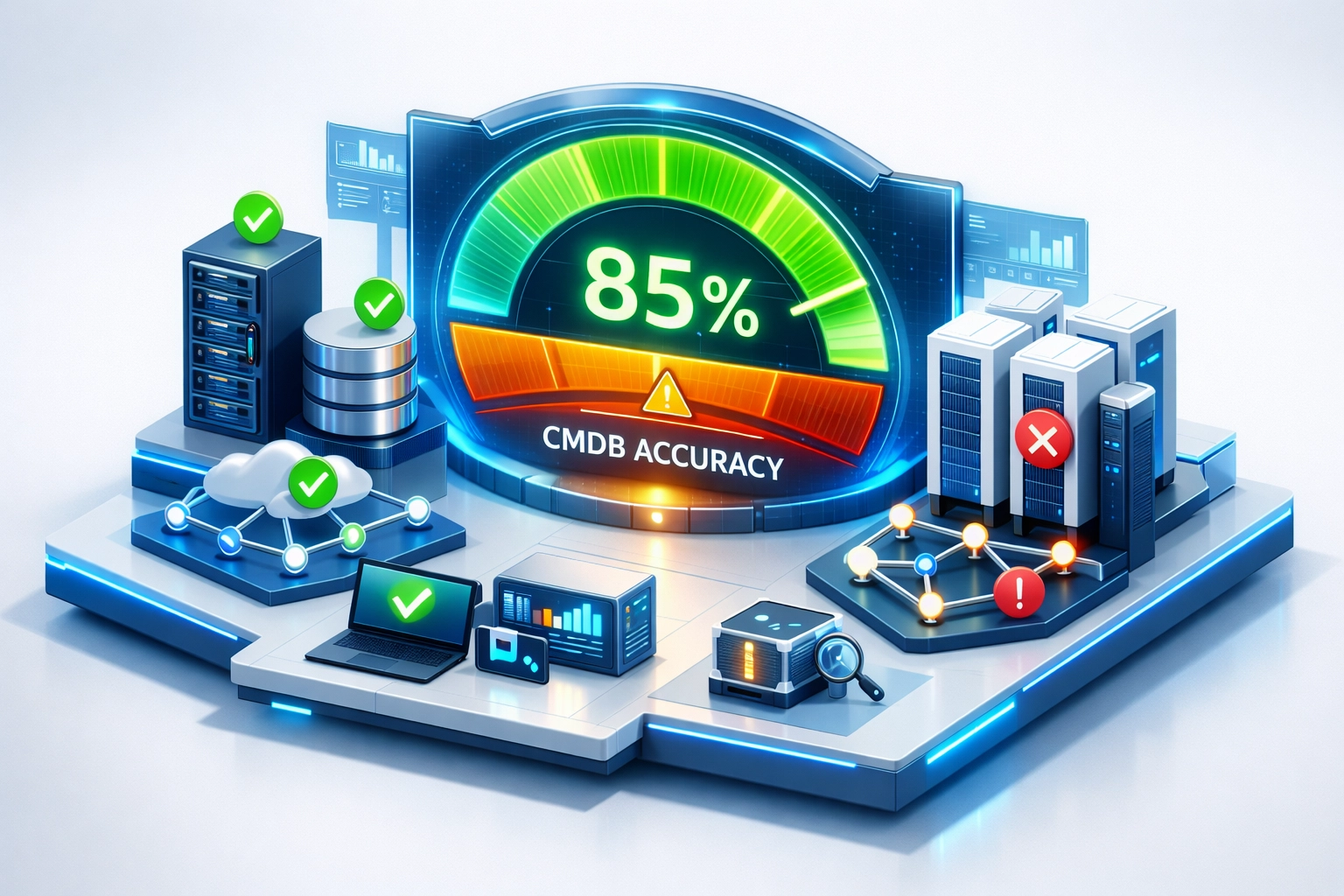
Your CMDB accuracy sitting at 60-75%? You're operating in what I call the "catastrophic zone" for AI-driven automation.
I have seen organizations confidently deploy predictive AI capabilities on the Washington release, only to watch them systematically fail because their foundational data quality falls below the critical 85% accuracy threshold. At 70% accuracy, your incident management creates cascading failures, your change management operates on incomplete information, and your asset tracking becomes educated guesswork.
The threshold for genuine transformation isn't negotiable: you need above 85% CMDB accuracy to unlock ServiceNow's full potential. This demands proper implementation of Discovery patterns paired with automated validation rules that continuously verify configuration item integrity.
Mistake #2: Ignoring Discovery Scope Limitations
This mistake creates what I call "phantom confidence": believing you understand your infrastructure based on partial data while making critical decisions completely blind.
Many organizations deploy Discovery with incomplete credential coverage, leaving 40-60% of their actual IT estate invisible. You're running Discovery scans, generating reports, and making million-dollar infrastructure decisions based on data representing barely half your environment.
I recommend conducting a comprehensive scope assessment that maps credential coverage against your complete IT estate. Pair this with Service Mapping deployment to reveal true application dependencies. Without this visibility, every change becomes a risk, and every incident investigation starts from scratch.
Mistake #3: Treating ITOM and ITAM as Separate Domains
Operating these disciplines in silos costs you significantly more than you realize.
Organizations achieving proper ITOM-ITAM integration reach First Call Resolution rates of 91%, compared to just 68% without integration. That 23-percentage-point gap translates to $400K-$800K in annual ROI improvements for mid-market enterprises alone.
Siloed approaches also cause:
Broken dependency tracking between assets and services
MTTR increases of 35-50% due to incomplete asset context
Infrastructure budget waste of 20-30% through over-provisioning and duplicate purchases
Your ServiceNow implementation partner should architect ITOM and ITAM integration from day one, not retrofit it after deployment. This integration becomes the foundation for Change Intelligence capabilities in the Washington release, enabling predictive risk scoring that actually works.
Mistake #4: Retrofitting Compliance Instead of Architecting It
With 2026 bringing unprecedented regulatory pressure, bolting compliance frameworks onto existing implementations fails spectacularly.
DORA's operational resilience requirements specifically demand accurate ICT asset inventories and ICT-related function identification: impossible with duplicate CIs or poor data quality. GDPR enforcement continues tightening around data sovereignty, and ESG reporting mandates require granular tracking of IT environmental impact.
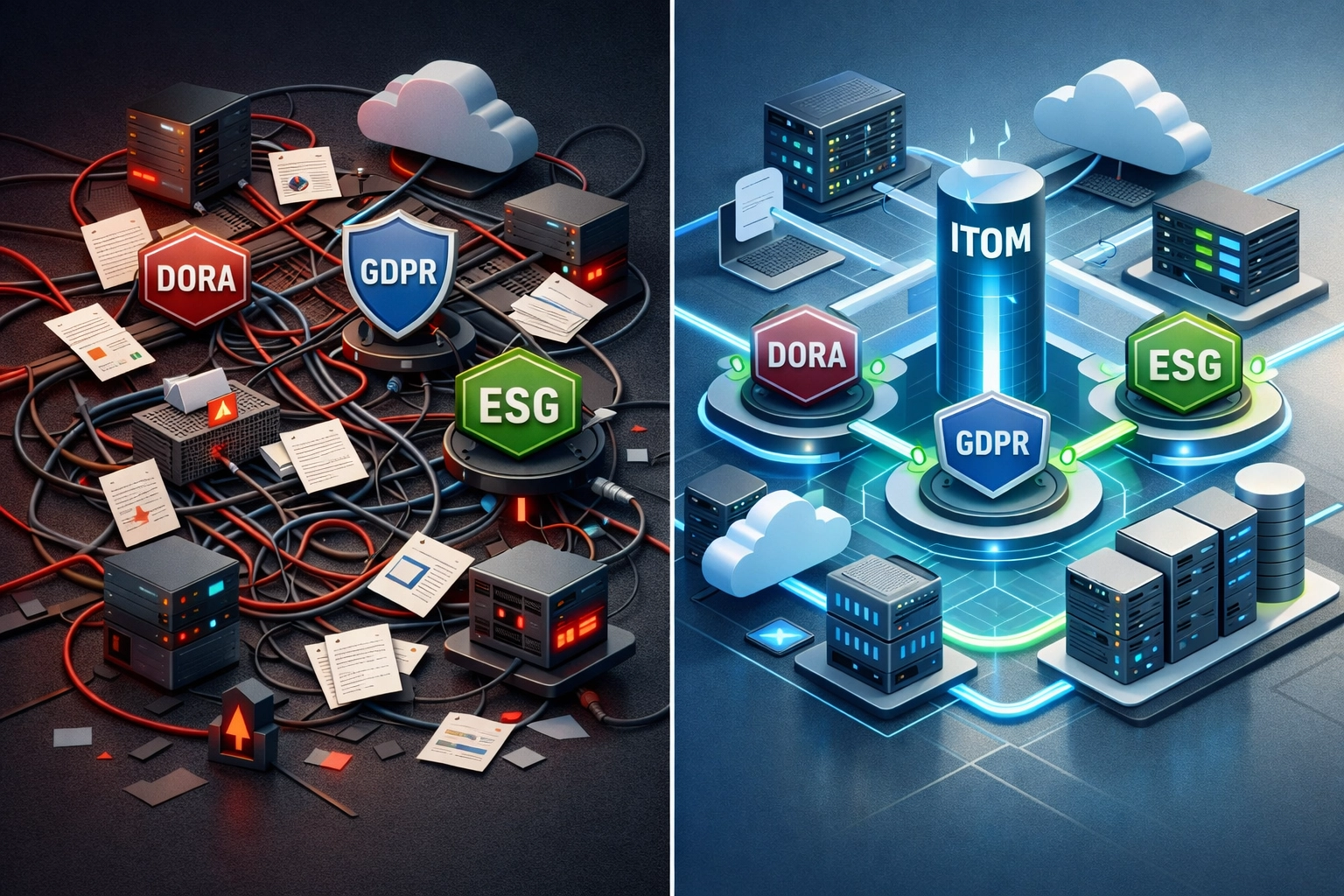
I've guided organizations through compliance architecture, and the difference is transformative. When you architect compliance into your ITOM foundation from the start, reporting becomes automated, audit trails exist natively, and regulatory changes require configuration updates instead of costly redesigns.
Retrofitting compliance after implementation? Expect 60-80% more ongoing maintenance costs and remediation budgets between $150,000-$400,000 when regulatory requirements change.
Mistake #5: Underutilizing Service Mapping for Dependency Management
Deploying Discovery without properly implementing Service Mapping leaves you blind to critical application dependencies.
Without understanding how configuration items relate to business services, your change impact analysis becomes guesswork. Your teams ask, "If we patch this database server, which business services go down?" And nobody can answer with confidence.
Service Mapping elevates ITOM from infrastructure monitoring ("what servers exist") to business service management ("which infrastructure components support which critical business processes"). This visibility is non-negotiable for achieving the Change Success Rates above 95% that best-in-class organizations maintain.
ServiceNow consulting services should prioritize Service Mapping deployment alongside Discovery: not as a phase two add-on, but as a fundamental component of your ITOM architecture.
Mistake #6: Overlapping Discovery Schedules and MID Placement Issues
Multiple discovery processes targeting identical network segments simultaneously cause MID server CPU utilization spikes of 200-300%, generating discovery timeouts and conflicting CMDB updates that undermine data integrity.
Wrong MID placement creates equally serious problems. I recently worked with an organization running a single MID server in their data center, scanning cloud VMs via VPN. Discovery took hours, timeout rates exceeded 40%, and data freshness made the CMDB practically useless for real-time decision-making.
After placing MIDs per network zone: one for on-premises infrastructure, dedicated MIDs for AWS and Azure environments, and proper scheduling to eliminate overlaps: their discovery completion rates improved from 58% to 97%, and scan times dropped by 73%.

Mistake #7: Modifying Out-of-the-Box Discovery Patterns
Directly customizing ServiceNow's standard Discovery patterns blocks platform upgrades and security patches for years.
Organizations making this mistake spend 60-80% more on platform maintenance annually. When they're eventually forced to upgrade for security reasons or to access critical new capabilities, remediation costs range from $150,000 to $400,000 just to unwind the customizations.
I advocate an "out-of-the-box first" philosophy. Leverage native Service Mapping and Discovery capabilities, use configuration over customization, and extend functionality through Update Sets that preserve upgradeability. This approach prevents technical debt while maintaining access to innovation in every ServiceNow release.
What a Free 2026 ROI & License Audit Reveals
A comprehensive audit I conduct measures exactly where your ITOM implementation stands and quantifies the ROI impact of addressing these mistakes:
CMDB Accuracy & Data Quality Metrics – Comparing your configuration data against infrastructure reality, identifying discrepancy patterns and remediation priorities
Discovery Scope Completeness – Mapping credential coverage, identifying blind spots, and calculating the percentage of your IT estate actually under management
ITOM-ITAM Integration Maturity – Quantifying the ROI differential between your siloed current state and fully integrated target state
Compliance Readiness Assessment – Evaluating DORA operational resilience capabilities, GDPR data sovereignty controls, and ESG tracking readiness against 2026 requirements
Service Mapping Deployment Analysis – Measuring business service visibility, dependency mapping completeness, and change impact analysis effectiveness
Change Management Effectiveness – Benchmarking your Change Success Rate against industry standards and assessing risk scoring maturity
Overall Architectural Soundness – Identifying technical debt accumulation, customization risks, and upgrade readiness
Organizations addressing these mistakes before Q3 position themselves to leverage Change Intelligence capabilities from the Washington release: predictive risk scoring, automated impact analysis, and AI-driven change recommendations. But these capabilities only deliver value when your CMDB accuracy and Service Mapping foundations are solid.
Your Next Step Toward ITOM Excellence
The difference between organizations struggling with ServiceNow ITOM and those achieving operational excellence isn't budget or team size: it's strategic execution guided by expertise.
As a dedicated ServiceNow implementation partner, I invite you to visit the SnowGeek Solutions contact page at https://www.snowgeeksolutions.com to share your project details and schedule your Free 2026 ServiceNow ROI & License Audit. This comprehensive assessment reveals exactly which of these seven mistakes are impacting your environment and provides a prioritized remediation roadmap with quantified ROI projections.
Additionally, register with SnowGeek Solutions for platform updates and expert insights that keep you ahead of ServiceNow releases, regulatory changes, and ITOM best practices. You'll receive actionable guidance on maximizing your investment while avoiding the costly mistakes that derail implementations.
The organizations that thrive in 2026 won't be the ones with the biggest ServiceNow deployments: they'll be the ones with the soundest ITOM architecture, the cleanest data, and the strategic foresight to fix problems before they become entrenched technical debt.
Don't let these seven mistakes sabotage your ROI. Let's fix them together before Q3.
Comments