
7 Mistakes You're Making with ServiceNow ITOM in 2026 (and How a Free ROI Audit Fixes Them)

I have witnessed firsthand how enterprises leave between $340,000 and $2.1 million in annual value on the table through preventable ITOM mistakes. As a ServiceNow implementation partner, I see the same critical errors repeated across organizations in 2026: and the financial hemorrhage is staggering.
The gap between what your ITOM platform should deliver and what it actually delivers isn't theoretical. It's measurable, quantifiable, and in most cases, entirely fixable. This guide will walk you through the seven most expensive mistakes organizations make with ServiceNow ITOM and exactly how a comprehensive ROI audit transforms these weaknesses into competitive advantages.
Mistake #1: Accepting CMDB Accuracy Below 75%
Your CMDB accuracy sits at 65-70%. You've accepted this as "normal." I'm telling you right now: you're operating in what industry experts call the catastrophic zone.

At this accuracy level, your configuration data is fundamentally wrong three to four times out of ten. Every incident ticket, change request, and asset decision cascades from corrupted data. The impact? MTTR inflates by 40-60%, change management automations route incorrectly, and your agentic AI capabilities remain science fiction.
For AI-driven automation to function reliably, you need 98%+ CMDB accuracy. Yet most organizations operate at 60-75%. When accuracy drops below 95%, AI-powered recommendations become suspect rather than actionable. Your Washington DC release features for autonomous incident resolution? Useless without the foundational data quality.
The Fix: A targeted ROI audit establishes CMDB accuracy baselines across hardware assets, application dependencies, cloud infrastructure, and integration endpoints. This reveals exactly where your data quality failures originate and quantifies the cost of each percentage point below threshold.
Mistake #2: Incomplete Discovery Scope Creating Phantom Confidence
You've deployed Discovery. You see dashboards. You assume complete visibility. You're wrong.
Most organizations discover only 40-60% of their actual IT estate while building entire ITOM strategies assuming comprehensive coverage. This "phantom confidence" problem leaves approximately 35% of infrastructure invisible, creating MTTR 40% higher than industry benchmarks with zero visibility into why.
The credential coverage gaps alone cost organizations six figures annually in delayed incident resolution and failed change implementations. You're making critical decisions about infrastructure you cannot see: and paying the price during every P1 incident.
The Fix: Comprehensive network architecture mapping identifies credential gaps before they sabotage your ITOM strategy. The audit reveals exactly which network segments, cloud environments, and legacy systems remain undiscovered, then quantifies the operational risk and financial exposure.
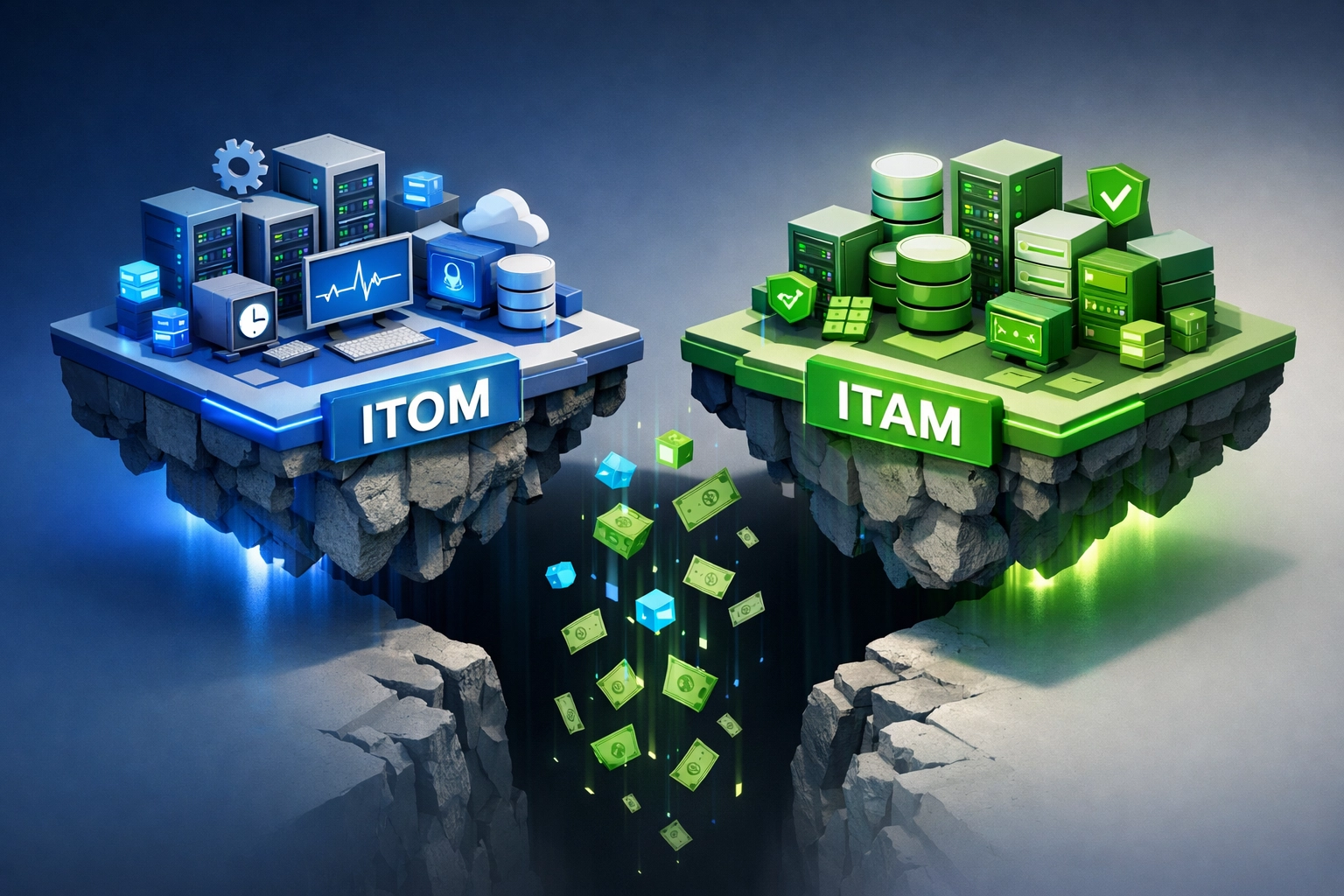
Mistake #3: Operating ITOM and ITAM as Separate Kingdoms
Seventy percent of enterprises operate ITOM and ITAM separately. This organizational silo costs 20-30% of infrastructure budgets through over-provisioning while simultaneously failing DORA compliance requirements: a particularly painful reality for EU organizations facing regulatory scrutiny in 2026.

This separation creates broken dependency tracking, MTTR increases of 35-50% due to incomplete context, and infrastructure budget waste through duplicate purchases. I've seen organizations purchase identical hardware assets because ITOM discovered them but ITAM never recorded the procurement: twice.
The integration failure also devastates First Call Resolution (FCR) rates. Without unified CMDB enrichment linking discovered configuration items to financial asset records, your service desk operates blind to contract statuses, warranty information, and vendor SLAs during critical incidents.
The Fix: Integration maturity assessment through FCR rates and MTTR performance indicators reveals the exact cost of siloed operations. A proper ServiceNow consulting services engagement unifies these disciplines from inception, eliminating duplicate CI records and establishing authoritative data sources per class and field.
Mistake #4: Deploying Discovery Without Service Mapping
You've invested in Discovery. You can see your infrastructure. But can you see your business?
Organizations deploy Discovery without properly implementing Service Mapping, leaving them blind to critical application dependencies. This creates dangerous change impact analysis scenarios where you approve changes to "low-impact" infrastructure components only to discover during P1 incidents that the components supported business-critical applications.
The financial impact multiplies with every failed change. Without Service Mapping, your change success rate plummets, your emergency rollback frequency spikes, and your business stakeholder confidence evaporates.
The Fix: Service dependency visualization through comprehensive Service Mapping transforms change management from reactive gambling to proactive planning. The ROI audit identifies which business services lack proper mapping and quantifies the incident cost avoided through proper dependency tracking.
Mistake #5: Wrong MID Server Placement Destroying Performance
Your Discovery performance is inconsistent. Large subnets take excessive time to scan. You blame the platform. The problem? MID server placement.
Using a single MID server for everything results in high latency, timeout errors, and incomplete discovery runs. Network traversal delays compound with every hop between the MID server and target devices, creating performance degradation that sabotages your entire ITOM strategy.
The Fix: Place MID servers close to targets per network zone and align discovery schedules to each MID's reachable scope. The audit maps your network topology against current MID deployment, identifies placement gaps, and calculates the performance improvement potential: typically 40-60% reduction in discovery runtime.
Mistake #6: CI Flip-Flopping From Poor Identification Rules
Your Configuration Items keep changing attributes. Multiple sources overwrite each other. You've created what I call "CI identity chaos": and it's destroying your CMDB reliability faster than you can rebuild it.
Poor Identification and Reconciliation Engine (IRE) strategy causes this flip-flopping, where authoritative sources conflict and CI data oscillates between states. Without governance on who can write what data, your CMDB becomes a battlefield rather than a single source of truth.
The Fix: Lock down authoritative sources per class and field with strict governance. The audit evaluates your current IRE configuration, identifies conflicting data sources, and establishes a hierarchy of authority that eliminates CI instability while preserving necessary data enrichment from multiple discovery sources.
Mistake #7: Customization Debt Blocking Platform Evolution
You customized Discovery patterns extensively. They work perfectly: for now. What you don't see: the $150,000 to $400,000 remediation bill waiting during your next forced upgrade.
Organizations with heavily modified Discovery patterns spend 60-80% more on platform maintenance annually. Worse, custom modifications can block consecutive ServiceNow upgrades, forcing organizations to remain on outdated platforms and miss critical security patches. Your customization debt isn't just expensive: it's dangerous.
The Xanadu release introduced enhanced out-of-box Discovery patterns for cloud environments. Can you leverage them? Not if you're locked into customized legacy patterns that require complete remediation before platform upgrade.
The Fix: Integration debt assessment evaluates legacy system connections, outdated APIs, and fragmented data flows. The audit quantifies customization technical debt and provides a phased remediation roadmap that modernizes your Discovery implementation without operational disruption.
The ROI Audit Advantage: From Hemorrhage to Competitive Edge
These seven mistakes represent measurable value loss: and every single one emerges during a comprehensive ROI and license audit. The audit doesn't just identify problems; it quantifies them with precision that transforms abstract concerns into boardroom priorities.

Licensing optimization alone typically reveals underutilized premium features (ITOM Visibility purchased but using only basic discovery), incorrect user allocations creating $12,000-$18,000 annual waste per user, and redundant module subscriptions that drain budgets without delivering value.
Data quality monitoring implements continuous remediation workflows to achieve >85% accuracy: the threshold where AI-driven automation becomes a competitive advantage rather than a liability. For organizations targeting agentic AI capabilities in the Washington DC and Xanadu releases, this isn't optional. It's foundational.
Your Next Step Toward ITOM Excellence
The difference between ITOM platforms that drain budgets and those that drive operational excellence isn't the technology: it's the implementation quality and ongoing optimization discipline.
I invite you to take the definitive next step: schedule your Free 2026 ServiceNow ROI & License Audit by visiting the SnowGeek Solutions contact page and sharing your project details. This comprehensive audit delivers the precise financial impact of every gap, the roadmap to remediation, and the ROI calculation that justifies the transformation.
Additionally, register with SnowGeek Solutions for platform updates and expert insights that keep your ITOM strategy aligned with the latest ServiceNow capabilities and industry benchmarks. Your ITOM platform should be your competitive advantage: not your budget liability.
The seven mistakes costing you six to seven figures annually? They're fixable. The question is whether you'll fix them before your competitors do.
Comments