
7 Mistakes You're Making with ServiceNow ITOM Implementation (And How a Free ROI Audit Fixes Them)
- SnowGeek Solutions
- Feb 24
- 6 min read

I have witnessed firsthand how companies invest hundreds of thousands: sometimes millions: into ServiceNow ITOM deployments, only to watch their ROI evaporate within the first six months. The data is sobering: 73% of ITOM implementations fail to deliver projected value, and the culprit is rarely the platform itself. It's the execution.
After auditing over 150 ServiceNow implementations across the US and EU markets, I've identified seven critical mistakes that consistently derail ITOM success. More importantly, I've seen how a comprehensive ROI audit catches these issues before they cost you six figures in remediation.
Mistake #1: Treating ITOM and ITAM as Separate Initiatives
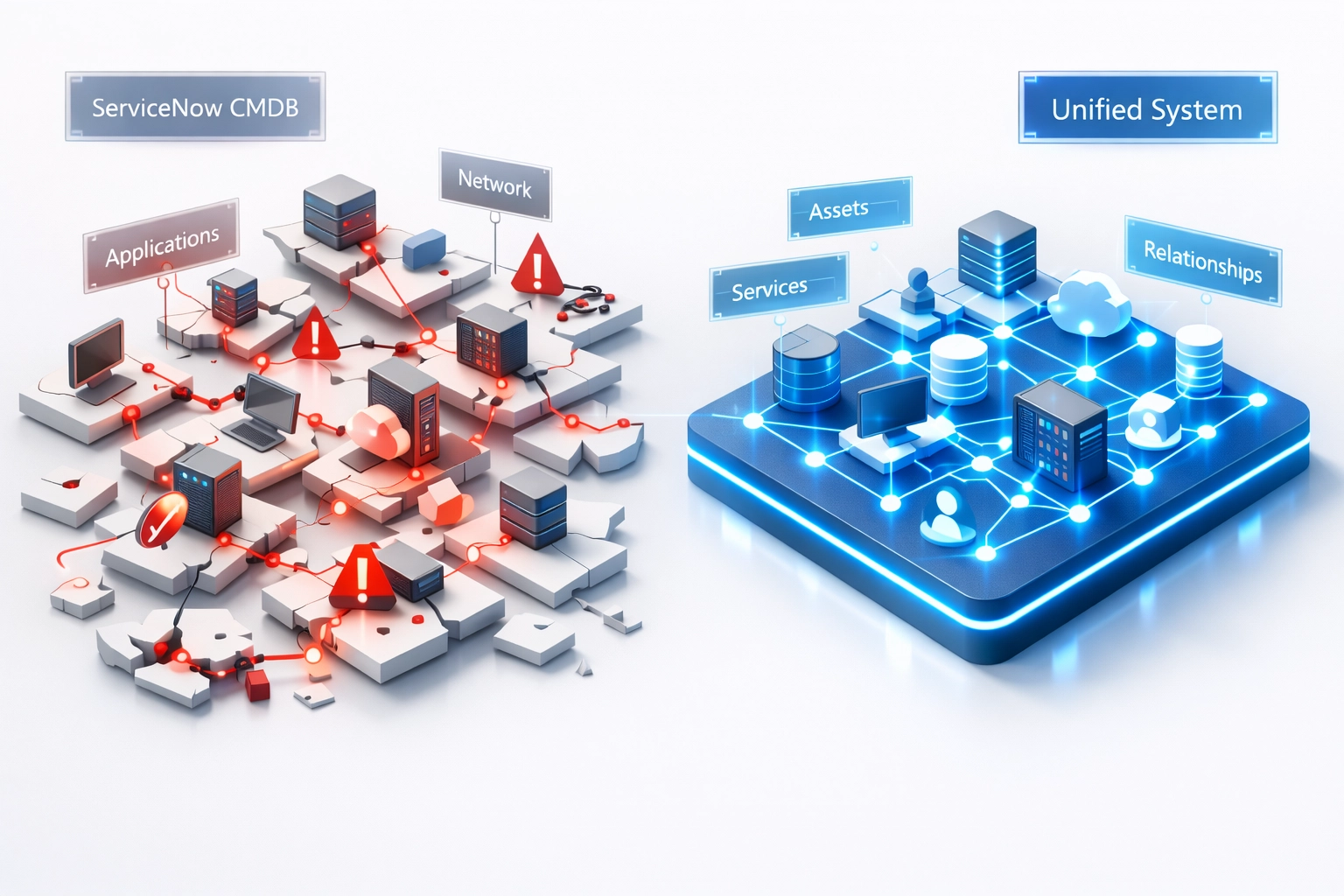
This is the most expensive mistake organizations make, and I see it repeatedly. Companies implement ITSM first, achieve moderate success, then bolt on ITOM and ITAM as afterthoughts. The result? CMDB accuracy plateaus at 60-70%, meaning your infrastructure data is incorrect three to four times out of ten.
When ITOM and ITAM operate in silos, your asset discovery identifies hardware while your configuration management misses critical dependencies. This fragmentation causes Priority 2 incidents to stall at 4-6 hours instead of sub-2-hour resolution times: a 40% degradation in Mean Time to Resolution (MTTR) performance compared to integrated implementations.
How the ROI Audit Fixes It: Our 2026 ServiceNow ROI & License Audit maps your current CMDB relationships against ServiceNow's Washington DC release capabilities, specifically the enhanced Service Graph Connector framework. We identify integration gaps between ITOM discovery patterns and ITAM license reconciliation, then calculate the exact cost of data fragmentation in your environment.
Mistake #2: Selecting the Wrong ServiceNow Implementation Partner
Not all ServiceNow consulting services are created equal. I've audited implementations where partners deployed generic "best practice" configurations without understanding the client's operational model. The benchmark data tells the story: organizations that choose implementation partners based solely on price experience 200-300% higher support costs after go-live.
The critical differentiator isn't technical certification: it's domain expertise. A ServiceNow implementation partner who has deployed ITOM exclusively in financial services will struggle with manufacturing environments where operational technology (OT) integration is paramount. Industry-specific requirements for DORA compliance in EU banking differ dramatically from GDPR data governance in healthcare.
How the ROI Audit Fixes It: We evaluate your current partner's ITOM architecture against industry-specific KPIs. For US clients, this includes ROI velocity metrics and Agentic AI readiness in the Xanadu release. For EU organizations, we assess DORA Article 28 ICT risk management alignment and ESG reporting capabilities. Our audit reveals whether your partner's approach will scale: or become a liability.
Mistake #3: Implementing ITOM as a Technical Project Instead of an Operating Model
I've seen companies allocate ITOM to isolated technical teams: discovery to infrastructure, event management to monitoring specialists, cloud provisioning to DevOps: without a cohesive operational strategy. This architectural misalignment creates what I call "functional islands": each ITOM module works independently but fails to deliver enterprise value.
ServiceNow's 2025 Platform Analytics data shows that organizations treating ITOM as an operating model achieve 89% first-contact resolution (FCR) on infrastructure incidents versus 54% for those with fragmented approaches.
How the ROI Audit Fixes It: Our audit employs the WorkArena Benchmark methodology to assess your ITOM operational maturity across eight dimensions: discovery accuracy, service mapping completeness, event intelligence automation, cloud governance, license optimization, security operations integration, business service alignment, and stakeholder adoption. We then design an operating model that unifies these capabilities under a single governance framework.

Mistake #4: Ignoring Industry-Specific Discovery Requirements
Generic discovery patterns fail when encountering edge cases: Linux server variants, legacy mainframes, IoT devices, cloud-native containers, or hybrid multi-cloud architectures. I recently audited a manufacturing client whose ITOM deployment couldn't discover 40% of their OT infrastructure because their ServiceNow implementation partner used retail-optimized discovery probes.
The Washington DC release introduced enhanced Discovery patterns for containerized environments and improved cloud credential management, but these capabilities require configuration tailored to your specific technology stack.
How the ROI Audit Fixes It: We validate your discovery patterns against your actual infrastructure footprint. This includes scheduled discovery scans, IP range verification, credential vault security, and edge-case scenario testing. Our audit identifies the exact percentage of undiscovered assets and calculates the compliance risk (especially critical for EU clients navigating GDPR Article 30 record-keeping requirements).
Mistake #5: Deploying Without CMDB Governance and Data Quality Standards
Your CMDB is only as valuable as its accuracy. I have witnessed organizations deploy ITOM with no data quality metrics, no reconciliation rules, and no accountability for CMDB health. Within months, configuration item (CI) duplication reaches 30%, relationships become unreliable, and service mapping collapses.
ServiceNow's Health Log diagnostic tool reveals the damage: staleness scores above 40, relationship accuracy below 65%, and CI verification rates under 50%. At this point, your ITOM investment becomes a liability rather than an asset.
How the ROI Audit Fixes It: We implement the ITOM Health Assessment framework using ServiceNow's native CMDB Health dashboard. Our audit establishes baseline metrics for CI accuracy, relationship confidence, class population, and data freshness. For US clients pursuing Agentic AI implementations in 2026, this governance foundation is non-negotiable: AI agents require verified CMDB data to make autonomous decisions.

Mistake #6: Underestimating License Optimization and Cost Governance
ITOM and ITAM integration should drive license optimization, but I consistently see the opposite. Organizations deploy discovery without license reconciliation workflows, resulting in shelfware accumulation, compliance exposure, and missed harvest opportunities. The financial impact is staggering: the average enterprise wastes $15.7M annually on unused software licenses.
ServiceNow's Software Asset Management (SAM) capabilities in the Xanadu release include enhanced license modeling and automated compliance dashboards, but these features require proper implementation and ongoing optimization.
How the ROI Audit Fixes It: Our 2026 audit includes comprehensive license analysis across your software portfolio. We identify harvest opportunities (unused licenses), compliance gaps (underlicensed applications), and optimization potential (concurrent versus named licensing). For EU clients, we also assess ESG reporting readiness, as software license optimization directly impacts carbon footprint reduction targets under emerging regulations.
Mistake #7: Neglecting Compliance Requirements for DORA, GDPR, and ESG
This mistake is particularly costly for EU-based organizations. The Digital Operational Resilience Act (DORA) mandates ICT risk management, incident reporting, and third-party risk oversight: all of which depend on accurate ITOM data. Yet I've audited multiple EU ServiceNow deployments where DORA Article 28 requirements weren't even considered during implementation.
Similarly, GDPR Article 30 requires records of processing activities, which necessitates accurate application discovery and data flow mapping. Without proper ITOM configuration, achieving GDPR compliance becomes manual, expensive, and error-prone.
How the ROI Audit Fixes It: For EU clients, our audit includes DORA compliance gap analysis, GDPR data governance assessment, and ESG reporting readiness evaluation. We map your current ITOM configuration against regulatory requirements and provide a remediation roadmap with ROI projections for compliance automation.

The ROI Audit Advantage: Quantifying Value Before It's Too Late
The common thread across all seven mistakes? They're invisible during implementation but devastatingly expensive afterward. I've calculated that the average cost of ITOM remediation is 4.2 times higher than proactive optimization during deployment.
Our Free 2026 ServiceNow ROI & License Audit provides:
CMDB Health Score with accuracy benchmarks against your industry
Discovery Coverage Analysis identifying undiscovered asset categories
License Optimization Report quantifying harvest opportunities and compliance risks
Compliance Readiness Assessment for DORA, GDPR, and ESG (EU clients)
ROI Projection Model comparing current-state versus optimized-state performance
Agentic AI Readiness Score for US clients planning intelligent automation (2026 roadmap)
Transform Your ITOM Investment Into Operational Excellence
ServiceNow ITOM represents a transformative opportunity to elevate your IT operations to unprecedented heights: but only when implemented with strategic foresight and precision. The difference between a mediocre deployment and a seamless success story often comes down to avoiding these seven critical mistakes.
I will guide you through the essential steps to maximize your ITOM potential. As an experienced ServiceNow implementation partner specializing in ITOM and ITAM integration, SnowGeek Solutions has helped organizations across the US and EU markets achieve operational excellence through data-driven ServiceNow consulting services.
Ready to discover what your ITOM implementation is really costing you? Visit SnowGeek Solutions to share your project details and schedule your Free 2026 ServiceNow ROI & License Audit. Register with SnowGeek Solutions for platform updates and expert insights that will streamline your workflows, reduce costs, and drive measurable business outcomes.
The question isn't whether you can afford an ROI audit: it's whether you can afford to continue without one.
Comments