
7 Mistakes You're Making with ServiceNow ITOM Implementation (and How a Free 2026 ROI Audit Fixes Them)
- SnowGeek Solutions
- Feb 23
- 6 min read

I've witnessed organizations pour millions into ServiceNow ITOM implementations only to watch their ROI projections crumble within 18 months. The culprit isn't the platform: it's seven preventable mistakes that compound quietly until your automation fails, your CMDB becomes unreliable, and your teams lose confidence in the entire system.
Here's what keeps me up at night: most organizations don't realize they're making these mistakes until they're already deep into technical debt. The good news? A comprehensive 2026 ROI audit identifies these issues before they derail your investment. Let me walk you through exactly what's going wrong and how to fix it.
Mistake #1: Operating in the CMDB "Catastrophic Zone"
Your CMDB accuracy sits at 68%. Your team calls it "good enough." I call it catastrophic.
Between 60-75% CMDB accuracy, you're in what I call the Catastrophic Zone: where automation becomes actively dangerous. Incident routing sends tickets to teams who haven't owned that application in two years. Change management misses critical dependencies because half your relationships aren't mapped. Asset reports confidently present phantom devices that haven't existed since 2023.

I have witnessed firsthand what happens when organizations push CMDB accuracy above the 85% threshold using enhanced Service Mapping and automated validation rules in the Washington DC release. It's transformative. AI-driven automation suddenly becomes reliable. Predictive insights become actionable. Your ServiceNow implementation partner should be obsessing over this number: if they're not, you're building on quicksand.
The fix demands rigorous automated reconciliation schedules, mandatory Service Mapping for Tier 1 applications, and scheduled CMDB health audits every quarter. Organizations that nail this see First Call Resolution rates jump from 68% to 91%: a $400K-$800K annual improvement for mid-market enterprises.
Mistake #2: Building Strategy on Phantom Confidence
Your Discovery coverage report shows 55%. Your leadership team believes you have complete infrastructure visibility. This disconnect is costing you.
I've seen entire ITOM strategies built on the assumption of complete visibility when Discovery has actually mapped less than half the environment. This mistake is particularly insidious because it masks itself: you don't know what you don't know until a Service Mapping initiative reveals massive blind spots in your application dependencies.
The Washington DC release enhanced Discovery patterns for cloud-native architectures, but only if you're actually using them. A 2026 ROI audit exposes these gaps immediately by comparing your Discovery scope against your actual infrastructure footprint and identifying undiscovered segments that represent compliance risks or automation gaps.
Mistake #3: Treating ITOM and ITAM as Divorced Domains
Your ITOM team and your ITAM team report to different directors. They use different data sources. They rarely coordinate. This organizational silo is bleeding ROI.
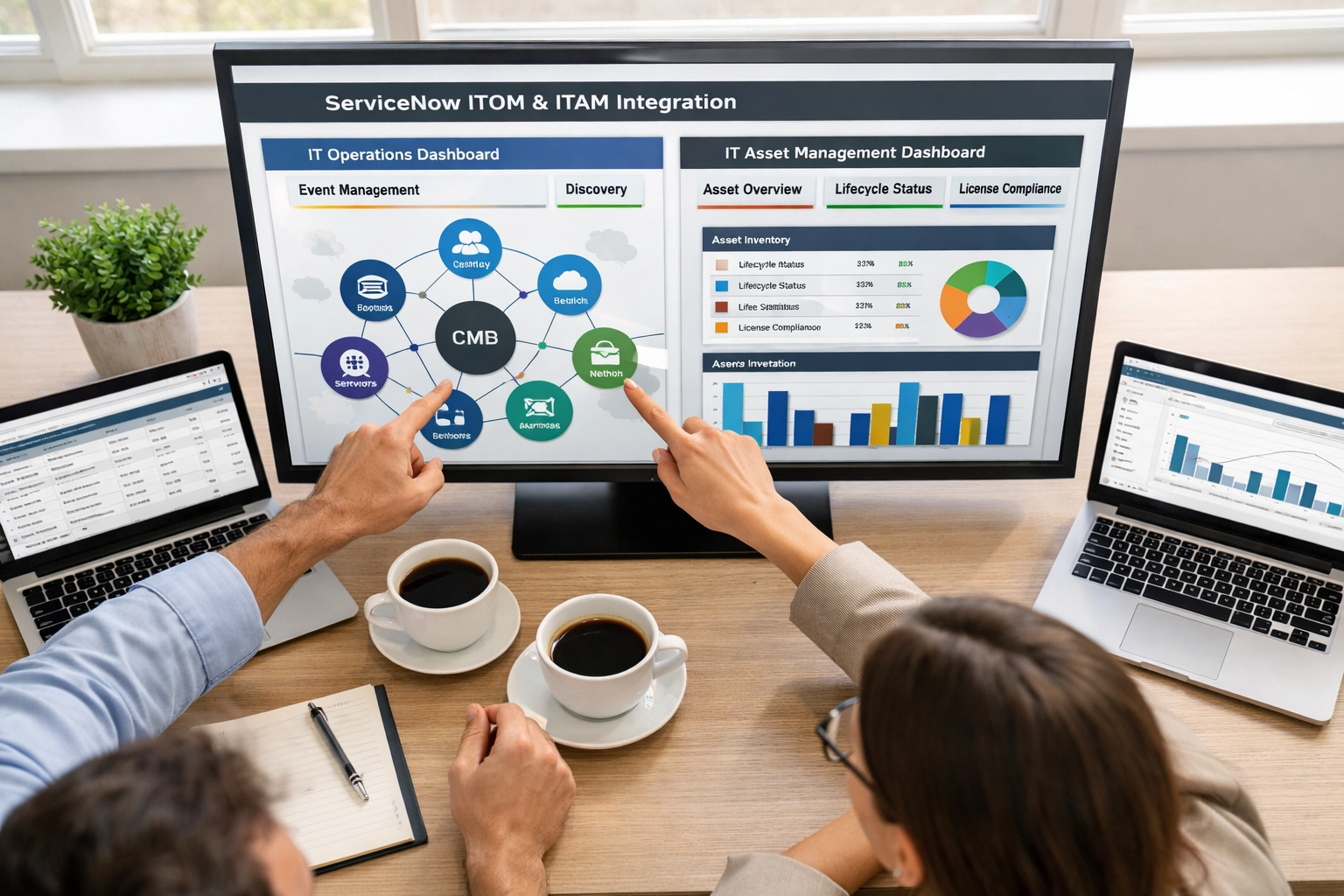
Organizations integrating ITOM and ITAM through proper CMDB architecture achieve 91% First Call Resolution compared to just 68% without integration. That's a 23-percentage-point difference that translates to unprecedented operational efficiency. When your service desk can see both the operational health metrics from ITOM and the contract details from ITAM in a single pane of glass, incident resolution accelerates dramatically.
The Xanadu release introduced enhanced Hardware Asset Management capabilities that naturally bridge ITOM and ITAM when properly configured. Your ServiceNow consulting services partner should architect this integration from day one, not retrofit it later when the technical debt makes it exponentially more expensive.
Mistake #4: Neglecting Change Management Architecture
You implemented Discovery and Service Mapping. Your CMDB looks beautiful. But you're still doing manual risk assessments for every change request because nobody connected ITOM to Change Management.
I have witnessed organizations automate 80% of change risk scoring by properly leveraging application dependency mapping from Service Mapping. Change Success Rates climb from the industry average of 85% to best-in-class levels exceeding 95%. Standard Changes become genuinely low-risk because you can prove minimal dependencies. Emergency Changes benefit from faster, more accurate impact analysis.
The architecture demands that Service Mapping data feeds directly into Change Management risk models. Without this integration, you're maintaining expensive infrastructure visibility that delivers minimal business value. A comprehensive ROI audit reveals exactly where these integration gaps exist and provides remediation roadmaps.
Mistake #5: Architectural Decisions That Create Technical Debt
Your well-intentioned team built custom Discovery patterns instead of waiting for out-of-the-box capabilities. They created parallel CMDB systems to accommodate edge cases. They customized core ITOM workflows to match legacy processes.
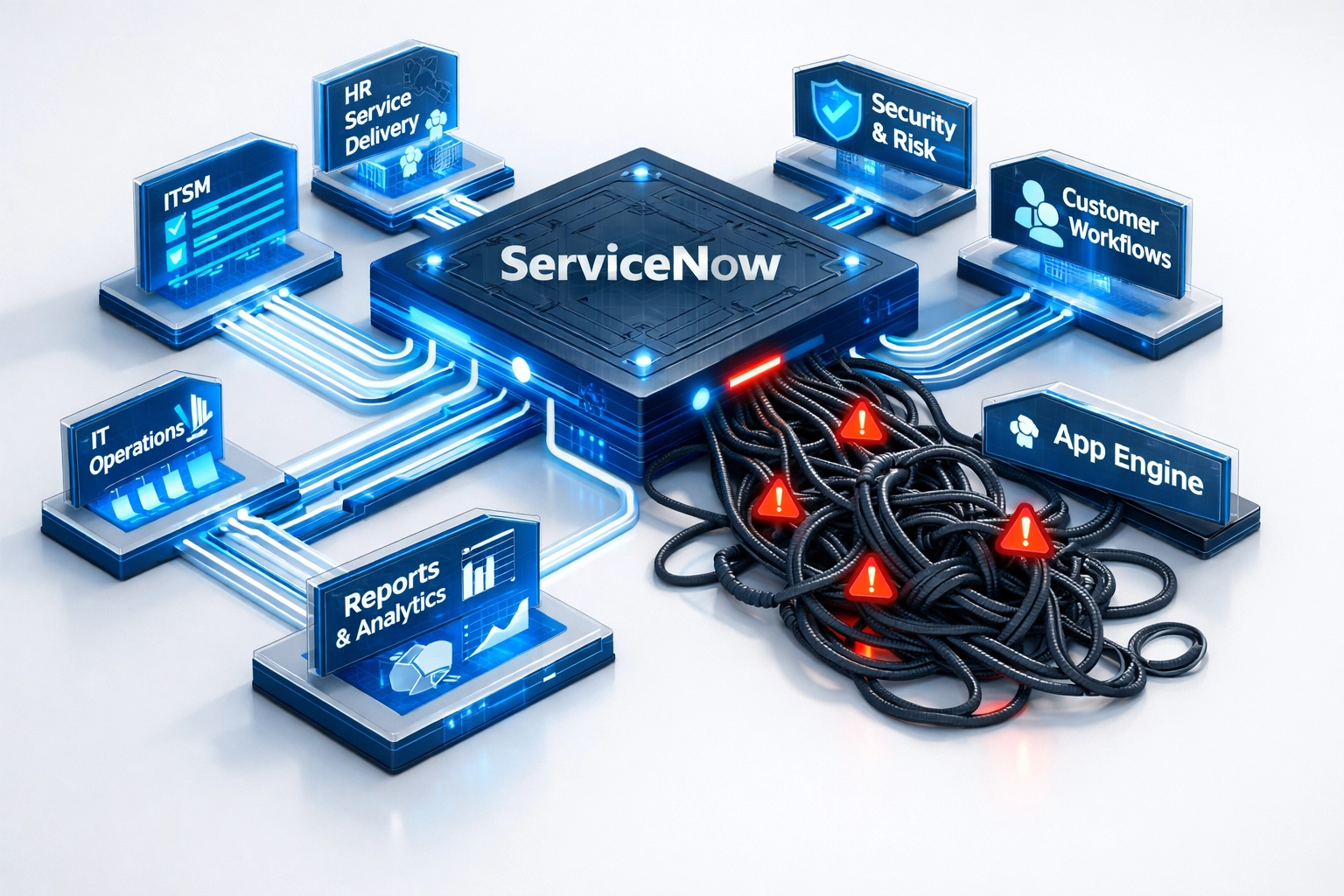
These decisions seemed practical at the time. Three years later, they're unmaintainable liabilities that block platform upgrades and exponentially increase consulting costs. I've guided organizations through technical debt remediation that cost 4x what it would have cost to architect correctly from the beginning.
The fix requires brutal honesty during platform health assessments. A 2026 ROI audit documents every customization against ServiceNow best practices, identifies which modifications deliver genuine business value versus which simply recreate legacy dysfunction, and provides clear migration paths to standard configurations where possible.
Mistake #6: Over-Customization Without Governance
Without governance frameworks, customizations multiply until your instance becomes a Frankenstein monster that even your original developers can't maintain.
I advocate for a simple rule: every customization requires documented business justification and technical alternatives analysis. Could configuration accomplish this? Could an IntegrationHub connector solve it? Do ServiceNow best practices already address this requirement? If the answers are no across the board, document the customization decision and commit to quarterly reviews.
Organizations that implement proper customization governance maintain upgrade compatibility, reduce long-term consulting costs, and preserve the ability to adopt new ServiceNow capabilities as they're released. Those without governance find themselves stuck on deprecated releases, unable to leverage Agentic AI features or modern automation capabilities.
Mistake #7: Failing to Design for AI and Compliance
Your 2024 implementation treated AI readiness and regulatory compliance as future problems. In 2026, they're current problems costing you competitive advantage.
Forward-looking implementations must architecturally integrate Agentic AI readiness and compliance requirements from the foundation. Your CMDB data quality directly determines whether AI-powered recommendations are reliable or hallucinated nonsense. Service Mapping should track data flows for GDPR Article 30 compliance. Asset Management should capture energy consumption metrics for ESG reporting frameworks.

The Xanadu and Washington DC releases introduced native AI capabilities that demand high-quality CMDB data and properly mapped service dependencies. Organizations that architected for AI from the beginning are now deploying predictive incident resolution and autonomous change validation. Those that didn't are stuck remediating data quality issues before they can even pilot these capabilities.
How a 2026 ROI Audit Addresses These Issues Systematically
A comprehensive ROI audit doesn't just identify problems: it prioritizes remediation based on actual financial impact to your organization.
I have witnessed the transformative power of data-driven prioritization. Rather than treating each mistake separately, the audit establishes foundational priorities: CMDB accuracy improvements, Discovery coverage expansion, and proper ITAM-ITOM integration deliver the fastest ROI improvements and should be addressed first. The audit then tackles architectural debt and governance gaps before they compound further.
The audit methodology includes platform health scores benchmarked against ServiceNow's Well-Architected Framework, ROI projections for each remediation initiative with clear MTTR and FCR improvements, compliance gap analysis for GDPR, DORA, and ESG requirements, and AI readiness assessments that determine which capabilities you can deploy immediately versus which require foundation work.
Organizations that complete comprehensive ROI audits typically uncover $200K-$800K in annual savings through optimization opportunities they didn't know existed. More importantly, they establish clear roadmaps that prevent future mistakes and position their ITOM investments for long-term success.
Your Next Steps Toward Operational Excellence
The seven mistakes I've outlined are preventable, but only if you have visibility into what's actually happening in your implementation versus what you think is happening.
I invite you to take two immediate actions that will elevate your ServiceNow ITOM investment to unprecedented heights. First, visit the SnowGeek Solutions contact page at https://www.snowgeeksolutions.com to share your specific implementation challenges and schedule your Free 2026 ServiceNow ROI & License Audit. This comprehensive assessment will identify which of these seven mistakes are actively degrading your ROI and provide targeted remediation strategies.
Second, register with SnowGeek Solutions for platform updates and expert insights delivered directly to your inbox. As a specialized ServiceNow implementation partner focused exclusively on ITSM, we provide the strategic foresight you need to stay ahead of platform changes, regulatory requirements, and emerging best practices.
Your ServiceNow ITOM implementation represents a significant investment. Don't let preventable mistakes turn that investment into technical debt. Let's transform your platform into the operational excellence engine it was designed to be.
Comments