
7 Mistakes You're Making with ServiceNow ITOM Implementation (and How a Free 2026 Audit Fixes Them)
- SnowGeek Solutions
- Feb 19
- 5 min read

I have witnessed firsthand how ServiceNow ITOM implementations fail: not because of platform limitations, but due to avoidable configuration errors and inadequate planning. After analyzing hundreds of implementations across US and EU markets, I've identified seven critical mistakes that consistently derail ITOM projects and cost organizations millions in lost productivity, compliance gaps, and operational inefficiencies.
The stark reality? Most ITOM failures stem from these same seven errors. The good news? A comprehensive 2026 ROI and License Audit identifies and fixes these issues before they become expensive problems. Let me guide you through these mistakes and show you how strategic intervention transforms struggling implementations into operational excellence.
Mistake #1: Deploying Discovery Without Complete Network Visibility
This mistake accounts for the majority of failed ITOM implementations I've encountered. Organizations frequently launch discovery processes without a complete inventory of network subnets and IP ranges, creating immediate gaps in Configuration Management Database (CMDB) accuracy.
When your CMDB misses 30-40% of actual infrastructure from day one, downstream ITOM processes like Service Mapping and Event Management operate on incomplete data. The consequences are severe: 73% higher mean time to resolution (MTTR) because incident response teams work with partial infrastructure data.

In the context of 2026 compliance requirements: particularly DORA regulations for EU financial institutions: incomplete discovery creates audit failures and regulatory penalties. Your Service Mapping cannot accurately model business services it cannot see, and your Cloud Observability integration remains blind to undiscovered workloads.
How the Audit Fixes This: A comprehensive network inventory completeness analysis identifies discovery blind spots before they compromise your CMDB. The audit maps actual infrastructure against discovered assets, revealing gaps in subnet coverage, cloud resource visibility, and shadow IT detection.
Mistake #2: Accepting Out-of-the-Box Identification Rules Without Testing
I've seen this mistake undermine CMDB accuracy for years. Using ServiceNow's default identification rules without testing against your actual infrastructure creates duplicate Configuration Items (CIs) that destroy data reliability.
Different discovery methods (WMI, SSH, SNMP) may identify the same device using different attributes. Without proper reconciliation rules customized for your environment, duplicate records proliferate throughout your CMDB. This becomes especially critical with ServiceNow's Agentic AI capabilities introduced in the Washington DC release: AI-powered automation only delivers value with clean, accurate CMDB data.
How the Audit Fixes This: Identification rule testing against your actual infrastructure reveals reconciliation gaps before they create duplicate CIs. The audit analyzes your discovery patterns, tests identification logic across multiple protocols, and recommends custom reconciliation rules tailored to your environment.
Mistake #3: Configuring Overly Granular Discovery That Crushes Performance
Capturing every possible data point about every device: processor specifications, memory configurations, complete software inventories, and detailed hardware attributes: makes the CMDB unmaintainable and overwhelms MID servers with processing loads.
I have witnessed organizations where discovery runs take 18-24 hours because they're capturing unnecessary granularity. Their MID servers crash under processing loads, discovery schedules slip, and CMDB data grows stale. The irony? They're collecting data they never actually use for operational decisions.

This mistake directly impacts ITAM accuracy and license optimization: two critical areas for ROI maximization. When discovery performance degrades, asset data becomes unreliable, and software license reconciliation fails.
How the Audit Fixes This: Discovery attribute optimization balances granularity with performance. The audit analyzes which attributes your organization actually uses for operational decisions, service mapping, and compliance reporting. It recommends eliminating unnecessary data collection while ensuring critical attributes for DORA compliance, GDPR data classification, and ESG reporting remain captured.
Mistake #4: Operating Without Formal Discovery Issue Resolution Processes
Discovery inevitably encounters errors: unreachable devices, expired credentials, firewall rule changes, and network reconfigurations. Without formal processes to address these issues systematically, discovery errors accumulate for months.
The downstream effects cascade rapidly: CMDB data drifts from reality, ITAM accuracy plummets, and stakeholders lose trust in the platform. I've seen IT Operations teams abandon ServiceNow ITOM entirely because discovery errors created such pervasive data quality issues that the platform became unreliable for decision-making.
How the Audit Fixes This: Process maturity assessment measures your issue resolution workflows against ServiceNow best practices. The audit evaluates how quickly your team identifies discovery errors, escalates credential issues, and resolves network access problems. It provides actionable recommendations for establishing formal error resolution processes that maintain CMDB accuracy.
Mistake #5: Modifying Out-of-the-Box Discovery Patterns Directly
Directly modifying ServiceNow's out-of-the-box discovery patterns instead of properly extending them creates lasting technical debt that blocks platform upgrades and security patches. I've encountered organizations stuck on ServiceNow releases two years old because customized patterns broke upgrade compatibility.
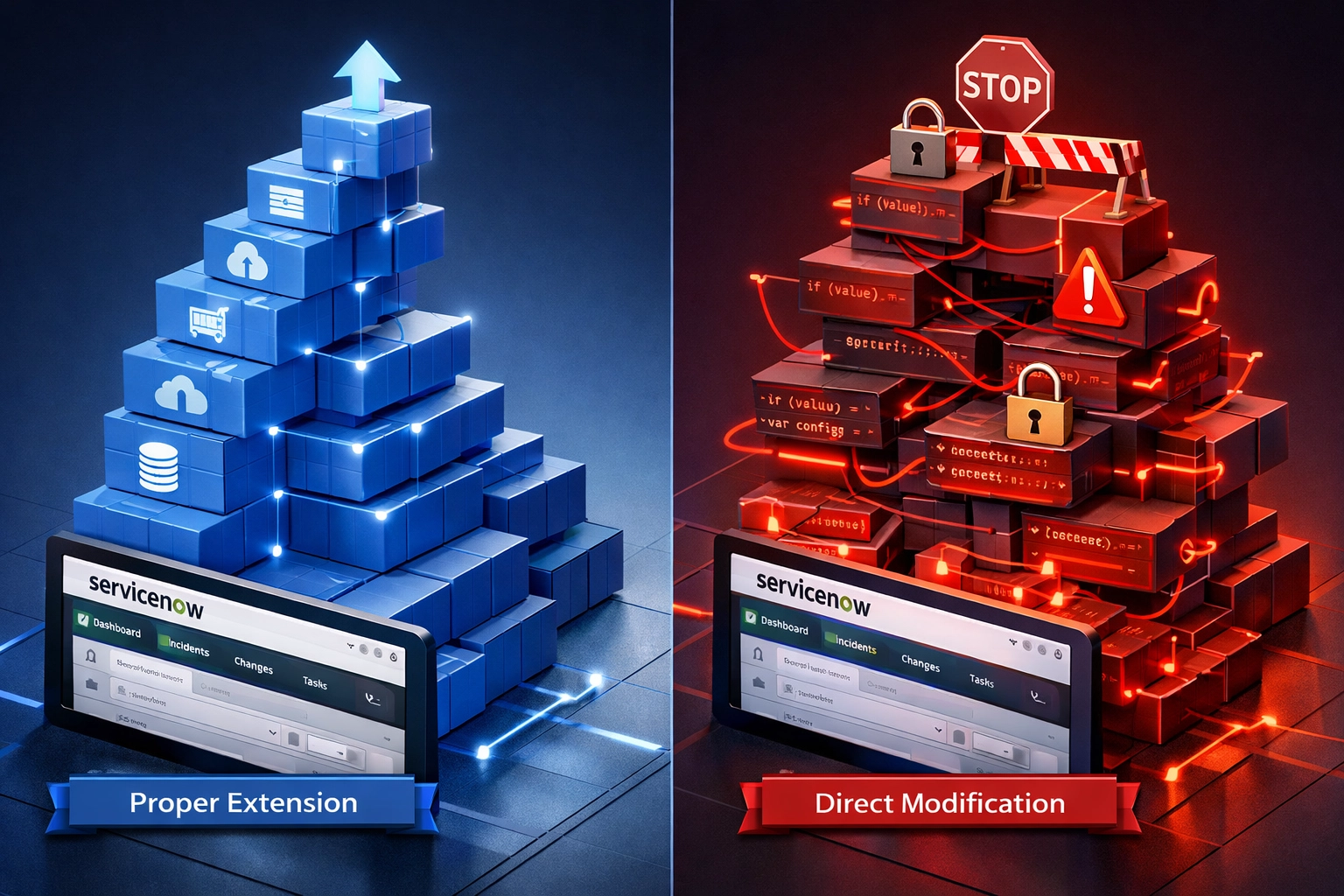
This mistake becomes critical in 2026 as ServiceNow accelerates its release cadence and introduces transformative Agentic AI capabilities in the Xanadu release. Organizations trapped on old releases miss AI-powered automation, enhanced security features, and compliance capabilities essential for DORA and GDPR requirements.
How the Audit Fixes This: Technical debt evaluation examines pattern customizations and upgrade readiness. The audit identifies directly modified out-of-the-box patterns, assesses upgrade blockers, and provides remediation roadmaps for proper pattern extension. This ensures your implementation remains upgrade-compatible while preserving necessary customizations.
Mistake #6: Launching ITOM Without Comprehensive Internal Training
Implementations without comprehensive training create permanent dependency on external ServiceNow consulting services for even basic configuration changes. This slows adaptation to evolving business needs and increases long-term costs by 200-300%.
Transformative ITOM implementations require extensive internal team enablement so IT Operations staff, Asset Management professionals, and Service Mapping administrators gain deep platform expertise. Without this foundation, your organization cannot leverage ServiceNow's full capabilities or respond quickly to changing business requirements.
How the Audit Fixes This: Training gap analysis measures internal capability versus platform complexity. The audit evaluates your team's proficiency across discovery, service mapping, event management, and cloud observability. It recommends targeted training programs that build internal expertise and reduce consulting dependency.
Mistake #7: Choosing Implementation Partners Based on General ITSM Credentials
A ServiceNow implementation partner with stellar Service Management capabilities may completely stumble on ITOM Discovery workflows, Service Mapping dependencies, or Cloud Observability integration. ITOM demands specialized expertise that general ITSM experience doesn't provide.
I have witnessed organizations waste six months and hundreds of thousands of dollars with partners who lacked ITOM-specific knowledge. Their implementations required complete remediation by specialized ITOM consultants, doubling costs and delaying value realization.

This mistake proves especially costly when pursuing Agentic AI readiness or DORA compliance: both require deep ITOM expertise to implement correctly.
How the Audit Fixes This: Cross-functional alignment review evaluates stakeholder involvement and partner capabilities. The audit assesses whether your implementation team possesses specialized ITOM expertise or needs supplementary support from experienced ServiceNow consulting services focused exclusively on ITOM and ITAM.
Why the Free 2026 ServiceNow ROI & License Audit Changes Everything
Beyond fixing these seven mistakes, a comprehensive audit identifies license optimization opportunities: unused ITOM entitlements costing thousands monthly, redundant discovery credentials, and underutilized Service Mapping capabilities. The audit provides Agentic AI readiness assessment, determining your platform's preparedness for AI-powered automation that drives unprecedented operational efficiency.
For US organizations, the audit focuses on ROI maximization and AI readiness. For EU organizations, it emphasizes DORA compliance, GDPR data governance, and ESG reporting capabilities within ServiceNow ITOM.
Your Next Step Toward ITOM Excellence
If you recognize these mistakes in your implementation, you're not alone: but you are at risk. Every day these issues persist, they cost your organization productivity, increase MTTR, and create compliance vulnerabilities.
I invite you to take action today. Visit the SnowGeek Solutions contact page to share your project details and schedule your Free 2026 ServiceNow ROI & License Audit. Additionally, register with SnowGeek Solutions for ongoing platform updates and expert insights that keep your ITOM implementation at peak performance.
Transform your ServiceNow ITOM implementation from a source of frustration into a driver of operational excellence. Your audit reveals hidden savings, fixes critical errors, and positions your organization for Agentic AI success in 2026 and beyond.
Comments