
7 Mistakes You're Making with ServiceNow ITOM (and How to Fix Them Before Your 2026 Budget Gets Cut)
- SnowGeek Solutions
- Feb 22
- 5 min read

I have witnessed firsthand how executive leadership responds to ITOM implementations that fail to deliver measurable ROI. In 2026, with CFOs scrutinizing every line item and regulatory frameworks like DORA demanding operational resilience, your ServiceNow ITOM investment needs to demonstrate tangible value: or risk getting slashed in the next budget cycle.
The unfortunate reality? Most organizations are making critical mistakes that actively sabotage their ITOM success. These aren't minor configuration issues. They're fundamental implementation errors that cascade across your entire IT operations, inflate costs by 20-30%, and create compliance gaps that regulators will not tolerate.
Let me guide you through the seven most damaging mistakes I see enterprises making with ServiceNow ITOM: and the precise remediation strategies that separate high-performing organizations from those constantly firefighting.
Mistake #1: Accepting Mediocre CMDB Data Quality
Your CMDB accuracy directly determines whether your 2026 AI-driven automation initiatives succeed or catastrophically fail.
The Problem: If your Configuration Management Database sits below 75% accuracy, you've entered what I call the "catastrophic zone" for intelligent automation. Organizations operating at 65-70% accuracy essentially maintain a fundamentally incorrect single source of truth three to four times out of ten. This isn't just poor data hygiene: it creates cascading failures across incident management, change management, and asset tracking that directly undermine your operational excellence targets.
The Fix: Target greater than 85% CMDB accuracy as your non-negotiable baseline. Implement enhanced Service Mapping capabilities available in recent ServiceNow releases and establish automated Discovery validation rules that continuously verify data integrity. This demands experienced ServiceNow consulting services that understand the intricate relationship between Discovery patterns, CMDB health scores, and enterprise-scale data governance.
Establish continuous monitoring workflows that automatically flag data quality degradation before it impacts operations. I recommend partnering with a specialized ServiceNow implementation partner who has demonstrated expertise in CMDB remediation: not generic IT consultants attempting to learn ServiceNow on your dime.

Mistake #2: Leaving Infrastructure Blind Spots Through Incomplete Discovery Scope
The Problem: Deploying Discovery with incomplete credential coverage discovers only 40-60% of your actual IT estate. Then organizations compound this error by building entire ITOM strategies assuming complete visibility. I worked with one enterprise that launched Discovery without comprehensive network architecture mapping, leaving 35% of infrastructure invisible. The result? Mean Time to Resolution (MTTR) that ran 40% higher than industry benchmarks because incident responders operated with incomplete dependency information.
The Fix: Identify blind spots and credential gaps across your complete IT estate before launching discovery initiatives. Map network architecture meticulously and validate discovered Configuration Items (CIs) against actual infrastructure inventory. This proactive approach prevents the dangerous assumption that what Discovery finds represents your total environment.
Under DORA's ICT risk management requirements, blind spots in critical infrastructure monitoring create unacceptable operational resilience gaps. EU organizations cannot afford incomplete visibility in 2026.
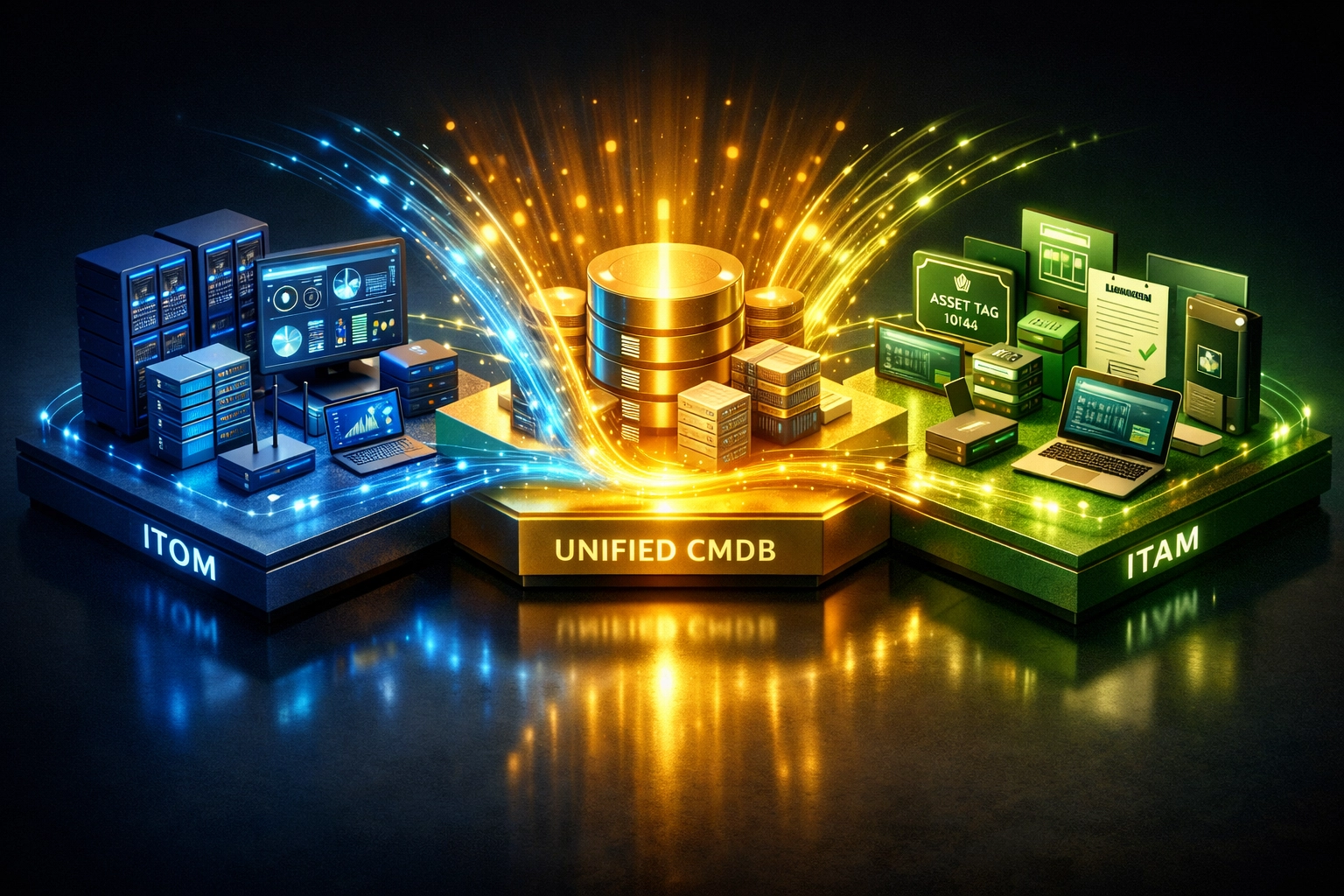
Mistake #3: Operating ITOM and ITAM as Siloed Disciplines
This mistake hemorrhages budget faster than almost any other implementation error.
The Problem: Approximately 70% of enterprises operate IT Operations Management (ITOM) and IT Asset Management (ITAM) in silos, bleeding 20-30% of infrastructure budgets through over-provisioning while simultaneously failing DORA compliance requirements. Siloed operations create broken dependency tracking, MTTR increases of 35-50%, and compliance gaps spanning DORA operational resilience, ESG reporting accuracy, and GDPR data sovereignty requirements.
The Fix: Integrate ITOM and ITAM from inception with unified CMDB enrichment and seamless data collection workflows. Stop creating duplicate CI records that force teams to reconcile conflicting asset information manually. Your ServiceNow platform should serve as a genuine single source of truth: not another data silo contributing to enterprise fragmentation.
I have witnessed the transformative impact when organizations properly integrate these disciplines. One client reduced infrastructure spending by $2.3M annually simply by eliminating over-provisioned resources that ITAM visibility exposed, while simultaneously improving change success rates by 28% through accurate dependency mapping.

Mistake #4: Underutilizing Service Mapping for Dependency Management
The Problem: Many organizations deploy Discovery without properly implementing Service Mapping, leaving them operationally blind to critical application dependencies. This transforms change impact analysis into dangerous guesswork. I've seen organizations approve changes to "low-impact" infrastructure only to discover during P1 incidents that the component supported three business-critical applications.
The Fix: Implement comprehensive Service Mapping to understand precisely which infrastructure components support which critical business processes. Use this mapping to conduct proper change impact analysis before approval. Service Mapping capabilities in the Washington DC and Xanadu releases provide unprecedented granularity for dependency visualization: but only if your ServiceNow implementation partner configures them correctly.
Mistake #5: Directly Modifying Out-of-the-Box Discovery Patterns
This seemingly innocent customization decision creates technical debt that can cost your organization between $150,000 and $400,000 in forced remediation.
The Problem: Organizations with extensively modified Discovery patterns spend 60-80% more on platform maintenance annually. These custom modifications can block consecutive ServiceNow upgrades, forcing organizations to remain on outdated platforms and miss critical security patches. Under DORA's operational resilience requirements, technical debt from modified patterns introduces unacceptable ICT risk that regulators will not tolerate.
The Fix: Avoid custom modifications and leverage ServiceNow's standard patterns. If business requirements seem to demand customization, engage ServiceNow consulting services to identify configuration-based solutions that achieve your objectives without creating upgrade-blocking technical debt.
The upgrade path from Tokyo to Washington DC to Xanadu should be seamless. Custom Discovery patterns transform it into a multi-month remediation project that drains resources from strategic initiatives.
Mistake #6: Wrong MID Server Placement Causing High Latency and Inconsistent Discovery
The Problem: Using a single Management, Instrumentation, and Discovery (MID) server for everything creates inconsistent results. The same schedule works sometimes and fails other times, with large subnets taking excessive time to scan. I worked with one organization attempting to scan cloud VMs via VPN with a single data center MID, resulting in abysmal performance and frequent failures that undermined stakeholder confidence in the entire ITOM initiative.
The Fix: Place MID servers close to targets per network zone rather than using one MID for everything. Align schedules to each MID's reachable scope. One client moved to one MID per Virtual Network (VNet), which drastically reduced scan time and eliminated failures. This architectural decision transformed Discovery from an unreliable batch process to a continuous, dependable capability.
Mistake #7: Poor CMDB Identification Rules Causing CI Data Degradation
The Problem: Without proper Identification and Reconciliation Engine (IRE) strategy, you get CI "flip-flopping" where one CI keeps changing attributes or multiple sources overwrite each other. DNS and reverse DNS gaps create duplicate CIs and "Unknown" hosts mapped to wrong nodes. IP range overlaps across networks produce duplicate CIs that fragment your single source of truth.
The Fix: Lock down your Identification and Reconciliation strategy by establishing authoritative sources per class and field. Enforce governance on who can write what data. Fix forward and reverse DNS, normalize hostnames, and enforce consistent naming rules before large-scale Discovery. Model network overlaps and Network Address Translation (NAT) explicitly, using identification rules that consider more than just IP addresses.
This technical precision separates organizations with CMDB health scores above 90% from those constantly fighting data quality fires.
Your Next Steps: The Free 2026 ServiceNow ROI & License Audit
These seven mistakes directly correlate to budget cuts because they undermine ROI, increase operational costs through manual workarounds, delay automation benefits, and create compliance risks in an increasingly regulated environment.
If you recognize your organization in any of these scenarios, I recommend taking immediate action. SnowGeek Solutions offers a Free 2026 ServiceNow ROI & License Audit that identifies exactly where your ITOM implementation is hemorrhaging value and provides a precise remediation roadmap.
This comprehensive audit examines your CMDB health scores, Discovery coverage, ITOM-ITAM integration maturity, Service Mapping utilization, technical debt from customizations, MID server architecture, and IRE configuration. You receive quantified ROI impact analysis and prioritized recommendations that speak directly to CFO-level budget concerns.
Visit the SnowGeek Solutions contact page to share your project details and schedule your complimentary audit. Register with SnowGeek Solutions to receive platform updates and expert insights that keep your ServiceNow investment delivering measurable business value.
Don't let these preventable mistakes cost you your 2026 budget. The organizations that thrive in the AI-driven, compliance-intensive environment ahead are those that address ITOM fundamentals with precision and strategic foresight today.
Comments