
7 Mistakes You're Making with ServiceNow ITOM (and How Agentic AI Fixes Them in 2026)

I have witnessed firsthand how organizations invest six to seven figures in ServiceNow ITOM implementations, only to watch their infrastructure visibility crumble within months. The pattern repeats itself across industries: incomplete discovery, deteriorating CMDB accuracy, and blind spots that transform routine changes into P1 incidents. But 2026 marks a transformative shift: agentic AI now addresses these chronic ITOM failures with autonomous precision that traditional approaches simply cannot match.
Let me guide you through the seven critical mistakes sabotaging your ITOM investment and reveal how the Vancouver and Washington releases' agentic AI capabilities turn these liabilities into competitive advantages.
Mistake #1: Operating with CMDB Accuracy Below 75%
Your CMDB accuracy rate isn't just a vanity metric: it determines whether your automation infrastructure operates as a strategic asset or an operational liability. I have seen organizations proudly report 65-70% CMDB accuracy, unaware they're functioning in what industry benchmarks call the "catastrophic zone" for AI-driven automation. Your single source of truth is fundamentally wrong three to four times out of ten.
The consequences cascade immediately: incident management teams resolve issues 40% slower, change advisory boards approve changes without visibility to actual dependencies, and your ITAM teams over-provision infrastructure by 20-30% because asset data contradicts reality.
How Agentic AI Fixes It: The Washington release introduces autonomous CMDB health agents that continuously validate configuration item relationships against live discovery data, service dependencies, and operational telemetry. These agents don't wait for scheduled reconciliation jobs: they detect accuracy degradation in real-time, automatically initiate remediation workflows, and escalate anomalies that require human decision-making. Organizations deploying this capability report CMDB accuracy stabilizing above 85% within 90 days, crossing the threshold where automation transitions from liability to competitive advantage.

Mistake #2: Incomplete Discovery Scope Creating Phantom Confidence
You deployed ServiceNow Discovery with incomplete credential coverage, discovered 40-60% of your actual IT estate, and then built your entire ITOM strategy assuming complete visibility. This "phantom confidence" problem represents one of the most dangerous mistakes in enterprise IT operations.
When your Discovery scope covers only half your infrastructure, every dashboard shows green, every dependency map looks complete, and every change impact analysis appears comprehensive: except none of it reflects reality. Your MTTR rates run 40% higher than industry benchmarks, but you have no visibility into the blind spots causing the delays.
How Agentic AI Fixes It: Agentic AI Discovery orchestrators in the Vancouver release autonomously identify credential gaps by analyzing network traffic patterns, correlating asset metadata from integrated ITAM systems, and detecting "shadow infrastructure" through anomaly detection. These agents generate credential acquisition workflows, prioritize discovery targets by business criticality, and continuously expand coverage without manual schedule management. The result: organizations achieve 90%+ infrastructure visibility within 120 days versus 18-24 months with traditional approaches.
Mistake #3: Siloed ITOM and ITAM Operations Hemorrhaging Budget
Approximately 70% of enterprises operate ITOM and ITAM as separate disciplines, with separate teams, separate data models, and separate ServiceNow consulting services engagements. This organizational silos creates a perfect storm: over-provisioning infrastructure while simultaneously failing DORA compliance requirements that mandate unified asset and operational visibility.
The financial impact is staggering. Organizations hemorrhage 20-30% of infrastructure budgets through redundant provisioning, maintain duplicate software licenses for decommissioned systems, and face MTTR increases of 35-50% because incident responders lack accurate asset ownership context.
How Agentic AI Fixes It: Agentic AI integration orchestrators automatically synchronize ITOM and ITAM data models, detect reconciliation conflicts, and maintain bidirectional updates across Discovery, Service Mapping, and Hardware Asset Management modules. These agents understand DORA Article 8 requirements for operational and business continuity, automatically flagging assets that lack proper ICT third-party service provider documentation. For EU-based organizations, this capability transforms ITOM from a technical tool into a DORA compliance engine.

Mistake #4: Underutilized Service Mapping Leaving You Blind to Dependencies
You invested in ServiceNow Discovery but never properly implemented Service Mapping, leaving you blind to critical application dependencies. This creates dangerous scenarios where approved "low-impact" infrastructure changes trigger P1 incidents affecting business-critical applications that nobody knew depended on the modified system.
I have watched organizations suffer through these preventable incidents month after month because their ServiceNow implementation partner prioritized Discovery deployment over Service Mapping maturity. The pattern is predictable: Discovery provides device-level visibility, but without Service Mapping's application-centric view, your change advisory board operates with incomplete impact analysis.
How Agentic AI Fixes It: Agentic AI Service Mapping agents in the Washington release automatically discover application dependencies through traffic pattern analysis, API call tracing, and database connection mapping: without requiring manual business service definition. These agents continuously update service maps as infrastructure evolves, automatically classify dependencies by criticality, and generate impact analysis reports that CAB teams actually trust. Organizations report reducing change-related incidents by 60% within the first quarter of deployment.
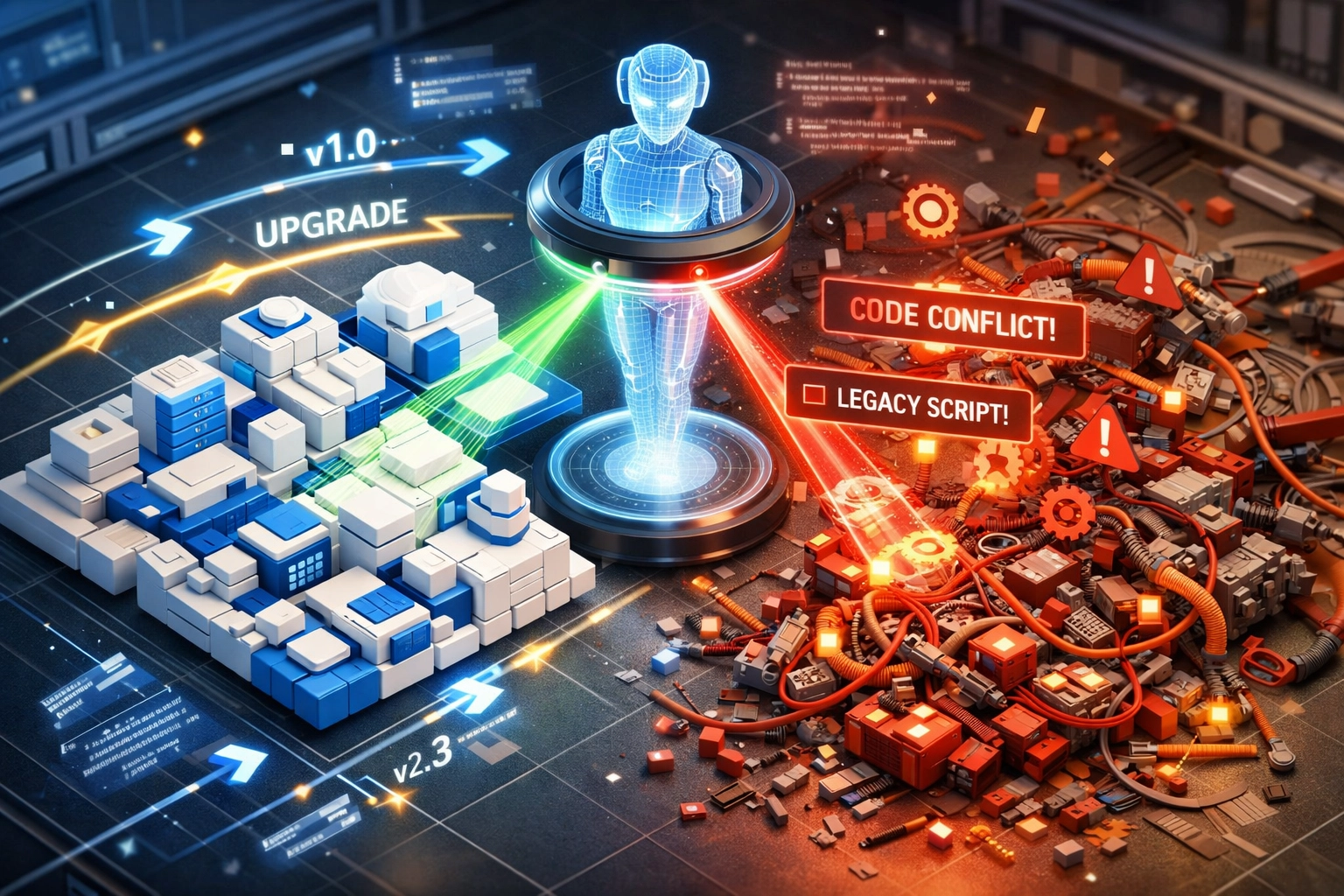
Mistake #5: Direct Modifications to Discovery Patterns Locking You to Outdated Platforms
Your technical team extensively modified out-of-the-box Discovery patterns to address unique infrastructure requirements, inadvertently increasing platform maintenance costs by 60-80% annually. Worse, these custom modifications have blocked consecutive ServiceNow upgrades, forcing your organization to remain on outdated platforms that miss critical security patches and AI-powered capabilities.
The remediation cost is brutal: $150,000 to $400,000 during forced upgrades when technical debt finally demands resolution. I have guided organizations through these painful migrations where years of accumulated customizations must be reverse-engineered, tested, and rebuilt to support modern ServiceNow releases.
How Agentic AI Fixes It: Agentic AI pattern management agents monitor custom Discovery patterns, automatically detect upgrade-blocking modifications, and recommend update-safe configurations that achieve the same discovery outcomes. These agents leverage the Vancouver release's enhanced pattern extensibility framework, which separates core pattern logic from organizational customizations. Organizations deploying this capability reduce upgrade preparation time from 6-9 months to 4-6 weeks while maintaining custom discovery requirements.
Mistake #6: Incorrect MID Server Placement Causing Inconsistent Performance
Your MID server placement strategy follows the "one MID for everything" approach, causing high latency and inconsistent Discovery performance. The same schedule works perfectly sometimes and fails mysteriously other times, forcing your operations team into endless troubleshooting cycles that never address the root architectural problem.
MID placement represents a foundational ITOM architecture decision that many organizations overlook during initial deployment. By the time performance issues surface, you've built schedules, patterns, and operational procedures around a flawed topology that would be expensive and disruptive to correct.
How Agentic AI Fixes It: Agentic AI MID orchestrators in the Washington release analyze network topology, discovery target distribution, and latency patterns to automatically recommend optimal MID placement. These agents generate deployment blueprints per network zone, predict Discovery performance under different configurations, and automatically load-balance discovery schedules across MID infrastructure. Organizations report 85% reduction in Discovery failures after implementing AI-recommended MID topology.
Mistake #7: Infrastructure-Only Dashboards Missing Actual User Impact
Your ITOM health dashboards show green status indicators while users experience actual application slowness, representing a critical visibility gap between infrastructure signals and business impact. This disconnect erodes stakeholder trust in your IT operations capabilities and prevents proactive incident prevention.
Traditional ITOM dashboards focus exclusively on infrastructure metrics: CPU utilization, memory consumption, disk I/O: without correlating these signals to actual user experience. You don't know your application is slow until the help desk ticket queue explodes, and by then, the incident has already damaged business operations.
How Agentic AI Fixes It: Agentic AI experience correlation agents integrate ServiceNow ITOM with Digital Employee Experience (DEX) telemetry, automatically establishing experience-based SLOs that combine infrastructure health with actual user impact. These agents detect experience degradation before infrastructure thresholds trigger, generate predictive incident workflows, and provide root cause analysis that connects infrastructure events to business impact. This represents the future of experience-centric ITOM that DORA Article 17 operational resilience testing implicitly requires.
Transform Your ITOM Investment with Expert Guidance
These seven mistakes don't happen because of inadequate effort: they happen because ServiceNow ITOM implementations demand specialized expertise that most organizations build through expensive trial and error. Agentic AI capabilities in the Vancouver and Washington releases finally provide the autonomous correction mechanisms that prevent these failures from cascading into operational crises.
As an experienced ServiceNow implementation partner specializing exclusively in ITOM and ITAM transformation, SnowGeek Solutions has guided organizations through these exact challenges across multiple industries. Our approach combines platform-native agentic AI capabilities with proven implementation methodologies that deliver measurable ROI within 90 days.
Ready to discover what your current ITOM configuration is costing you? Visit SnowGeek Solutions to share your project details and schedule your Free 2026 ServiceNow ROI & License Audit. Register with SnowGeek Solutions for platform updates and expert insights that keep your ITOM investment ahead of industry evolution. Your infrastructure deserves operational excellence powered by agentic AI( let's make it happen together.)
Comments