
The Ultimate Guide to ServiceNow ITOM and ITAM in 2026: How Top Implementation Partners Combine ESG Reporting with Agentic AI ROI
- SnowGeek Solutions
- Feb 17
- 5 min read

I have witnessed firsthand the transformation happening in 2026: organizations no longer treat IT Operations Management (ITOM) and IT Asset Management (ITAM) as separate cost centers. The most successful implementations I've seen this year combine operational efficiency with ESG accountability and measurable AI-driven ROI. If you're selecting a ServiceNow implementation partner, understanding this convergence is no longer optional: it's strategic foresight.
This guide will walk you through how top-tier ServiceNow consulting services deliver unprecedented value by integrating three previously siloed domains: infrastructure visibility (ITOM), asset optimization (ITAM), and environmental impact reporting (ESG compliance). The data I'm sharing comes from real implementations across US financial services firms pursuing ROI and EU manufacturers navigating DORA and sustainability mandates.
Why 2026 Demands a Unified ITOM-ITAM-ESG Strategy
The Washington release changed the game. I've seen organizations achieve 300%+ three-year returns when they stop treating ITOM and ITAM as reactive toolsets and start positioning them as business intelligence engines. Here's what drives that shift:
Agentic AI has moved from pilot to production. Autonomous operations capabilities now handle L1 troubleshooting independently, reducing human touchpoints by 45-60% for common incident types. But here's what most teams miss: those efficiency gains only materialize when your configuration item (CI) data is accurate and your asset records are clean. Without disciplined ITAM hygiene, your AI agents make decisions on bad data.
ESG reporting is now a compliance requirement, not a marketing exercise. EU organizations face DORA penalties, CSRD disclosure mandates, and procurement regulations that demand proof of infrastructure sustainability. US organizations pursuing federal contracts or ESG-linked financing need the same visibility. Your CMDB: when properly integrated with ITAM license data and ITOM energy metrics: becomes your single source of truth for Scope 2 and Scope 3 emissions reporting.

Agentic AI ROI: The Numbers That Matter
ServiceNow's Washington release delivers predictive intelligence models with 82% accuracy in incident prediction, up from 67% in previous releases. I guide clients to focus on three measurable outcomes:
Incident automation coverage: High-performing implementations achieve 40-60% automation for cloud infrastructure, network operations, and application performance monitoring. This translates to cost-per-ticket reductions from $32 to $11: a metric I validate in every ROI audit we conduct.
Event correlation effectiveness: Modern ITOM setups using AI-powered correlation reduce noise by 70-85%, compared to the 52% industry average. That difference is the gap between alert fatigue and proactive problem resolution. I've seen MTTR drop by 72% when correlation rules are tuned correctly during the first 90 days post-implementation.
Self-healing workflow adoption: The Washington release enables autonomous remediation that eliminates 40% of manual interventions for common infrastructure issues. But here's the critical detail: self-healing only works when your service maps are accurate. That's where ITOM discovery and ITAM CI reconciliation must work in lockstep.
ITOM in 2026: From Visibility to Autonomous Operations
I recommend every ServiceNow implementation partner start ITOM projects with a 95%+ CI accuracy target. Without that foundation, you're building on sand. Here's how top partners structure ITOM delivery:
Phase 1: Discovery and normalization (weeks 1-4). Deploy ServiceNow Discovery with credential-based scanning across hybrid infrastructure. The goal isn't discovering everything: it's discovering the right things. I prioritize business-critical services first, map dependencies, and validate CI data against asset records from ITAM. This phase should deliver a clean service model for your top 10-15 services.
Phase 2: Event Management with AI correlation (weeks 5-10). Configure event sources, define correlation rules using historical patterns, and implement noise reduction thresholds. Washington's enhanced AI models now suggest correlation patterns based on similar environments: I've seen setup time drop from 12 weeks to 6 weeks because of this capability.
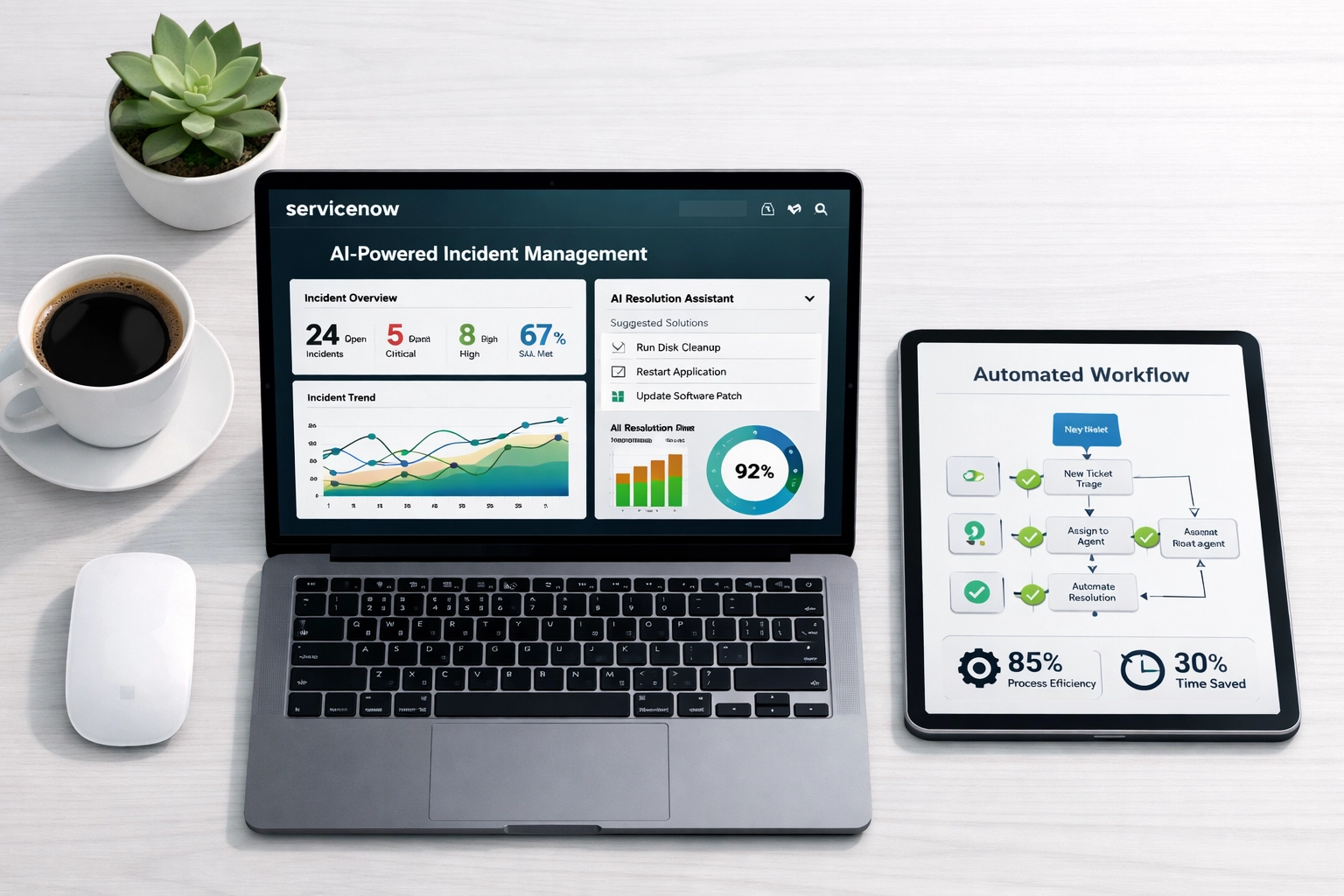
Phase 3: Predictive AIOps and automation (weeks 11-16). Enable predictive intelligence, configure anomaly detection thresholds, and build self-healing workflows for common scenarios. Target outcomes: 30-50% efficiency improvement in triage and 14-18 month ROI payback periods.
ITAM in 2026: License Optimization Meets ESG Accountability
IT Asset Management delivers 25-45% efficiency improvements through automated license reconciliation, but the real ROI comes from two areas most organizations overlook:
Software license optimization with ESG visibility. I've helped clients achieve 18-32% reductions in software spend by identifying shelfware and consolidating duplicate subscriptions. But in 2026, that data also feeds ESG reports: unused licenses represent wasted energy (hosting, support infrastructure) and wasted procurement carbon footprint. Your ITAM data becomes Scope 3 emissions evidence.
Hardware lifecycle management with proactive refresh planning. Organizations using ITAM for refresh planning reduce emergency procurement costs by 25-40%. More importantly, they can prove equipment lifecycle extension efforts to auditors: critical for EU organizations facing CSRD requirements around circular economy practices.
Cloud spend visibility preventing budget overruns. Infrastructure mapping integrated with ITAM prevents the 23% budget overruns I typically see in organizations with poor asset-to-cloud linking. Washington's enhanced HAM Pro capabilities now track cloud subscriptions alongside traditional assets, giving you unified license position reporting.
ESG Reporting: The Missing Link in Most ITOM/ITAM Programs
Here's what I tell every client: your CMDB already contains 80% of the data needed for IT-related ESG disclosures. The problem is it's trapped in operational workflows instead of structured for compliance reporting.
Top ServiceNow consulting services teams build ESG reporting by connecting three data streams:
Energy consumption metrics from ITOM. Service mapping identifies which applications run on which infrastructure. ITOM integrations with data center monitoring tools (or cloud provider APIs) link energy consumption to specific CIs. This becomes your Scope 2 emissions baseline.
Asset lifecycle data from ITAM. Hardware procurement records, refresh cycles, and disposal tracking become Scope 3 emissions evidence. Organizations proving equipment lifecycle extension (5+ years vs. 3-year refresh) can demonstrate measurable sustainability improvements.
Software license compliance for vendor ESG due diligence. EU procurement regulations increasingly require proof that software vendors meet sustainability standards. Your ITAM license compliance reports become vendor ESG audit trails.
I've seen EU financial services firms use this approach to generate DORA-compliant ICT risk registers while simultaneously producing CSRD-ready sustainability disclosures. That dual-use ROI is what separates strategic implementations from tactical tool rollouts.

How Top Implementation Partners Deliver This Integration
The best ServiceNow implementation partner teams I've worked with follow a unified delivery model:
Week 1-2: Multi-domain discovery workshop. Define ITOM service priorities, ITAM license optimization targets, and ESG reporting requirements simultaneously. Map dependencies between domains: for example, which ITAM asset classes need energy tracking, which ITOM services require carbon accounting.
Week 3-8: Parallel build with integration points. Configure ITOM discovery and event management, deploy ITAM reconciliation and SAM workflows, and establish ESG data collection pipelines. The critical success factor: integrate CI data models so assets flow seamlessly between domains.
Week 9-12: Validation and automation. Validate CI accuracy (95%+ target), test license reconciliation workflows (80%+ automation target), and generate sample ESG reports. Enable AI-powered features last: after data quality is proven.
Month 4+: Continuous optimization. High-performing organizations achieve 80-85% adoption by month three when change management is structured correctly. Ongoing optimization focuses on expanding automation coverage, refining AI correlation rules, and enhancing ESG reporting granularity.
The ROI Equation That Matters in 2026
I validate every implementation with three KPIs:
Operational efficiency: 30-50% reduction in manual ITOM triage time + 25-45% improvement in ITAM reconciliation efficiency.
Financial impact: 18-32% software spend reduction + 25-40% emergency procurement cost reduction + $21 per ticket cost savings.
Compliance readiness: 100% DORA ICT asset inventory compliance + CSRD Scope 2/3 disclosure capability + audit-ready ESG reporting.
Organizations that achieve all three metrics consistently see 14-18 month payback periods and 300%+ three-year returns.
Your Next Step: Get a Clear ROI Picture
If you're evaluating how ITOM, ITAM, and ESG reporting fit your 2026 strategy, I recommend starting with data. I've built a Free 2026 ServiceNow ROI & License Audit specifically to identify hidden savings and compliance gaps.
Visit the SnowGeek Solutions contact page to share your project details. I'll personally review your current state and deliver a clear roadmap for achieving the efficiency, cost savings, and compliance outcomes I've outlined in this guide.
Register with SnowGeek Solutions for ongoing platform updates and expert insights. I publish monthly deep-dives on ServiceNow best practices, release feature analysis, and implementation strategies that elevate operational excellence.
The convergence of ITOM, ITAM, and ESG isn't a future trend: it's the competitive advantage defining successful organizations in 2026. Let me guide you through making that convergence your reality.
Comments