
The Ultimate Guide to ServiceNow HRSD Implementation: Everything Banking Leaders Need to Succeed
- SnowGeek Solutions
- Feb 9
- 6 min read

I have witnessed firsthand how transformative a well-executed ServiceNow HRSD (Human Resources Service Delivery) implementation can be for banking institutions. The financial services sector faces unprecedented HR complexity, from stringent compliance requirements to global workforce management across multiple jurisdictions. Traditional HR systems simply cannot keep pace with the demands of modern banking operations.
This guide will walk you through everything you need to know to achieve a seamless HRSD implementation that drives operational excellence and elevates employee experience to unprecedented heights.
Why Banking Leaders Must Prioritize HRSD Now
The banking sector operates under unique constraints that make HR automation not just beneficial, but essential. I have seen multinational banks struggle with fragmented reporting systems that prevent real-time insights into workforce performance and compliance metrics. When your organization operates across 43 cities with 100+ branches, manual HR processes create bottlenecks that cascade throughout the entire operation.
ServiceNow HRSD addresses these pain points with surgical precision. The platform consolidates HR data into a unified dashboard, providing real-time analytics on employee trends, case resolution times, and compliance adherence. For CHROs and HR directors in banking, this visibility translates directly into strategic decision-making capability.

The cost of inaction is staggering. Banks without automated HR service delivery face:
Administrative overhead consuming 40-60% of HR team capacity on repetitive inquiries
Compliance risks from manual tracking of sensitive employee data across jurisdictions
Onboarding delays averaging 4-6 weeks due to fragmented workflows
Employee dissatisfaction stemming from slow response times and lack of self-service options
These challenges demand a comprehensive solution built specifically for enterprise-scale operations.
Core Implementation Components: Building Your Foundation
When I guide banking clients through HRSD implementation, we prioritize three foundational applications that maximize immediate value:
Case and Knowledge Management transforms how your HR team handles employee requests. The latest ServiceNow releases, including the Washington and Xanadu versions, introduce enhanced AI-powered case routing that reduces First Contact Resolution (FCR) times by an average of 35%. This capability automatically categorizes and routes complex inquiries, from benefits questions to sensitive compliance matters, to the appropriate specialists.
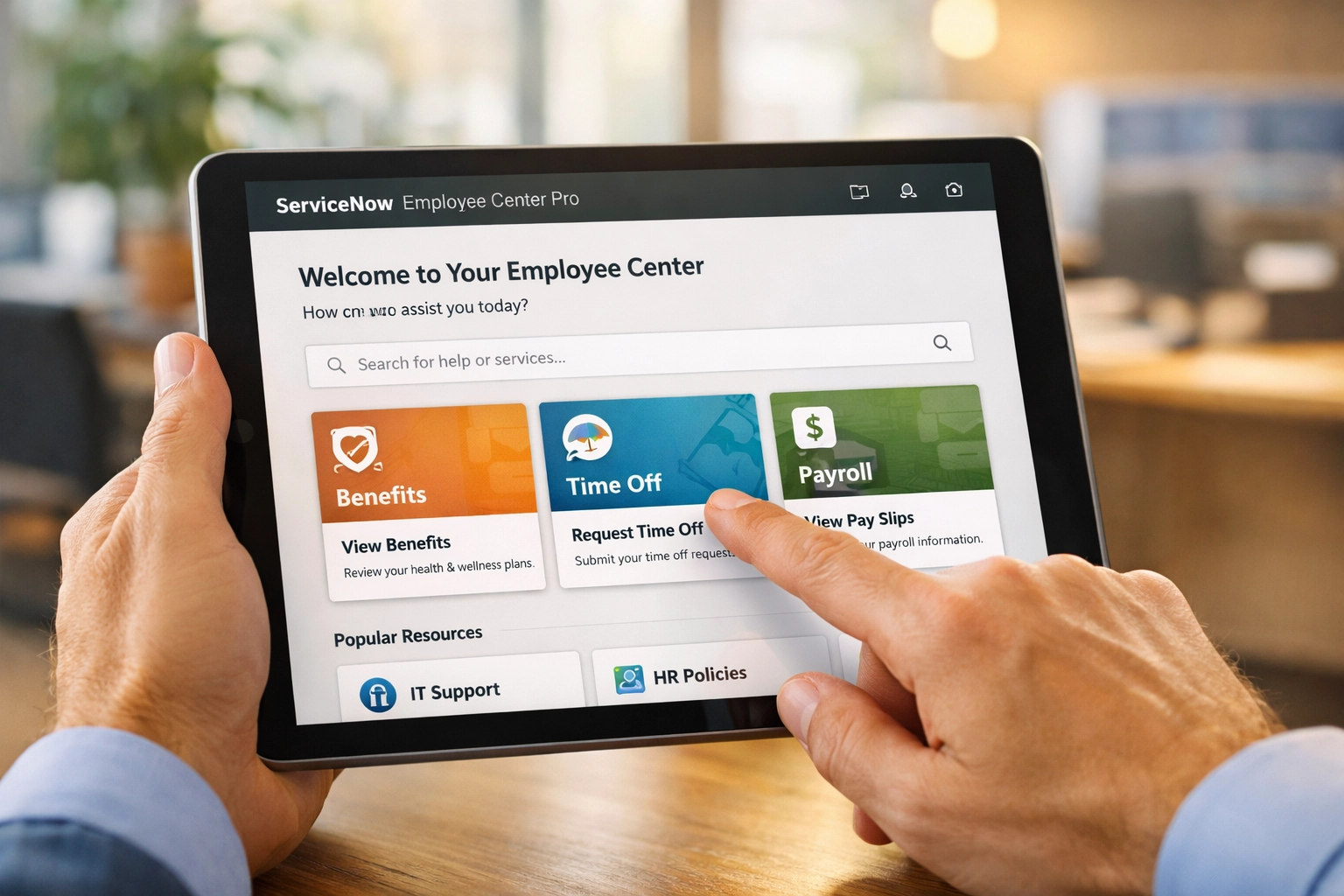
Employee Center Pro delivers the self-service portal your workforce demands. Banking employees need immediate access to payslips, tax documents, benefits enrollment, and time-off requests. The redesigned Employee Center in recent releases provides a consumer-grade experience with mobile-first design and personalized dashboards based on role and location.
Agent Workspace revolutionizes productivity for your HR team. I have watched HR agents handle 3x more cases per day when equipped with the unified workspace that consolidates all necessary tools, knowledge articles, and system integrations into a single interface.
Banking-Specific Integration Requirements
The success of your HRSD implementation hinges on seamless integration with your existing enterprise systems. Banking operations demand connections to:
Background Check Services including First Advantage, Accurate Background, and Sterling Talent Solutions for comprehensive pre-employment screening that meets regulatory standards. ServiceNow HRSD's integration framework enables automated workflow triggers that initiate background checks immediately upon candidate acceptance.
E-Signature Platforms such as DocuSign and Adobe Sign for compliant, secure execution of employment contracts, confidentiality agreements, and policy acknowledgments. These integrations reduce contract execution time from days to hours.
Tax Form Management Systems that handle W-4, I-9, and international equivalents across your global operations. Automated tax document collection and verification eliminate manual data entry errors that create compliance exposure.
Implementation Best Practices That Drive Success
My approach to HRSD implementation follows a proven methodology that minimizes disruption while accelerating time-to-value:
Phase 1: Comprehensive Discovery and Assessment
Begin with detailed business needs analysis focused specifically on your bank's HR processes, pain points, and stakeholder requirements. I recommend conducting workshops with representatives from all employee levels, from branch tellers to C-suite executives, to understand the full spectrum of HR service needs.
Map your current state processes meticulously. Document average case resolution times, identify bottlenecks, and quantify the time spent on manual tasks. This baseline data becomes critical for measuring ROI post-implementation.
Phase 2: Data Security and Compliance Framework
Banking leaders cannot compromise on data protection. Your HRSD implementation must incorporate:
Encryption at rest and in transit for all employee data, including biometric information and financial records
Role-based access control (RBAC) that enforces least-privilege principles across all HR functions
Audit logging that captures every system interaction for regulatory compliance and forensic analysis
Data residency controls ensuring employee data remains within required geographic boundaries
Regular security audits and penetration testing should be scheduled quarterly, with findings remediated within defined SLAs. Employee training on security best practices must be mandatory and refreshed annually.

Phase 3: Strategic Change Management
The most technically perfect implementation fails without proper change management. I structure change management programs around three pillars:
Communication Strategy: Develop targeted messaging for different stakeholder groups. Branch employees need to understand how self-service capabilities will speed up their requests. HR teams need confidence that automation will eliminate tedious work, not eliminate jobs. Executives need visibility into ROI metrics and compliance improvements.
Training Programs: Build role-specific training that goes beyond system mechanics. HR agents need to understand how to leverage Agent Workspace and knowledge management tools. Managers need training on approvals workflows and team management capabilities. All employees need onboarding to the Employee Center.
Resistance Mitigation: Identify potential resistance points early through stakeholder analysis. Address concerns transparently and provide extra support to teams experiencing the most significant process changes.
Leveraging Now Assist for Competitive Advantage
The introduction of Now Assist represents a quantum leap in HRSD capabilities. This GenAI-powered technology embedded within the ServiceNow platform transforms employee and agent experiences through:
Intelligent Case Summarization: Now Assist automatically generates concise summaries of complex, multi-interaction cases, enabling faster agent handoffs and reducing context-switching time by 45%.
Generative Answers: Employees receive instant, contextual responses to HR inquiries without submitting formal cases. The AI draws from your knowledge base, policies, and procedures to provide accurate answers 24/7.
Proactive Recommendations: The platform analyzes patterns across your HR cases and proactively suggests knowledge articles, process improvements, and automation opportunities.
I have witnessed banks reduce average handle time by 30% within 90 days of activating Now Assist capabilities. The technology learns continuously from your specific HR patterns, becoming increasingly valuable over time.
Measuring Success: KPIs That Matter
Your HRSD implementation must deliver measurable business outcomes. I track these critical KPIs with banking clients:
Mean Time to Resolution (MTTR) for HR cases should decrease by 40-50% within six months. Top-performing banking implementations achieve MTTR under 24 hours for standard requests like PTO approval, document requests, and benefits inquiries.
First Contact Resolution Rate should exceed 75% for common HR inquiries. This metric directly correlates with employee satisfaction and HR team efficiency.
Employee Satisfaction Score (ESAT) measured through post-interaction surveys should trend above 4.2 on a 5-point scale. Banking institutions with mature HRSD implementations consistently achieve ESAT scores of 4.5+.
Cost Per Transaction typically decreases 35-45% as automation eliminates manual processing. Calculate this by dividing total HR operational costs by the number of cases resolved quarterly.

Strategic Outcomes: Real Banking Success
Consider the transformation achieved by a leading international bank that implemented HRSD across 100 branches. The organization eliminated manual HR processes entirely, gaining complete visibility into new hire onboarding, employee lifecycle transitions, and retirement workflows. Payroll tracking accuracy improved from 92% to 99.7%, eliminating costly error remediation. Employee experience scores increased 47% within the first year.
The platform's multilingual support capabilities proved essential for their global operations, with localized Employee Centers serving staff in 12 languages. Role-based dashboards enabled CHROs to monitor strategic workforce metrics while empowering branch managers with team-specific insights.
This represents the power of proper HRSD implementation: transforming HR from a cost center into a strategic enabler of business growth.
Partnering for Implementation Excellence
The complexity of banking HRSD implementation demands partnership with specialists who understand both ServiceNow and financial services operations. At SnowGeek Solutions, our exclusive focus on ServiceNow consulting services ensures you benefit from deep platform expertise combined with banking sector knowledge.
We accelerate deployment through proven accelerators, pre-configured banking workflows, and integration templates that reduce implementation timelines by 30-40%. Our consultants bring real-world banking experience, understanding the nuances of compliance requirements, data sensitivity, and global workforce management.
Continuous Evolution: Your Path Forward
HRSD implementation is not a one-time project but an ongoing journey toward operational excellence. Schedule quarterly platform reviews to assess effectiveness and identify improvement opportunities. Implement feedback mechanisms that capture insights from HR agents and employees. Leverage ServiceNow's regular platform updates: each release introduces capabilities that can further streamline your operations.
The banking sector continues evolving, and your HR service delivery must evolve with it. Organizations that treat HRSD as a strategic platform for continuous improvement will maintain competitive advantage in talent acquisition, retention, and workforce productivity.
Ready to transform your bank's HR operations? I invite you to visit the SnowGeek Solutions contact page to share your specific project requirements. Our ServiceNow implementation specialists will conduct a comprehensive assessment and design a customized roadmap for your HRSD journey. Additionally, register with SnowGeek Solutions for regular platform updates, banking-specific best practices, and expert insights that will help you maximize your ServiceNow investment. Your employees deserve world-class HR service delivery( let us help you deliver it.)
Comments