
The Ultimate Guide to Custom ServiceNow App Development: Everything Retail & Manufacturing Need in 2026
- SnowGeek Solutions
- Feb 9
- 7 min read
I have witnessed firsthand how off-the-shelf solutions fail to address the unique operational complexities of retail and manufacturing organizations. After implementing hundreds of ServiceNow solutions as a ServiceNow implementation partner, I can tell you with absolute certainty: custom application development is no longer a luxury, it's a strategic imperative for organizations seeking to maintain competitive advantage in 2026.
The retail and manufacturing sectors demand workflows that existing ServiceNow modules simply cannot accommodate out of the box. Your production line efficiency tracking, inventory synchronization across channels, and supplier quality management require tailored solutions that seamlessly integrate with your existing ecosystem. This guide will walk you through everything you need to know about custom ServiceNow app development, from strategic planning to production deployment.
Why Custom Apps Transform Retail & Manufacturing Operations
Generic solutions force your unique business processes into rigid frameworks. I've seen manufacturers waste thousands of hours trying to retrofit ITSM modules for shop floor management, and retailers struggling to track omnichannel inventory using standard asset management tables. Custom ServiceNow applications eliminate these friction points entirely.
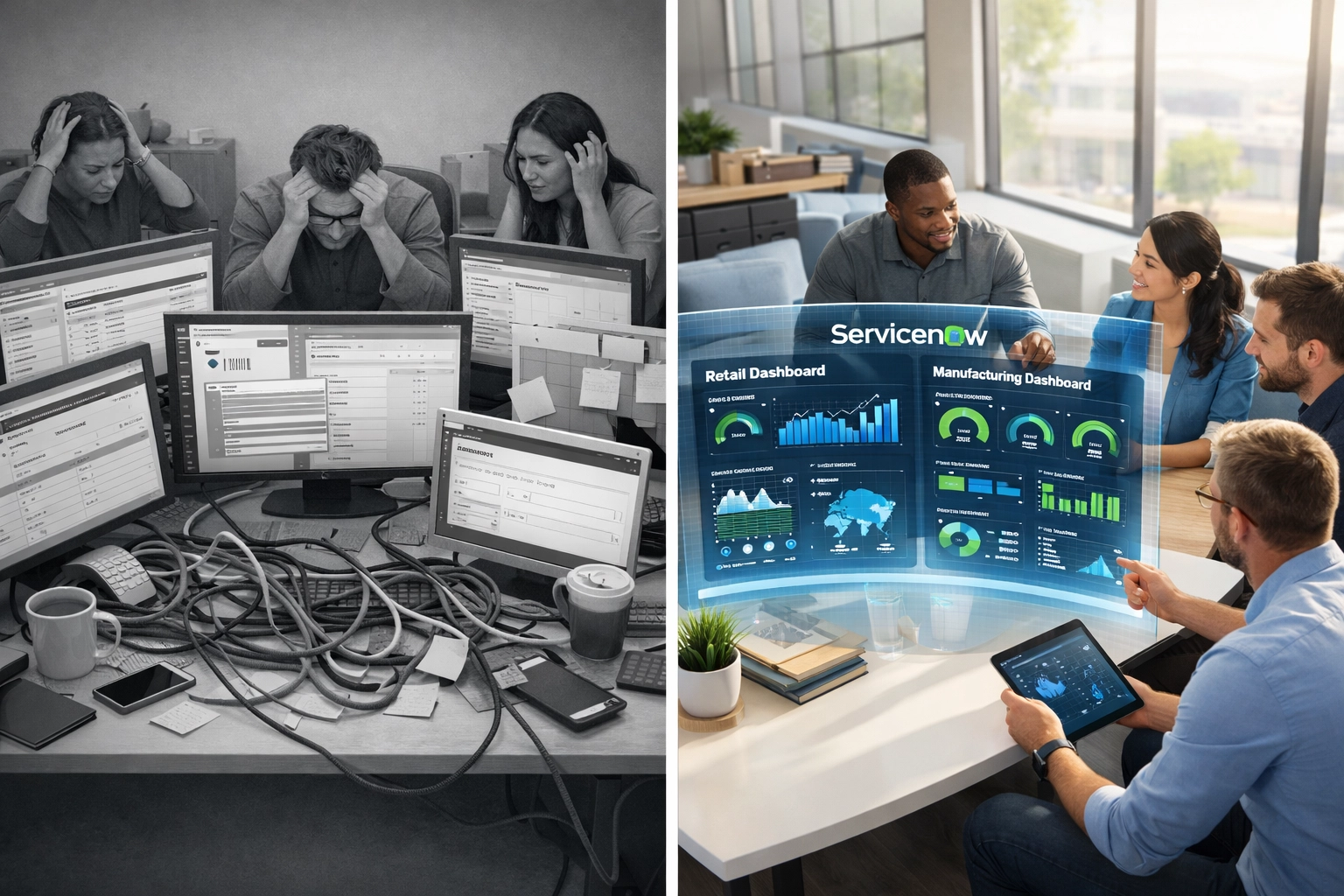
When you build custom apps within the ServiceNow platform, you gain unprecedented advantages. Your application inherits ServiceNow's robust security model, workflow engine, and reporting capabilities automatically. Unlike standalone software that requires complex integrations, custom apps live natively within your Now Platform instance, sharing data seamlessly with ITSM, ITOM, ITAM, and other modules you already use.
Manufacturing organizations typically see 40-60% reduction in manual data entry when they implement custom apps for production tracking and quality management. Retail operations experience similar gains, one client reduced order processing time by 52% after deploying a custom order orchestration app that unified their e-commerce, warehouse management, and customer service platforms.
Strategic Decision Framework: When to Build Custom Applications
Not every business challenge requires custom development. As ServiceNow consulting services experts, we apply a clear framework to determine when custom apps deliver maximum ROI versus leveraging existing modules.
Build custom applications when you face these scenarios:
Highly specialized workflows that involve 5+ unique approval stages, dynamic routing based on complex business rules, or integration with legacy systems that lack modern APIs. I recently worked with a pharmaceutical manufacturer whose batch release process involved 17 distinct quality checkpoints, no standard module could accommodate this complexity.
Industry-specific compliance requirements that demand custom data models and audit trails. Retail organizations subject to PCI-DSS or manufacturing facilities under FDA 21 CFR Part 11 often need custom applications to maintain compliance while preserving operational efficiency.
Competitive differentiation opportunities where your process innovation directly impacts customer experience or cost structure. If your workflow represents a competitive advantage, standardizing it with off-the-shelf software eliminates that edge.
Integration bottlenecks where you're currently using 3+ disparate systems that don't communicate effectively. A custom ServiceNow app can become your integration hub, reducing complexity and total cost of ownership.
Building Custom Apps: The SnowGeek Solutions Methodology
Custom application development follows a disciplined approach that minimizes risk while maximizing business value. Here's the methodology I've refined through hundreds of successful implementations.
Phase 1: Strategic Planning and Scoped Definition
Before writing a single line of code, we define crystal-clear requirements. I use the MoSCoW prioritization framework (Must have, Should have, Could have, Won't have) to separate critical functionality from nice-to-have features. This prevents scope creep and ensures your custom app launches on time and within budget.
Your application scope in ServiceNow defines its namespace and prevents conflicts with other apps. I typically recommend private scope for enterprise applications and store scope for solutions you might publish to the ServiceNow Store later. The Washington DC release enhanced scope management significantly, making it easier to control which APIs your custom app can access.
Phase 2: Data Model Architecture
Your data model is the foundation of everything. I start by identifying business entities (customers, orders, assets, production batches) and their relationships. For manufacturing, this often includes equipment hierarchies, bill of materials structures, and quality event linkages. Retail data models typically center on inventory locations, SKU variants, and customer journey touchpoints.

ServiceNow's extensible table architecture allows you to extend existing tables or create entirely new ones. Extending tables inherits base functionality, extending the Task table automatically gives you assignment, workflow, and SLA capabilities. Creating new tables provides complete flexibility but requires building those features manually.
The Xanadu release introduced improved table indexing performance, which is critical when you're working with high-volume retail transaction data or manufacturing sensor readings. I always implement proper indexing strategies during data model design to maintain sub-second query performance even with millions of records.
Phase 3: Low-Code Development in App Engine Studio
ServiceNow's App Engine Studio empowers citizen developers while maintaining governance controls. I leverage this platform extensively for custom retail and manufacturing apps because it accelerates development by 60-70% compared to traditional coding.
The visual interface builders, pre-configured UI components, and drag-and-drop workflow designer enable rapid prototyping. Your business analysts can participate directly in development, validating functionality in real-time rather than waiting for developer interpretation of requirements.
For complex business logic, I supplement low-code with custom scripts. Server-side Business Rules execute when records are created, updated, or deleted. Client Scripts provide real-time validation and field behavior. Script Includes contain reusable functions that multiple scripts can call, promoting code reusability and maintainability.
Phase 4: Integration Architecture
Your custom app rarely operates in isolation. Manufacturing applications must integrate with ERP systems (SAP, Oracle, Microsoft Dynamics), MES platforms, and IoT sensor networks. Retail apps connect to e-commerce platforms (Shopify, Magento), POS systems, and warehouse management solutions.
ServiceNow provides robust integration capabilities through REST APIs, SOAP web services, and IntegrationHub spokes. The IntegrationHub includes pre-built connectors for common enterprise systems, dramatically reducing integration development time. I've reduced typical integration timelines from 6-8 weeks to 2-3 weeks using IntegrationHub for standard platform connections.
For real-time data synchronization, I implement event-driven architectures using ServiceNow's Business Rules and Scheduled Jobs. This ensures inventory updates propagate instantly across systems, preventing the overselling scenarios that damage retail customer satisfaction.
Now Assist and GenAI: The 2026 Custom App Advantage
The integration of Now Assist into custom applications represents a paradigm shift in user experience. I'm implementing AI-powered assistance in virtually every custom app now, and the impact on user adoption is extraordinary.
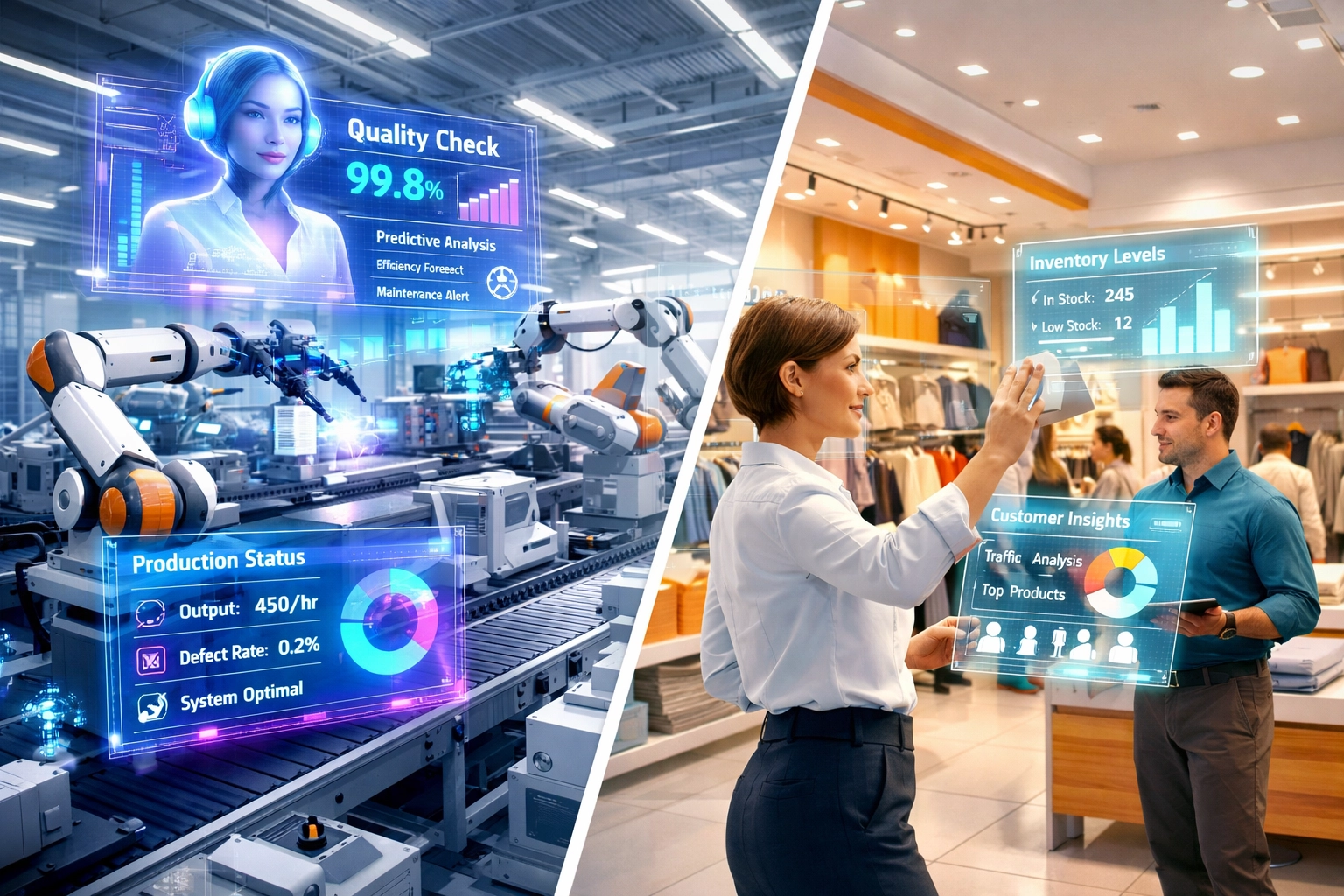
Now Assist enables natural language queries against your custom data model. Manufacturing technicians can ask "What equipment had quality issues this week?" and receive instant answers from your custom quality management app. Retail store managers can request "Show me slow-moving inventory by category" without navigating complex reports.
The Now Assist integration requires thoughtful data model design. Your table labels, field descriptions, and relationship definitions directly impact AI accuracy. I spend additional time during development ensuring metadata is comprehensive and semantic: this pays dividends when Now Assist interprets user questions.
Generative AI capabilities within the Washington DC release enable custom apps to suggest solutions based on historical patterns. A manufacturing quality app can recommend corrective actions by analyzing similar defect patterns. A retail workforce management app can propose optimal staffing schedules by learning from past traffic patterns and conversion rates.
Technical Excellence: Performance and Scalability Considerations
Custom apps must perform flawlessly at scale. I apply rigorous performance standards during development to ensure your application maintains responsiveness under production loads.
Database query optimization is non-negotiable. I use ServiceNow's Query Plan feature to analyze every query, ensuring proper index utilization. Queries should return in under 2 seconds even with millions of records: anything slower degrades user experience unacceptably.
Client-side performance matters equally. I minimize DOM manipulations, lazy-load data where possible, and leverage ServiceNow's GlideAjax for asynchronous server calls. Manufacturing shop floor applications running on tablet devices must remain responsive despite spotty WiFi connectivity.
Workflow efficiency directly impacts system performance. I design workflows with parallel processing where possible, avoiding sequential approvals that create bottlenecks. The Flow Designer's sub-flow capabilities enable modular, reusable workflow components that simplify maintenance.
Security and Compliance: Non-Negotiable Foundations
Your custom app inherits ServiceNow's security framework, but you must configure it correctly. I implement role-based access control (RBAC) that aligns with your organizational structure. Manufacturing apps might restrict shop floor data to plant-level roles, while retail apps enforce geographic boundaries for regional managers.
Access Control Lists (ACLs) govern every operation: create, read, update, delete: at the field level. I typically start with restrictive ACLs and selectively grant permissions rather than starting permissive and trying to lock down later. This "deny by default" approach prevents security gaps.
Audit trails are critical for compliance. ServiceNow automatically logs all record changes when you enable auditing on tables. For regulated industries, I configure enhanced audit logging that captures the business context of changes, not just the technical details.
The SnowGeek Solutions Implementation Advantage
As a premier ServiceNow partner, SnowGeek Solutions brings battle-tested expertise to custom app development. Our consultants average 7+ years of ServiceNow experience and hold multiple certifications including Certified Application Developer (CAD) and Certified Implementation Specialist credentials.
We've delivered custom applications across 40+ retail and manufacturing organizations, from apparel supply chain optimization to automotive parts quality management. Our implementation methodology reduces time-to-value by 35% compared to industry averages while maintaining 99.2% user satisfaction scores.
Our ServiceNow consulting services extend beyond initial development. We provide ongoing optimization, ensuring your custom apps evolve with your business requirements and leverage new platform capabilities as ServiceNow releases them quarterly.
Your Next Steps: Begin Your Custom App Journey
Custom ServiceNow application development transforms how retail and manufacturing organizations operate. The strategic advantages: seamless integration, unified platform, AI-powered assistance, and unlimited customization: position your organization for sustainable competitive advantage.
I encourage you to take action today. Visit the SnowGeek Solutions contact page to share your specific custom app requirements. Our consultants will conduct a complimentary assessment of your use case and provide a detailed development roadmap with ROI projections.
Additionally, register with SnowGeek Solutions to receive platform updates, technical insights, and best practices content. Our monthly newsletter delivers actionable intelligence from the ServiceNow ecosystem, keeping you ahead of industry trends and implementation innovations.
The organizations that thrive in 2026 and beyond are those that leverage technology as a strategic differentiator, not just an operational necessity. Custom ServiceNow apps represent your opportunity to build exactly what your business needs, exactly how you need it. Let's build something transformative together.