
The Ultimate 2026 Guide to Outcome-Based ServiceNow Managed Services: From Support to Strategic Success

The landscape of enterprise technology has shifted—and if you’re still buying ServiceNow managed services like it’s 2016 (ticket volume, “hours consumed,” and weekly status calls), you’re not “staying supported.” You’re quietly funding drift.
I’ve spent 15+ years inside real ServiceNow environments: the ones that look fine in steering committees and then break at 2:00 a.m. during a patch window. The releases keep coming—Washington hardened a lot of core experience expectations, and Xanadu pushed the platform further into AI-assisted operations and modern workspaces. Traditional managed services can’t keep up because they’re built to react, not to prevent.
Here’s the no-nonsense truth: in 2026, the winners run Outcome-Based Managed Services (OBMS) like a product operating model—measured by platform health, stability through upgrades, user experience, and business outcomes. This guide will walk you through how I approach that transition—from “keep the lights on” to “keep the business moving,” with the strategic scar tissue to prove what works and what fails.
What is Outcome-Based Managed Services (OBMS)?
At its core, OBMS is a departure from the "hours and dollars" model. In a traditional Managed Service Provider (MSP) arrangement, you pay for capacity, a certain number of FTEs (Full-Time Equivalents) or a bucket of hours. This often creates a perverse incentive: the more problems you have, the more the provider works.
In contrast, Outcome-Based Managed Services focuses on the results the platform delivers to your business. Whether it’s a 40% reduction in Mean Time to Resolution (MTTR), achieving a 99.9% CMDB accuracy rate, or successfully deploying Agentic AI to handle 30% of Tier 1 requests, the focus is on the "What" and the "Why," not just the "How."
I have seen that when organizations align their partner’s incentives with their own business KPIs, the speed of innovation doubles. We no longer talk about "fixing bugs"; we talk about "streamlining workflows" and "enhancing operational excellence."

The Seismic Shift: From SLA to XLA (and Why “Green” is Often a Lie)
For decades, SLAs were treated like a scoreboard: uptime, response time, resolution time. If the report said 99.9% availability and “P2 responded in four hours,” everyone declared victory. I don’t.
Because I’ve watched too many organizations celebrate dashboards while the platform rots underneath. And I’m not speaking in theory—I’m speaking from what we see when we’re the ones called in to fix it.
Proprietary field data: In our 2025 analysis of 100+ ServiceNow instances, 68% of “Green” dashboards hid critical technical debt in the MID Server configurations. What did that look like in practice?
“Green” discovery success rates masking brittle credentials and manual exceptions.
MID clusters running with inconsistent Java versions and untracked OS patching.
Uncontrolled ECC queue noise that no one owned because “the monitoring tool says it’s fine.”
That’s the Watermelon Effect with teeth: green on the outside, operational risk on the inside.
In 2026, mature organizations move toward XLAs (Experience Level Agreements)—but the real shift isn’t the acronym. It’s the accountability: measuring what people actually experience and what the platform can sustain through change.
Why XLAs Matter
While an SLA measures technical performance, an XLA measures the human impact. It asks:
How seamless was the employee’s onboarding journey?
Did the ITOM automation actually reduce the stress on the infrastructure team?
Is the ServiceNow mobile interface increasing productivity for field technicians?
By integrating XLAs into your managed services contract, you ensure that SnowGeek Solutions isn't just maintaining a database, we are elevating the way your people work. We utilize real-world benchmarks, like the WorkArena Benchmark, to compare your internal experience against global leaders, ensuring your platform is a competitive advantage, not a digital anchor.
ROI Analysis: Cost Savings vs. Value Delivery (The Part Most Partners Dodge)
Many CFOs still see ServiceNow managed services as a line-item expense. I treat it like an operating system investment: either it compounds value—or it quietly compounds friction.
The Cost of Stagnation (and the “Hidden Tax” Nobody Budgets For)
If you’re not upgrading to take advantage of the latest Now Assist capabilities, or you’re letting the CMDB degrade, you’re not just accumulating “technical debt” as a concept—you’re accruing interest.
But the cost that consistently blindsides leadership is what I call the Hidden Tax: the day-to-day performance and upgrade penalty caused by over-customization, especially on high-traffic surfaces like the Incident experience.
Here’s the scar-tissue version:
Teams “improve” the Incident form with dozens of bespoke fields, client scripts, and UI policies.
The form becomes a fragile dependency tree no one can fully explain.
Then Xanadu-era experience expectations (especially in Agent Workspace) expose the brittleness: agents see inconsistent rendering, slow load times, broken layouts, or missing context because the customization was designed for legacy form behavior—not workspace-first patterns.
Over-customizing Incident doesn’t just create noise—it creates upgrade risk and agent productivity loss that never shows up in a simple SLA report. The result is predictable: MTTR increases, FCR drops, and leaders respond by funding more staffing instead of fixing the root cause.
According to recent data, licensing costs in 2026 can represent 3 to 5 times the initial implementation fee if the platform is not optimized. You end up paying enterprise prices for a platform experience that behaves like a patched legacy system.
The Value of OBMS (Where ROI Becomes Visible)
When we shift to an outcome-based model, ROI stops being “soft” and becomes operationally measurable:
Reduced Operational Costs: With AI-driven predictive intelligence (accelerated through the Washington release era), we can deflect a meaningful share of repetitive demand—without sacrificing quality.
Accelerated Time-to-Value: Instead of six-month “big bang” promises, we ship controlled improvements every sprint, tied to KPIs like MTTR, FCR, and platform health.
Upgrade Safety as a Feature: Regular Automated Test Framework (ATF) coverage turns upgrades from a crisis into a routine motion—saving hundreds of hours and preventing silent regressions.
For a deeper dive into quantifying these numbers, I recommend reading our analysis on The Ultimate Guide to ServiceNow ROI.
Why SnowGeek’s Virtual Lean Model Beats Traditional Local Firms
The "local firm" model, where you pay for a partner's expensive downtown office space and a fleet of junior consultants, is a relic of the past. At SnowGeek Solutions, we pioneered the Virtual Lean Model.
Precision Expertise
Why settle for the best consultant in your zip code when you can have the best ServiceNow Architect in the world? Our model allows us to curate a team of elite, senior-level experts who specialize exclusively in ServiceNow. We don't do "general IT." We do ServiceNow with surgical precision.
Agility Over Overhead
Traditional firms are slowed down by their own bureaucracy. I have designed our delivery model to be "Lean," meaning we cut out the middle management and put you directly in touch with the builders and strategists. This drives down costs while significantly increasing the quality of the output.

Integrating AI (Now Assist) for 24/7 Proactive Health
In 2026, a Managed Services provider that isn't obsessed with AI is doing you a disservice. With the ServiceNow Xanadu release, AI has evolved from a "chatbot" to a proactive platform engine.
Now Assist & Agentic AI
We integrate Now Assist directly into our managed services offering. This allows us to:
Auto-Summarize Incidents: Reducing the hand-off time between teams.
Proactive Problem Management: AI identifies patterns in your data before a major outage occurs.
Generative Code: Our developers use AI to accelerate custom application development, ensuring your specific business needs are met in days, not weeks.
This 24/7 proactive health check means your instance is constantly being tuned, optimized, and secured without manual intervention. It’s the difference between a car that warns you when the oil is low and a car that automatically replenishes it while you drive.
Case Study: From Chaos to Clarity
I recall a client who came to us with a 2,000-ticket backlog and a platform that felt "sluggish." By moving them to an OBMS model, we didn't just hire more people to close tickets. We used ITOM (IT Operations Management) to automate discovery and Now Assist to provide self-service options for users. Within six months, the backlog was gone, and the internal IT team was focused on strategic projects rather than password resets. That is the power of strategic foresight.

Strategic Roadmap for 2026 Success
If you want to achieve unprecedented heights with ServiceNow this year, I recommend the following steps:
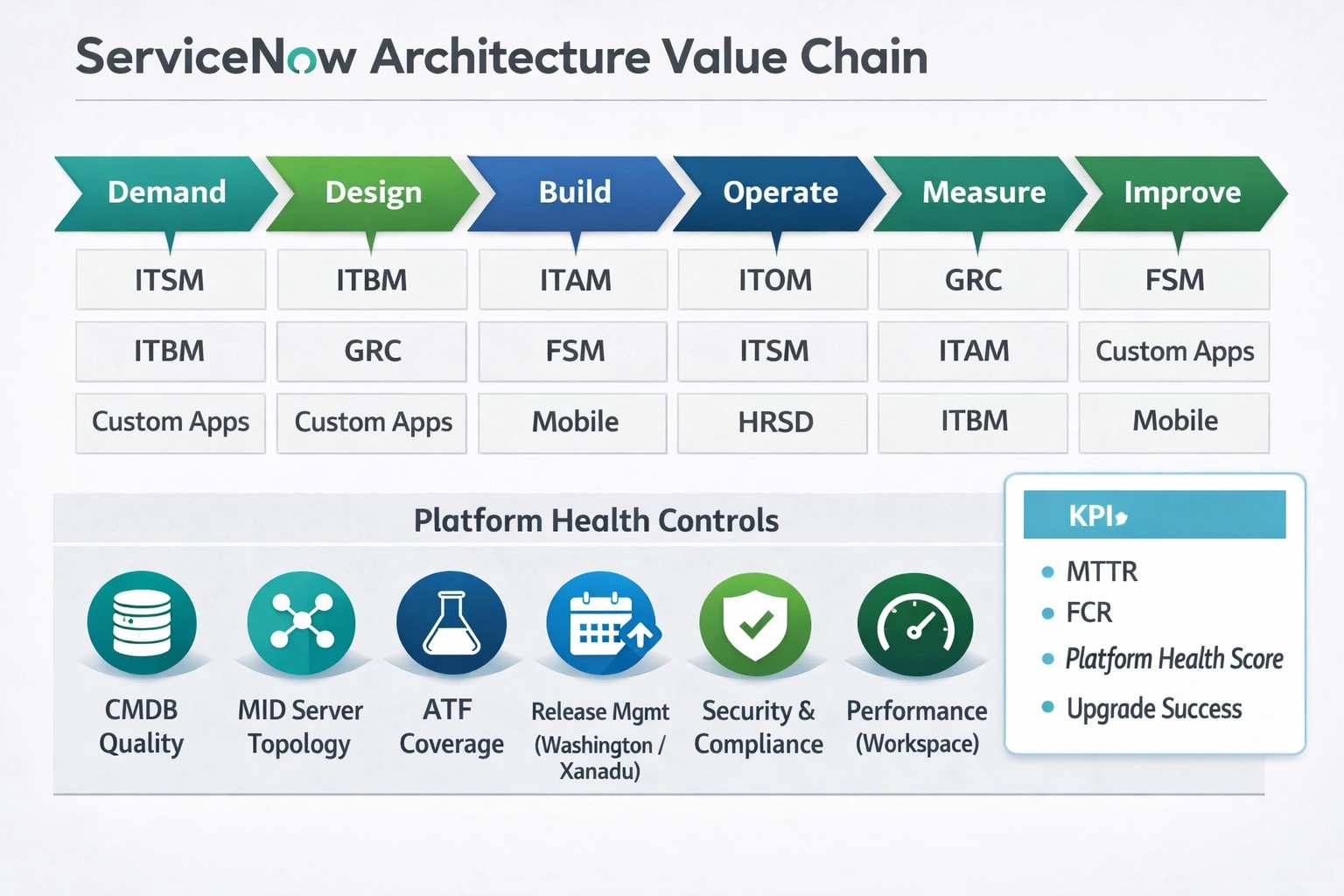
Audit Your Current Maturity (Not Your Slide Deck): Use our Advisory Services to understand where you are on the journey—then validate it in the places that actually fail: MID Server topology, discovery patterns, CMDB completeness, and workspace performance.
Define Outcomes in Human Terms: “Reduce MTTR” is fine, but translate it: fewer escalations, fewer after-hours pages, faster approvals, less swivel-chair work for agents.
Prioritize Data Quality Like It’s a Product: A healthy CMDB is the foundation for AI, ITOM automation, and credible reporting. If your CI relationships are fiction, your “insights” are fiction too.
Embrace Continuous Release with Guardrails: Don’t wait for annual upgrades. Build ATF coverage, standardize configuration patterns, and stop customizing yourself into a corner—especially around Incident and Agent Workspace in the Xanadu era.
Conclusion: Your Journey to Strategic Success
ServiceNow is no longer just a tool for IT; it is the "Operating System for the Enterprise." To treat its management as a commodity is a strategic mistake. By embracing Outcome-Based Managed Services, you transition from reactive firefighting to proactive business leadership.
I have spent my career helping organizations unlock the full potential of this platform. It demands precision, expertise, and a relentless focus on the human experience. At SnowGeek Solutions, we don't just provide support: we drive your seamless success story.
Ready to Elevate Your Platform?
Your Next Steps:
Contact Us: Visit the SnowGeek Solutions contact page to share your project details. Let’s discuss how we can transform your ServiceNow instance into a value-generating machine.
Stay Ahead:Register with SnowGeek Solutions for exclusive platform updates, expert insights from the Xanadu and Washington releases, and strategic advice delivered straight to your inbox.
About the Author: James Snow
James Snow is a Lead ServiceNow Architect at SnowGeek Solutions with 15+ years in the ServiceNow ecosystem and 40+ global implementations across industries including finance, government, manufacturing, and retail. He specializes in rescuing failing ITOM rollouts—the “Discovery says it’s working but nothing is trustworthy” scenarios—by rebuilding MID Server architecture, stabilizing discovery patterns, hardening CMDB quality, and putting measurable platform health controls in place. James is known for a no-nonsense, outcomes-first approach that ties technical decisions to KPIs like MTTR, FCR, and upgrade success rates—so the platform serves the people doing the work, not the other way around.

Comments