
ServiceNow Consulting Services Pricing 2026: What You're Actually Paying For (And How to Slash ITAM Costs Before Q2)
- SnowGeek Solutions
- Feb 18
- 5 min read

Let me be blunt: if you're budgeting for ServiceNow consulting services in 2026 without understanding exactly where your money goes, you're already overpaying. I have witnessed firsthand how organizations burn through implementation budgets by failing to distinguish between essential consulting work and unnecessary customization overhead: especially in ITAM and ITOM deployments where license sprawl quietly drains six figures annually.
After guiding dozens of enterprises through ServiceNow implementations across US and EU markets, I can tell you that pricing transparency isn't just about hourly rates. It's about understanding the strategic value you're purchasing and identifying where legitimate investment ends and waste begins. This guide will walk you through the real cost structure of ServiceNow consulting services in 2026 and reveal specific tactics to reduce ITAM costs before Q2 closes.
The 2026 Pricing Reality: What Certified Partners Actually Charge
ServiceNow implementation partner rates have stabilized around $150-$250 per hour for certified consultants in the United States, with European rates hovering at €140-€230 depending on regulatory complexity. But that headline number means nothing without context.
Here's what you're actually funding:
Initial Consultation and Discovery ($20,000-$500,000)
This isn't just a few discovery calls. For mid-sized organizations, consultation fees range from $20,000 to $50,000 and cover business process mapping, integration assessment, and customization roadmapping. Enterprise-scale consultations: especially those requiring DORA compliance planning or cross-border data governance for EU operations: typically run $100,000 to $500,000.
I recently worked with a financial services firm where proper discovery saved them $340,000 in avoided customizations by identifying out-of-box Washington DC release capabilities that met their DORA technical screening requirements without custom development.

Implementation Services ($30-$80/hour or $400-$600/day)
The implementation work itself is charged either hourly or daily depending on project structure. Small to medium business implementations average $20,000-$50,000 for basic ITSM setup. Mid-size foundational builds with ITOM integration typically fall between $150,000-$450,000. Large enterprise multi-module deployments start at $100,000 and can exceed $500,000. Global multi-instance rollouts with regulatory considerations like GDPR data residency requirements range from $1.2 million to $4.5 million.
What separates smart investments from bloated ones? Clarity on modular scope. ServiceNow's pricing model means you only pay for specific modules you activate. I have seen organizations slash 40% from projected costs by deferring non-critical modules to Phase 2 implementations.
Portal Customization and User Experience ($10,000-$100,000)
ServiceNow portal customization: branding, UX design, workflow automation, and third-party integrations: adds between $10,000 and $100,000 depending on complexity. The critical insight here: customization typically adds 50-60% on top of base license fees.
For US organizations focused on ROI optimization, I recommend leveraging the Xanadu release's enhanced Now Mobile capabilities and AI-powered workspace personalization features before building custom interfaces. These out-of-box tools deliver 70-80% of what most organizations actually need.
Ongoing Support and Annual Maintenance ($200-$50,000)
Annual maintenance starts around $200 for small deployments but scales to $5,000-$50,000 for enterprise service levels. This covers software upgrades, technical support, and access to ServiceNow's Now Learning platform. The variance depends on whether you're maintaining a basic ITSM instance or supporting complex ITOM discovery across hybrid cloud environments with continuous compliance monitoring.
The Hidden ITAM Cost Drain (And How to Stop It Before Q2)
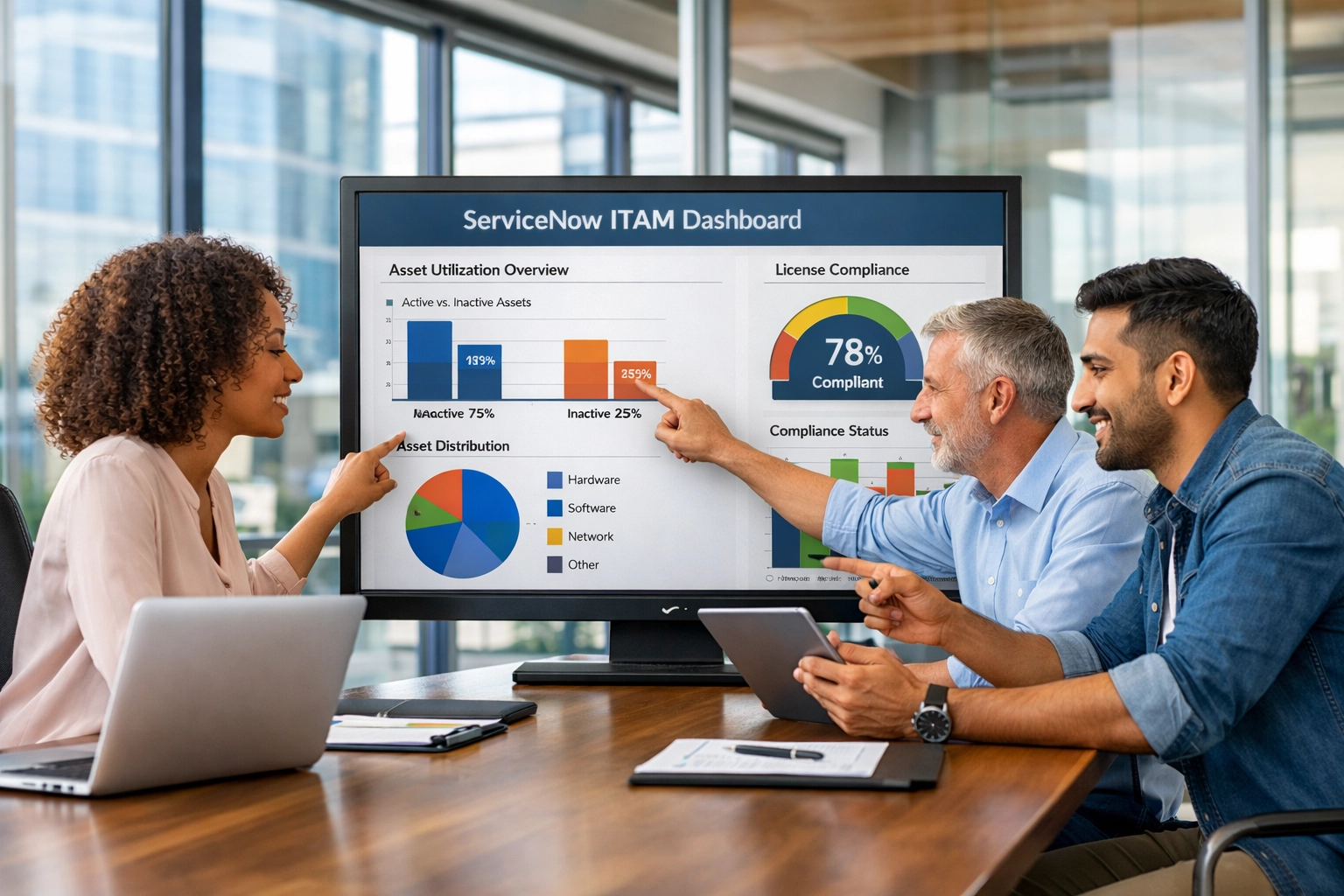
ITAM represents the single largest opportunity to reduce ServiceNow total cost of ownership before Q2 ends. I have witnessed enterprises hemorrhaging budget through three primary cost vectors:

Unlicensed User Proliferation
ServiceNow licenses are tied to user roles. The average enterprise accumulates 15-20% inactive or over-privileged user accounts within the first 18 months. At $100-$150 per user annually for standard licenses (and up to $500 for specialized roles), that's $75,000-$150,000 in annual waste for a 500-user deployment.
Solution: Implement automated user access reviews leveraging ServiceNow's Identity and Access Management capabilities introduced in the Washington release. Set quarterly recertification workflows that force department heads to validate user requirements. One manufacturing client reduced licensed users by 18% ($127,000 annually) using this approach.
Software Asset Sprawl
Poor ITAM governance leads to redundant software purchases, compliance violations, and audit penalties. Organizations without automated software asset lifecycle management typically overspend by 30-40% on software procurement.
The Washington DC release enhanced ServiceNow's ITAM Pro module with improved software normalization and vendor management capabilities. By centralizing software requests through ServiceNow Service Catalog and automating approval workflows based on existing entitlements, you can prevent duplicate purchases before they occur.
Hardware Asset Underutilization
I recently conducted a free ServiceNow ROI and license audit for a European logistics company. We discovered €380,000 worth of server hardware marked "in production" but generating zero network activity for 14+ months. Their ITOM Discovery module wasn't configured to flag dormant assets.
Immediate Action Steps for Q2:
Run a comprehensive ITAM audit using ServiceNow's built-in Health Log and Scan tool to identify inactive assets
Enable automated decommissioning workflows that trigger after 90 days of inactivity
Integrate ITAM with procurement systems to enforce redeployment checks before new purchases
Leverage Predictive Intelligence in the Xanadu release to forecast hardware refresh needs based on actual utilization patterns
2026 Market Shifts: Agentic AI and Regulatory Compliance
Two forces are reshaping ServiceNow consulting services pricing in 2026:
Agentic AI and ROI Acceleration (US Focus)
ServiceNow's Now Assist and Agent Builder capabilities introduced in recent releases are transforming ITSM economics. Organizations implementing AI-powered virtual agents report 40-60% reduction in Level 1 ticket volume and 25-35% improvement in First Contact Resolution (FCR) rates.
From a pricing perspective, this means higher upfront consulting investment in AI enablement ($50,000-$150,000 for proper training data preparation and agent development) but 12-18 month payback periods through reduced support headcount requirements.
DORA and ESG Compliance (EU Focus)
European organizations face mandatory Digital Operational Resilience Act (DORA) compliance by January 2025. ServiceNow's ITOM and Integrated Risk Management modules provide critical capabilities for continuous monitoring, incident response orchestration, and audit trail documentation.
I have worked with three financial institutions preparing DORA documentation. The pattern is consistent: organizations that integrate DORA requirements into initial ServiceNow implementations spend 30-40% less on compliance preparation than those retrofitting capabilities post-deployment.
ESG reporting requirements are similarly reshaping ITAM strategies. ServiceNow's Hardware Asset Management module now includes carbon footprint tracking for IT assets, enabling automated ESG metric collection without separate reporting tools.
Strategic Partnership Selection: Not All ServiceNow Implementation Partners Are Equal
The difference between a $200,000 implementation that delivers transformational value and a $200,000 implementation that becomes a costly maintenance burden comes down to partner selection.
Key Evaluation Criteria:
Certified consultant depth: Verify your partner maintains multiple Certified Implementation Specialists (CIS) across relevant modules (ITOM, ITAM, ITSM)
Release knowledge: Partners should demonstrate active deployment experience with Washington DC and Xanadu features, not just theoretical knowledge
ROI methodology: Demand specific KPI frameworks: MTTR reduction targets, FCR improvement projections, platform health score benchmarks
Regulatory expertise: For EU deployments, verify GDPR and DORA implementation experience with documented compliance outcomes
I have consistently observed that organizations working with specialized ServiceNow implementation partners achieve 25-40% faster time-to-value compared to those using generalist IT consultancies attempting ServiceNow deployments.

Your Next Steps: Transform ServiceNow Investment Into Measurable ROI
The gap between ServiceNow's transformative potential and actual organizational outcomes depends on three factors: strategic implementation planning, disciplined scope management, and continuous optimization.
If you're planning a 2026 ServiceNow deployment or questioning whether your current instance delivers adequate ROI, I encourage you to take two immediate actions:
First, visit the SnowGeek Solutions contact page to share your specific project details. Whether you're tackling DORA compliance, optimizing ITAM costs, or implementing ITOM discovery across hybrid cloud environments, our team provides the technical depth and strategic foresight necessary for successful ServiceNow transformations.
Second, register with SnowGeek Solutions for platform updates and expert insights. We regularly publish analysis of new ServiceNow releases, cost optimization strategies, and implementation best practices tailored to both US ROI-focused deployments and EU regulatory compliance requirements.
The pricing transparency you need starts with understanding exactly what you're purchasing: and demanding measurable outcomes from every dollar invested. The difference between serviceable implementations and transformative ones often comes down to the expertise and accountability your ServiceNow consulting services partner brings to the engagement.
Don't let Q2 close without addressing ITAM cost leakage or validating your current ServiceNow investment delivers the operational excellence you're paying for. Take action today, and let's elevate your ServiceNow instance to unprecedented heights.
Comments