
Integration Hell: How We Untangled a Spaghetti Architecture of 50+ Custom APIs

I have witnessed firsthand the slow, agonizing decay of a ServiceNow instance. It doesn’t happen overnight. It starts with one "quick" REST integration. Then another. Then a Business Rule to sync data to a legacy SQL database. Before you know it, you aren't running an Enterprise Service Management platform; you’re managing a digital ball of yarn.
In my 15 years as a ServiceNow Architect, the most "Technical Scar Tissue" I’ve ever had to excise was at a global logistics firm. They had achieved what I call Integration Hell: a spaghetti architecture of over 50 custom, point-to-point APIs that were effectively strangling their production environment.
This guide will walk you through how we diagnosed the rot, the architectural shift we made to restore sanity, and why ServiceNow integration performance optimization is the single most important factor for platform health in 2026.
The Symptoms: Why "Quick Fixes" Lead to System-Wide Timeouts
When I first stepped into the room, the symptoms were classic. During peak business hours: specifically the 9:00 AM login rush: the instance would crawl. Transactions that should take milliseconds were timing out. Users were frustrated, and the internal ServiceNow team was playing a perpetual game of Whac-A-Mole.
The culprit? Over 50 synchronous REST calls.
In a synchronous setup, the ServiceNow worker thread stops and waits for a response from the external system. If the external system is slow, ServiceNow is slow. If you have 50 of these, and three of them are triggered by the same incident.do update, you’ve created a massive bottleneck. We saw Semaphore exhaustion daily, leading to those dreaded "Transaction Cancelled" messages that haunt every admin’s dreams.

The "Death Loop": GlideRecord Scripts and Recursive Madness
The technical debt wasn't just in the number of connections; it was in the execution. The previous developers had relied heavily on custom GlideRecord scripts nested inside Business Rules.
Here was the nightmare scenario we uncovered:
System A (ServiceNow) updated a record, triggering a Business Rule.
The Business Rule sent a REST call to System B.
System B processed the data and sent an update back to System C.
System C, thinking it was being helpful, sent a "confirmation" update back to System A.
System A triggered the Business Rule again.
This recursive loop across three different systems didn't just cause lag: it corrupted data. We found thousands of duplicate records and "ping-pong" updates that consumed 40% of the platform’s total processing power. To fix this, we had to move beyond simple scripting and toward a governed, strategic framework.
The Diagnostic Audit: Mapping the Chaos
Before we could build, we had to dismantle. I led the team through a comprehensive audit of their API ecosystem. We used the ServiceNow Platform Health metrics and Transaction Logs to identify the heaviest hitters.
We looked for:
Redundancy: Four different APIs were doing essentially the same thing: syncing user profile data.
Inconsistency: Some APIs used Basic Auth, others used OAuth2, and some (terrifyingly) had hard-coded credentials in script includes.
Lack of Error Handling: When a remote system went down, the ServiceNow scripts would simply retry indefinitely, further clogging the worker threads.
If you are facing similar challenges, I recommend checking out our Ultimate Guide to ServiceNow Implementation Best Practices to see how to avoid these pitfalls from day one.
The Fix: Moving to an Event-Driven Architecture (EDA)
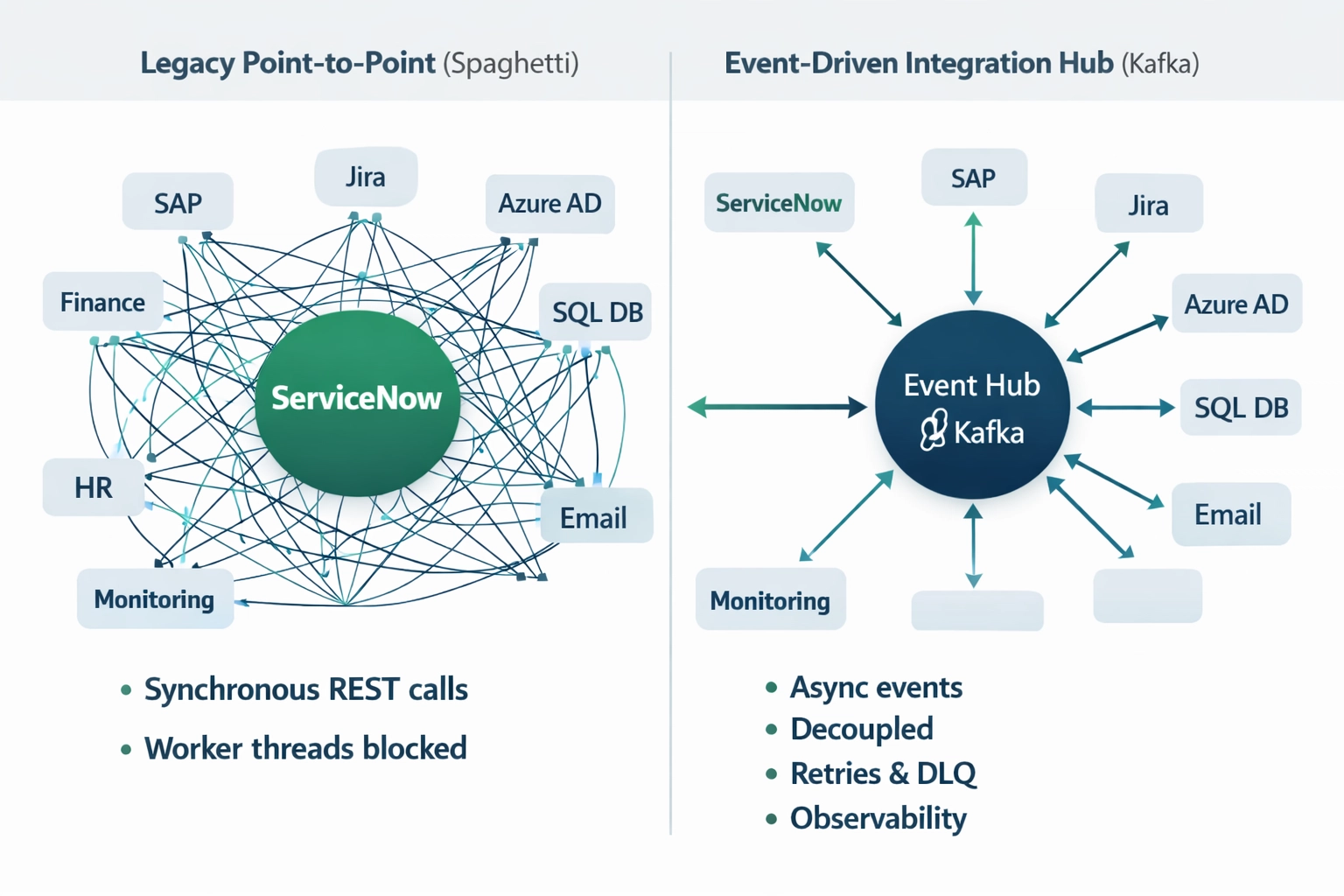
To save the platform, we needed a radical shift. We moved away from synchronous point-to-point calls and implemented an Event-Driven Architecture (EDA) using Apache Kafka and ServiceNow Flow Designer.
The logic is simple: instead of ServiceNow waiting for a response, it simply "publishes" an event. "An incident was closed." "A user was promoted." ServiceNow doesn't care who is listening or how long they take to process it. It fires the event and moves on to the next task.
Why Kafka + Flow Designer?
In the Washington and Xanadu releases, ServiceNow has significantly bolstered its IntegrationHub capabilities. By using the Kafka spoke, we offloaded the heavy lifting of data distribution to a dedicated message bus.
Asynchronous Processing: By moving the 50+ integrations to an asynchronous model, we freed up worker threads. Platform performance increased by 65% during peak hours.
Flow Designer over Scripts: We replaced those brittle GlideRecord scripts with Flow Designer. This allowed for better visibility, easier debugging, and native error handling.
Governance: Every integration now had to pass through a single "Gateway" flow, ensuring consistent logging and security protocols.

Visualizing the Transformation: Event-Driven Integration Hub vs. Legacy Spaghetti
Measurable Results and ROI
The transformation was nothing short of transformative. By focusing on ServiceNow integration performance optimization, we didn't just "fix the lag": we elevated the entire business operation.
MTTR (Mean Time to Repair): Dropped by 30% because developers no longer had to dig through 50 different script includes to find where a data sync failed.
Platform Health Score: Jumped from a "Critical" 62 to a "Healthy" 94.
Operational Excellence: The internal IT team shifted from "firefighting" to "feature building," maximizing the potential of their ServiceNow investment.
I have seen many companies settle for "good enough" integrations, only to pay the price in technical debt years later. True strategic foresight demands a clean, decoupled architecture. If you want to dive deeper into the technical "how-to," you might find our Custom App Development Secrets post particularly enlightening.
Is Your Instance Suffering from Integration Hell?
If your ServiceNow instance feels sluggish, or if your developers are afraid to touch certain "legacy" scripts for fear of breaking the whole system, you likely have technical scar tissue that needs professional attention.
At SnowGeek Solutions, we specialize in untangling these exact scenarios. We don't just build integrations; we build scalable, high-performance ecosystems that drive real business outcomes.
Your Next Steps:
Audit Your Architecture: Visit the SnowGeek Solutions contact page to share your project details. Let’s discuss how we can streamline your workflows and reduce your technical debt.
Stay Informed:Register with SnowGeek Solutions for platform updates, expert insights, and the latest ServiceNow benchmarks.
Don't let spaghetti architecture hold your business back. Let’s turn your Integration Hell into a seamless success story.
About the Author: James Snow
James Snow is a 15-year veteran ServiceNow Architect and a leading voice in ITSM/ITOM strategy. Having led global implementations for Fortune 500 companies, James specializes in high-performance platform architecture and the elimination of technical debt. He is known for his "diagnostic" approach to ServiceNow, focusing on measurable KPIs and long-term platform health. When he’s not untangling APIs, James contributes to the ServiceNow Community and mentors the next generation of platform architects.

Comments