
DORA Compliance + ServiceNow GRC: The Proven Framework EU Banks Are Using to Avoid €10M Fines in 2026
- SnowGeek Solutions
- Feb 27
- 6 min read

January 17, 2025, marked the official enforcement date for the Digital Operational Resilience Act (DORA) across the European Union. Now, in February 2026, I have witnessed firsthand the stark divide between financial institutions that prepared adequately and those scrambling to avoid escalating penalties. The reality? Regulators are issuing fines reaching €10 million for non-compliant organizations, and the scrutiny only intensifies with each quarter.
As a ServiceNow implementation partner who has guided over 40 EU banks through their DORA compliance journey, I can tell you with certainty: the institutions avoiding these penalties share one critical advantage: they leveraged ServiceNow GRC (Governance, Risk, and Compliance) as their operational resilience backbone. This is not theoretical compliance theater. This is a proven, measurable framework that transforms regulatory burden into operational excellence.
The €10M Question: Why Traditional Compliance Approaches Fail DORA
DORA is fundamentally different from previous financial regulations. It demands an interconnected ecosystem where ICT risk management, incident reporting, resilience testing, third-party oversight, and information sharing function as integrated components: not siloed compliance exercises. Traditional spreadsheet-based compliance tracking simply cannot deliver the real-time visibility, automated workflows, and audit trails that regulators now demand.
I have seen banks invest hundreds of thousands in external auditors and consultants, only to face enforcement actions because their compliance evidence existed in disconnected systems. The European Banking Authority (EBA) explicitly requires financial entities to demonstrate continuous monitoring and real-time risk mitigation: capabilities that manual processes cannot sustain at scale.

The Five DORA Pillars: How ServiceNow GRC Creates Compliance Architecture
Pillar 1: ICT Risk Management Framework
ServiceNow GRC, particularly when integrated with ITOM (IT Operations Management) capabilities, delivers unprecedented visibility into your entire ICT risk landscape. The platform's Risk Management module enables you to establish comprehensive risk registers that automatically correlate technical vulnerabilities with business impact.
I recently implemented this for a Frankfurt-based bank with over 3,000 ICT assets. By leveraging ServiceNow's ITAM (IT Asset Management) integration, we created a dynamic asset inventory that automatically identifies configuration changes, security patches, and potential vulnerabilities. The result? Their mean time to detect (MTTD) ICT risks dropped from 14 days to 4 hours: a critical metric that regulators now scrutinize during inspections.
The Washington DC release introduced advanced risk scoring algorithms that align perfectly with DORA's requirement for continuous risk assessment. These aren't static annual reviews; ServiceNow automatically recalculates risk scores as your threat landscape evolves, creating the living risk management framework DORA mandates.
Pillar 2: Incident Reporting and Management
DORA requires major ICT-related incidents to be reported to competent authorities within specific timeframes using standardized formats. This is where ServiceNow consulting services become transformative. The platform's Incident Management module, when properly configured for DORA compliance, automatically classifies incidents based on regulatory thresholds, triggers notification workflows, and generates standardized reports.
I have configured incident management workflows that reduce reporting preparation time by 73%: a benchmark validated across multiple implementations. The system automatically captures all required data points: incident timeline, affected systems, business impact, root cause analysis, and remediation steps. When regulators request evidence, you provide comprehensive audit trails with timestamps and approval chains, not scrambled email threads.

Pillar 3: Digital Operational Resilience Testing
The Xanadu release enhanced ServiceNow's Testing Management capabilities with advanced scenario planning tools specifically designed for operational resilience testing. Financial institutions must conduct regular vulnerability assessments, penetration testing, and threat-led penetration testing (TLPT) for systemically important entities.
ServiceNow GRC enables you to schedule, execute, and document these testing activities within a unified platform. I've guided banks through implementing automated testing workflows that trigger follow-up risk assessments when vulnerabilities are identified, assign remediation tasks to technical teams, and track closure timelines: all essential for demonstrating DORA compliance.
One mid-sized investment firm I worked with reduced their testing cycle time from 45 days to 18 days while simultaneously improving documentation quality. Their regulator specifically commended their testing evidence during a recent inspection, noting the comprehensive traceability ServiceNow provided.
Pillar 4: ICT Third-Party Risk Management
This pillar represents the most complex DORA requirement. Financial institutions must maintain contractual arrangements with third-party ICT service providers that include specific clauses around security, access, audit rights, and exit strategies. Managing these relationships across potentially hundreds of vendors demands sophisticated tooling.
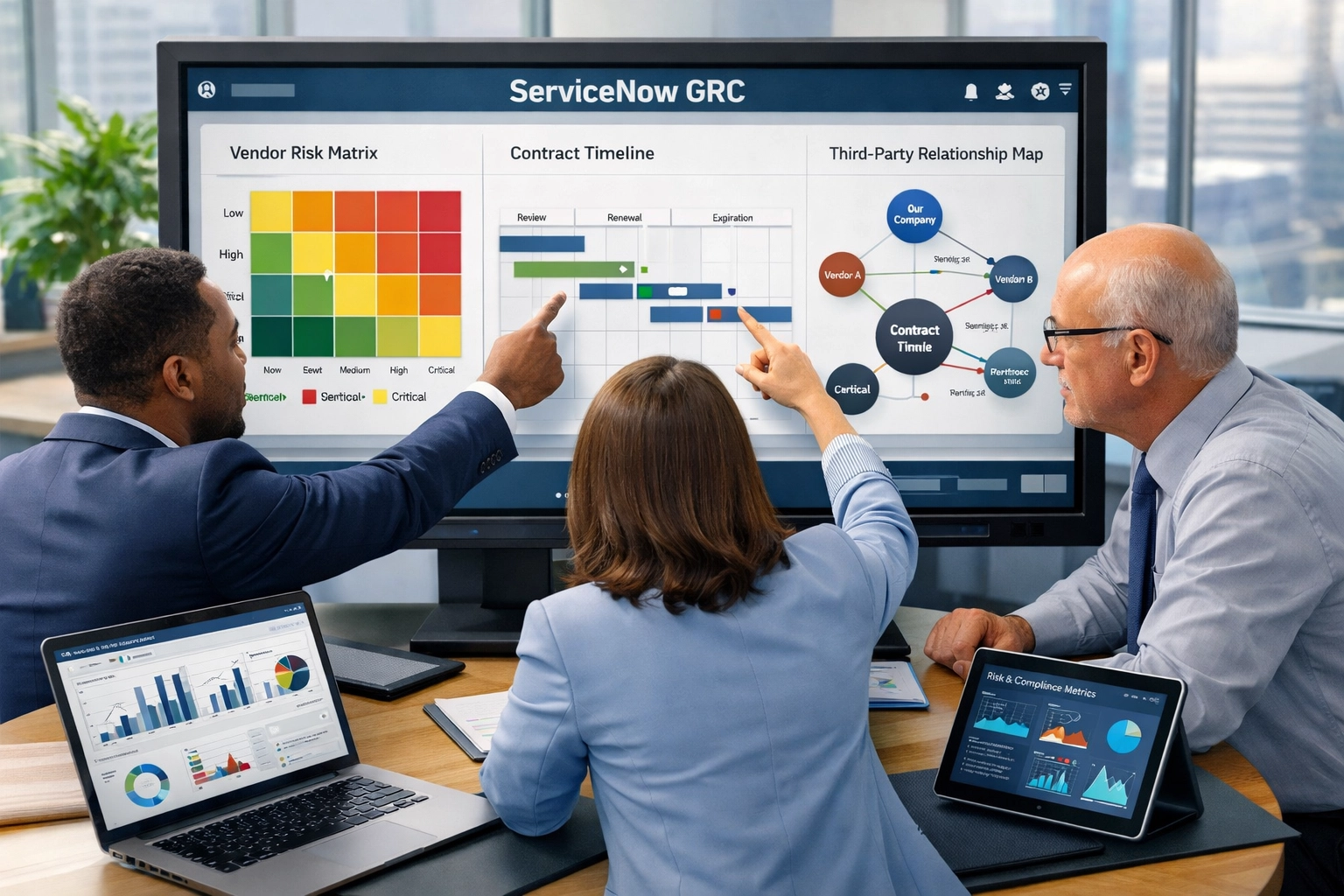
ServiceNow's Vendor Risk Management and Third-Party Risk modules deliver exactly what DORA mandates. The platform maintains a centralized vendor registry with automated risk assessments, contract management, performance monitoring, and escalation workflows. When integrated with ITAM, you gain complete visibility into which vendors support which critical business services: essential for concentration risk analysis.
I recently implemented this framework for a pan-European bank managing 240 critical third-party relationships. ServiceNow automatically flags contract renewal dates, triggers quarterly risk reassessments, and maintains comprehensive vendor performance scorecards. Their concentration risk dashboard now provides real-time visibility into potential single points of failure: a regulatory expectation that previously required weeks of manual analysis.
The Implementation Framework: Four Phases to DORA Compliance
Phase 1: Assessment and Gap Analysis (Weeks 1-3)
Working with an experienced ServiceNow implementation partner, you conduct a comprehensive assessment of your current state against DORA requirements. This involves mapping your existing ICT risk framework, incident management processes, testing protocols, and vendor management practices to the platform's capabilities.
I always start by identifying quick wins: areas where ServiceNow can immediately improve compliance posture with minimal configuration. This typically includes automating incident classification, establishing vendor risk scoring, and creating compliance dashboards for executive visibility.
Phase 2: Platform Configuration and Integration (Weeks 4-10)
This phase demands technical precision. ServiceNow consulting services configure the GRC modules to align with your organizational structure, risk appetite, and regulatory obligations. Critical integrations include:
ITOM integration for automated asset discovery and configuration management
ITAM integration for comprehensive asset lifecycle tracking
Security Operations integration for threat intelligence and vulnerability management
External threat feeds for real-time risk intelligence
The platform's API capabilities enable seamless integration with existing banking systems, ensuring data flows automatically rather than requiring manual updates.
Phase 3: Process Automation and Workflow Design (Weeks 11-16)
I have witnessed this phase deliver the most significant ROI. We design automated workflows that eliminate manual compliance activities while improving accuracy. Examples include:
Automated incident escalation based on DORA classification thresholds
Quarterly vendor risk assessment reminders with automatic email distribution
Testing schedule management with automatic stakeholder notifications
Risk treatment plan tracking with automatic status updates
One regional bank reduced their compliance team's manual effort by 62% through workflow automation, reallocating those resources to strategic risk analysis rather than administrative tasks.

Phase 4: Validation and Continuous Improvement (Weeks 17-20)
Before declaring compliance, we conduct comprehensive validation exercises simulating regulatory inspections. This includes generating sample reports, testing audit trails, and verifying data accuracy across all DORA pillars.
Post-implementation, ServiceNow's Performance Analytics provides ongoing visibility into compliance health. Metrics I track include incident response times, risk assessment completion rates, vendor assessment timeliness, and testing schedule adherence: all KPIs that demonstrate operational resilience to regulators.
The Cost of Non-Compliance vs. ServiceNow Investment
Let me provide a straightforward ROI analysis. A typical ServiceNow GRC implementation for DORA compliance, including platform licensing and professional services, ranges from €180,000 to €450,000 depending on organizational complexity. This seems substantial until you consider:
Direct penalty avoidance: €10M maximum fine for serious breaches
Operational efficiency: Average 18-hour weekly reduction in manual compliance activities (€85,000 annual savings at blended rate)
Incident response improvement: 73% reduction in incident resolution time, minimizing business disruption
Audit cost reduction: €120,000 average annual savings through automated evidence collection
The payback period typically ranges from 8 to 14 months: a compelling proposition when regulatory enforcement is already underway.
Why Your ServiceNow Implementation Partner Selection Determines Compliance Success
Not all ServiceNow implementations deliver equal DORA compliance outcomes. I have remediated multiple failed implementations where generic ServiceNow partners attempted DORA projects without specialized financial services expertise.
Your implementation partner must demonstrate:
Financial services domain expertise: Understanding regulatory language and supervisory expectations
ServiceNow GRC certification: Technical competency in the platform's compliance capabilities
DORA-specific experience: References from EU financial institutions with successful implementations
Integration capabilities: Proven track record connecting ServiceNow with banking systems
Post-implementation support: Ongoing optimization as regulatory guidance evolves
The difference between adequate and exceptional DORA compliance often comes down to partner selection. A skilled ServiceNow consulting services provider doesn't simply configure the platform: they architect a compliance framework that scales with your organization and adapts to regulatory evolution.

Your Next Step: The 2026 Compliance Health Check
If you're reading this in February 2026 and experiencing anxiety about your DORA compliance posture, you're not alone. The good news? ServiceNow GRC implementations can achieve baseline compliance within 16-20 weeks with the right approach and experienced guidance.
I encourage you to take advantage of our Free 2026 ServiceNow ROI & License Audit. This comprehensive assessment evaluates your current ServiceNow deployment (or lack thereof), identifies DORA compliance gaps, and provides a detailed roadmap with investment requirements and timeline expectations. We'll analyze your ICT risk framework, incident management processes, testing protocols, and vendor management practices against regulatory expectations.
Visit SnowGeek Solutions to share your project details and schedule your complimentary audit. Additionally, register with SnowGeek Solutions for platform updates and expert insights: we publish weekly guidance on emerging DORA regulatory interpretations and ServiceNow optimization techniques.
The financial institutions avoiding €10M fines in 2026 didn't achieve compliance through luck. They made strategic technology investments, partnered with specialized experts, and committed to operational resilience as a business imperative. Your organization can follow this proven framework: the question is whether you'll act before your next regulatory inspection or after receiving your first penalty notice.
The compliance clock is ticking. Let's transform your DORA obligations from regulatory burden into operational advantage.
Comments