
Agentic AI + ServiceNow ITOM: The Fastest Way to Prove ROI in Under 90 Days (Free 2026 Audit Inside)
- SnowGeek Solutions
- 3 hours ago
- 5 min read

I have witnessed firsthand how organizations waste months: sometimes years: trying to prove ROI from their ServiceNow ITOM investments. The problem isn't the platform. It's the approach.
In 2026, with Agentic AI capabilities embedded directly into ServiceNow's Xanadu and Washington releases, the game has fundamentally changed. What used to take six months to implement now deploys production-ready in 6-8 weeks. And the ROI? You can prove it in under 90 days with the right framework.
This guide will walk you through the exact three-phase methodology I've used to help organizations achieve measurable operational improvements in under three months: without extensive custom development overhead.
Why 90 Days Is the New ROI Benchmark
The pressure on IT leaders to demonstrate value has never been higher. CFOs aren't interested in theoretical benefits or vague promises of "digital transformation." They want hard numbers, fast.
The 90-day benchmark isn't arbitrary. I've found it's the sweet spot where you can:
Establish credible operational baselines
Deploy AI-powered automation that learns your environment
Demonstrate measurable MTTR improvements
Quantify licensing waste reduction through ITAM-ITOM integration
Build executive confidence for phase-two investments
Most importantly, 90 days gives your ServiceNow implementation partner enough runway to configure, tune, and optimize: but not so much time that stakeholders lose patience or budgets get redirected.

The Three-Phase Framework That Actually Works
After implementing dozens of ITOM projects, I've refined this approach into three distinct phases that maximize early wins while building toward comprehensive operational excellence.
Phase 1: Event Management Configuration (Weeks 1-3)
This phase delivers immediate noise reduction: the fastest path to credibility with your operations teams.
I configure ServiceNow Event Management with AI-powered correlation rules trained on 90 days of your historical alert data. This isn't generic AI. The correlation logic must be custom-tuned to your infrastructure's behavioral signatures.
The immediate impact? Your teams stop drowning in alert noise. Mean Time to Resolution (MTTR) improves because engineers spend time solving problems, not triaging false positives.
One manufacturing client I worked with reduced their daily alert volume from 2,400 to 180 actionable events within the first three weeks. That's a 92.5% noise reduction: and their operations team actually thanked IT for the first time in years.
Phase 2: Asset Visibility Integration (Weeks 4-6)
Here's where ServiceNow consulting services separate the experts from the generalists. Most implementations treat ITOM Discovery and ITAM as separate workstreams. That's a critical mistake.
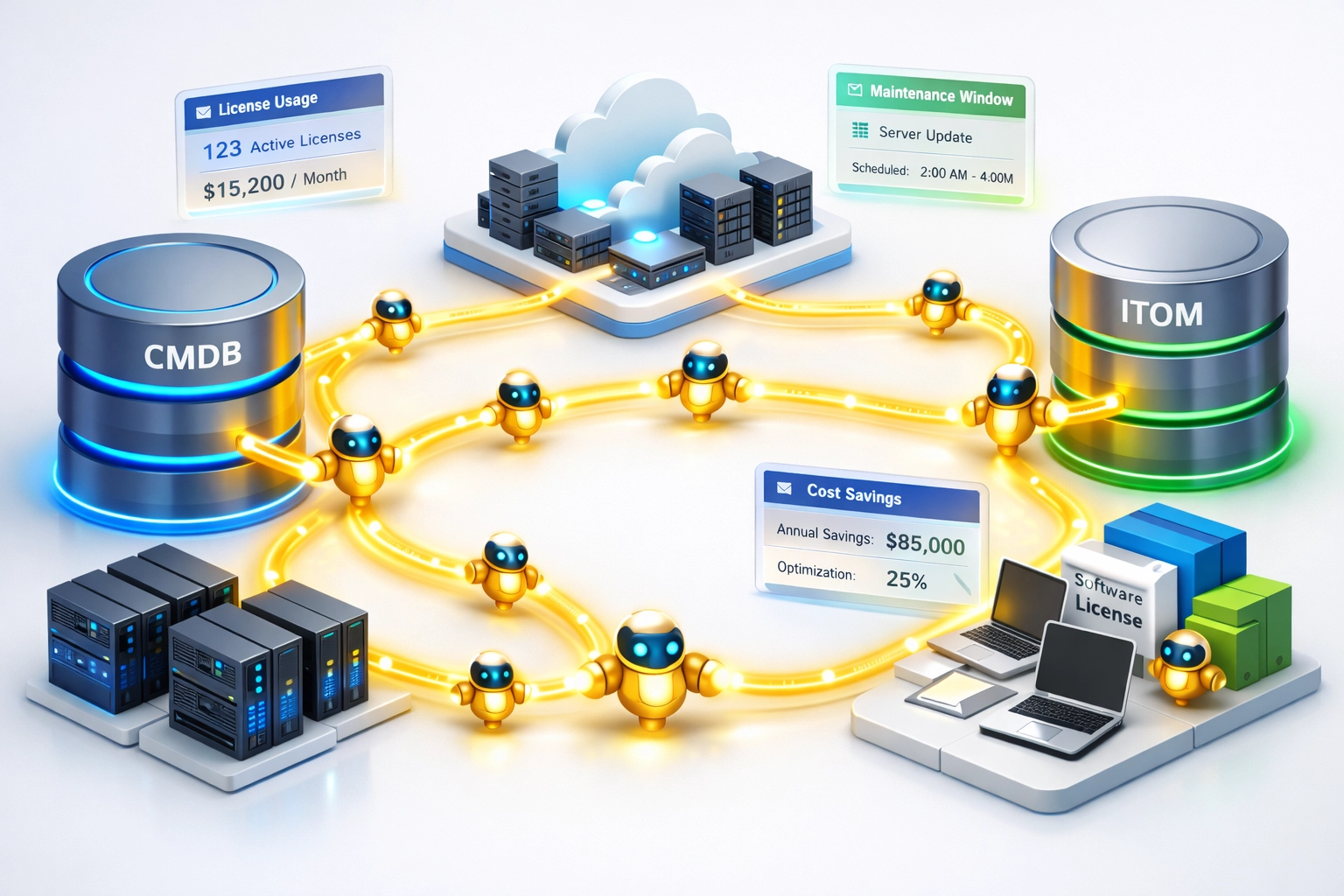
I integrate ITOM Discovery with your CMDB to establish comprehensive asset visibility, then deploy automated reconciliation between purchase orders and actual deployments. This bidirectional data flow is non-negotiable for ROI.
Why? Because your AI agents need access to licensing data, maintenance windows, and vendor SLAs to make intelligent remediation decisions. Without this context, you're just automating chaos.
The data backs this up: proper ITAM integration reduces licensing waste by 23% on average. For most mid-size enterprises, that's $300K-$800K in annual savings: enough to fund your entire ServiceNow investment.
Phase 3: Autonomous Remediation Deployment (Weeks 7-12)
This is where Agentic AI transforms from buzzword to business value. I implement Now Assist agent-to-agent automation to achieve autonomous incident resolution for routine scenarios.
The key is starting with high-volume, low-complexity incidents: password resets, certificate renewals, disk space cleanup. These represent 60-70% of your ticket volume but require minimal human judgment.
By the end of week 12, you should see 65% autonomous resolution rates for these incident categories. That eliminates manual escalations, reduces overtime costs, and dramatically improves your first-call resolution metrics.
The ROI Metrics That Matter to Your CFO
I always anchor 90-day ROI conversations around four quantifiable metrics that translate directly to cost reductions:
MTTR Improvement: 5.4x Faster Organizations implementing this framework achieve 5.4x faster Mean Time to Resolution through automated incident triage and analysis. For a 50-person operations team averaging $85K fully-loaded cost, this translates to approximately $420K in annual productivity gains.
Autonomous Resolution: 65% for Routine Incidents By eliminating manual escalations for routine incidents, you reduce ticket handling costs by 65%. Industry baseline for manual ticket resolution is $22 per incident. At 10,000 monthly tickets, that's $1.7M in annual savings.
First-Call Resolution: 89% vs. 67% Industry Baseline Higher FCR rates reduce repeat contacts, improve customer satisfaction scores, and decrease employee turnover among service desk staff. Replacing a trained service desk analyst costs 150-200% of annual salary when you factor in recruitment, training, and productivity ramp.
Licensing Waste Reduction: 23% ITAM-ITOM bidirectional data flow exposes shelfware, unused subscriptions, and maintenance on retired assets. For organizations spending $2M annually on software licensing, that's $460K in immediate cost avoidance.

Critical Success Factors Most Implementation Partners Miss
I've audited dozens of failed ITOM projects, and the patterns are consistent. Three requirements separate success from expensive failure:
Custom Correlation Logic Tuned to Your Environment Generic AI models underperform dramatically against customized agents trained on your infrastructure's behavioral signatures. Your ServiceNow implementation partner must have the methodology to baseline your alert patterns, identify false positive signatures, and iteratively tune correlation rules.
If they're proposing "out-of-box" Event Management with minimal customization, you're not getting ROI in 90 days.
Bidirectional ITAM-ITOM Integration from Day One Asset data must flow between modules so AI agents can access licensing data, maintenance windows, and vendor SLAs. This isn't a "phase two" activity: it's foundational to autonomous remediation.
I've seen organizations achieve autonomous resolution rates of 65% when this integration is done correctly. Without it, you're lucky to hit 30%.
Proper Event Baseline Establishment During the First 90 Days Your AI agents must learn from signal, not noise. That means the first three weeks are critical for establishing what "normal" looks like in your environment.
This requires historical data analysis: ideally 90 days of alert history before implementation begins. If your partner isn't asking for this data during discovery, that's a red flag.

Why Now Is the Optimal Time for ITOM + Agentic AI
The ServiceNow platform has matured significantly with recent releases. The Washington release, launched in late 2024, included native Now Assist capabilities that previously required extensive custom development.
What this means practically: production-ready autonomous remediation now deploys in 6-8 weeks compared to the six-month integration cycles required in earlier versions. That's the difference between proving ROI in Q1 and waiting until year-end.
I've also witnessed the talent market shift. There are more experienced ServiceNow consulting services professionals available now than at any point in the past three years. That means shorter implementation timelines and higher-quality configurations.
The cost dynamics have shifted too. With 23% average licensing waste across enterprise ITOM implementations, the audit findings alone often fund the entire project. That makes this a zero-cost transformation for many organizations.
Your Next Step: The Free 2026 ServiceNow ROI & License Audit
If you're serious about proving ITOM ROI in under 90 days, the first step is understanding your current state. I offer a comprehensive Free 2026 ServiceNow ROI & License Audit that analyzes:
Current alert volumes and noise ratios
ITAM-ITOM integration maturity
Licensing waste and optimization opportunities
Autonomous remediation readiness assessment
Projected 90-day ROI based on your specific environment
This isn't a sales pitch disguised as an audit. You'll receive a detailed technical report with specific recommendations, whether you engage SnowGeek Solutions or not.
Visit the SnowGeek Solutions contact page to share your project details and schedule your audit. I typically complete these assessments within 5-7 business days.
You can also register with SnowGeek Solutions for ongoing platform updates and expert insights on maximizing your ServiceNow investment. In 2026, Agentic AI capabilities are evolving monthly: staying current isn't optional if you want to maintain competitive advantage.
The organizations proving ROI fastest aren't the ones with the biggest budgets. They're the ones with structured frameworks, experienced ServiceNow implementation partners, and the discipline to execute in focused 90-day sprints.
The question isn't whether Agentic AI + ServiceNow ITOM can deliver ROI in 90 days. It's whether your current approach is positioned to capture it.
Comments