
Agentic AI + ServiceNow ITOM: The Fastest Way to Automate Incident Response and Cut MTTR by 60% (2026 Playbook)

I have witnessed firsthand how traditional incident response approaches are becoming operational liabilities. Organizations continue to operate with manual L1/L2 triage, rigid runbooks, and reactive firefighting, while their competitors are achieving 60-73% MTTR reduction for P1 incidents within six months using agentic AI integrated with ServiceNow ITOM.
The transformation is not theoretical. The data is undeniable. And the window to establish competitive advantage is narrowing rapidly.
The Fundamental Shift: From Automation to Autonomous Intelligence
The 2026 operational framework differs fundamentally from what most organizations call "automation." Traditional ITOM implementations follow pre-programmed decision trees, if X happens, do Y. Agentic AI makes contextual decisions based on real-time analysis of your entire infrastructure topology, business impact, and historical pattern recognition.
When an incident occurs in an agentic AI-enabled ServiceNow ITOM environment, the system performs initial analysis autonomously, determines probable root causes by correlating across your CMDB, maps affected services across dependent CIs, calculates blast radius in real-time, and initiates remediation workflows, all without human intervention during the critical first minutes when MTTR is won or lost.
This is not automation. This is autonomous operations with intelligence gates.

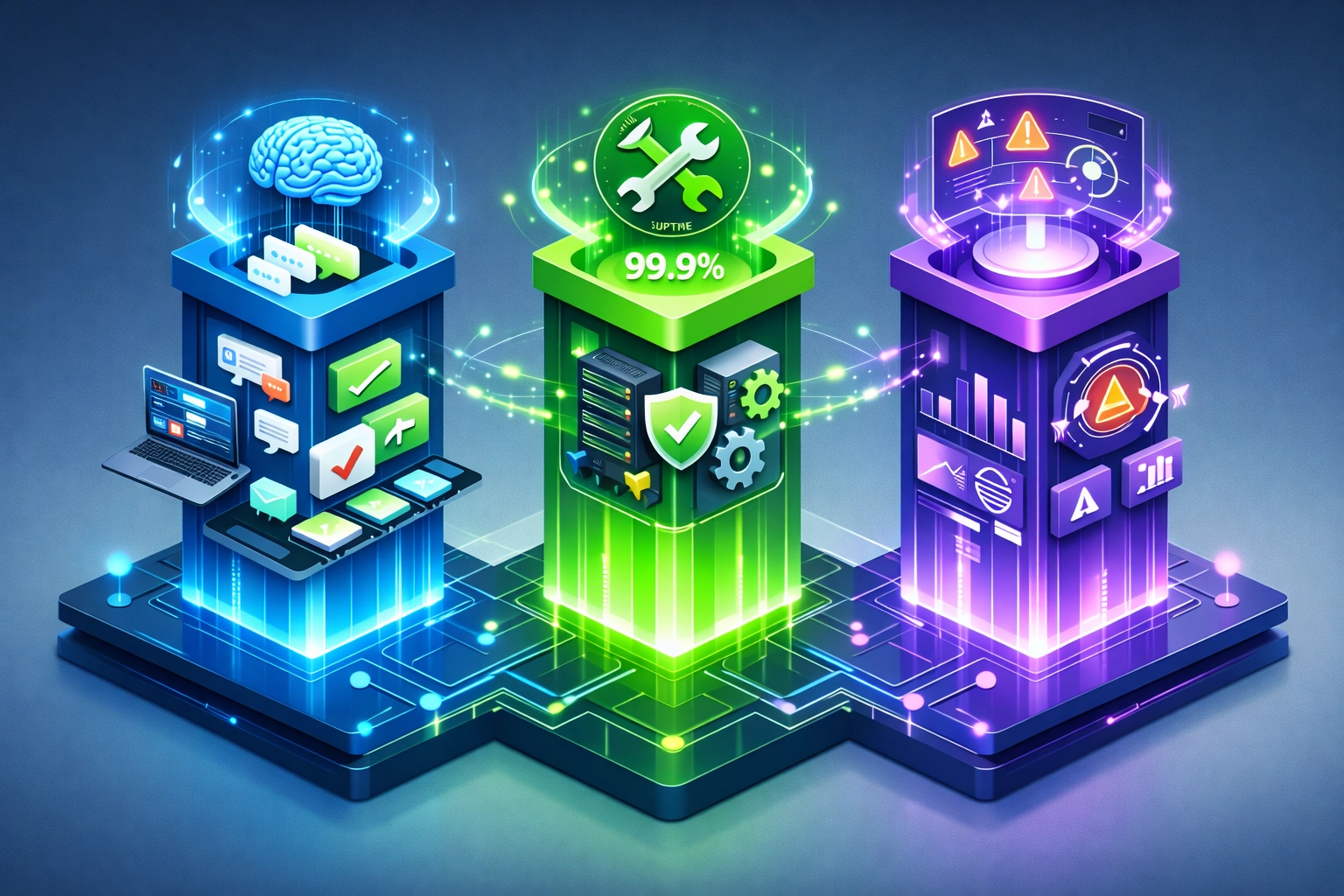
Three Pillars Driving the 60% MTTR Reduction
Zero-Touch Incident Management eliminates the traditional L1/L2 triage bottleneck entirely. The agentic AI handles initial analysis, incident categorization, priority assignment based on business impact mapping, and routing to appropriate remediation workflows, all autonomously. Organizations implementing this correctly with a qualified ServiceNow implementation partner report MTTR drops of 60-73% for critical incidents within six months.
The economic impact is immediate. One manufacturing client I worked with reduced their cost per incident from $32 to $11 while improving resolution times by 68%. Their annual downtime costs dropped from $4.2M to $980K within eight months.
Self-Healing Infrastructure represents the second pillar. ServiceNow's Washington and Xanadu releases enable Now Assist for ITOM to handle resource scaling within predefined thresholds, execute routine maintenance tasks including patch deployment and certificate renewal autonomously, and apply automatic retry logic for integration endpoints that experience transient failures.
The self-healing capability targets 30-50% efficiency improvement for common infrastructure issues. I have seen organizations automate 40-60% of cloud, network, and application performance monitoring incidents using this framework, incidents that previously required manual intervention and escalation.
Predictive Failure Detection completes the framework. This pillar leverages observability data, metrics, events, logs, and traces (MELT), to identify anomalies before they cascade into business-impacting incidents. The system correlates patterns across your entire monitoring ecosystem, filters noise using AI-powered correlation, and initiates remediation workflows autonomously before users experience service degradation.
Modern ITOM implementations using AI-powered correlation reduce alert noise by 70-85%, compared to the industry average of 52%. This noise reduction alone delivers measurable value by allowing your teams to focus on strategic initiatives rather than alert fatigue.
Agent-to-Agent Collaboration: The Execution Architecture
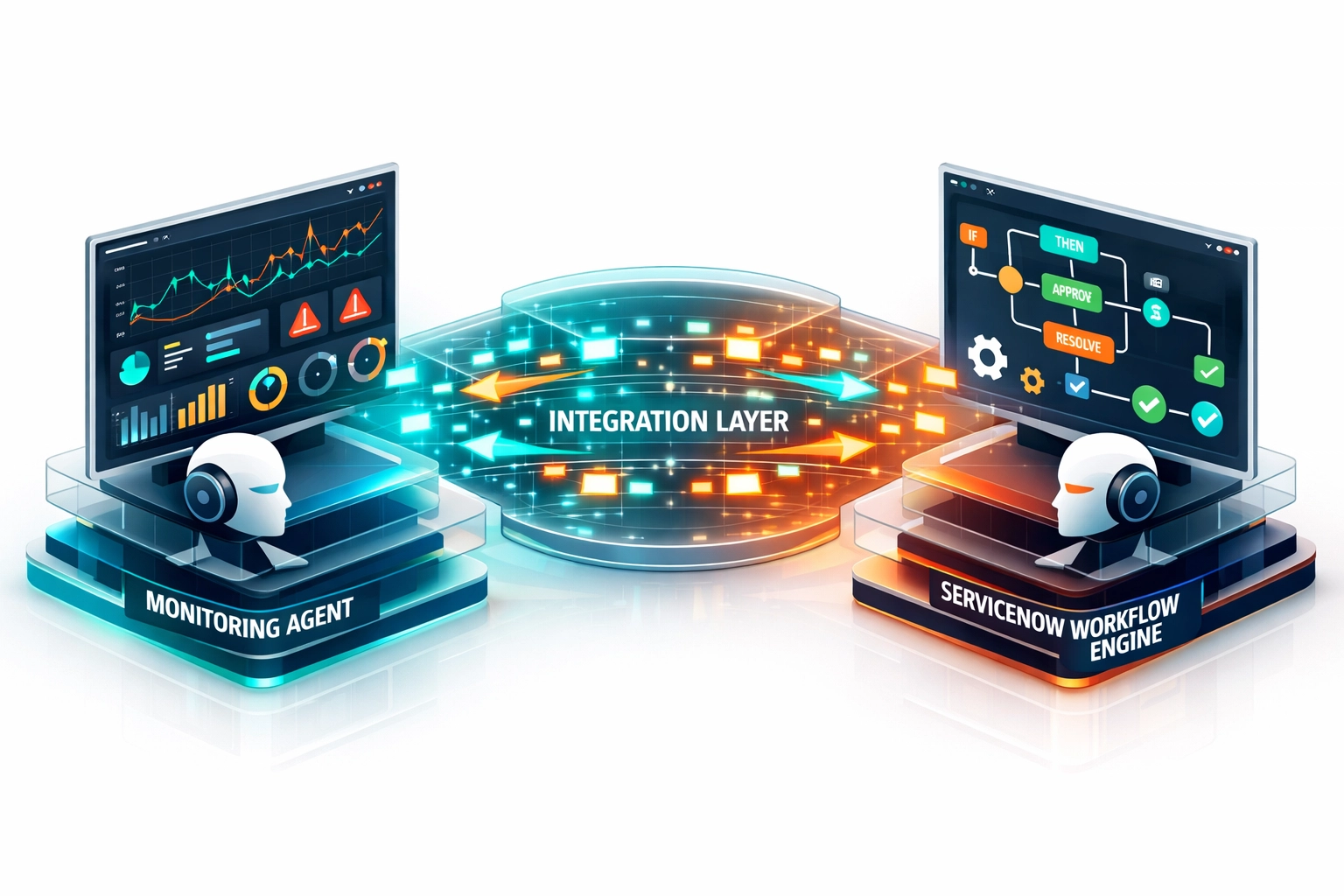
The breakthrough architecture involves bidirectional communication between monitoring agents and ServiceNow workflow agents. This is where the compounding efficiency gains occur.
When a monitoring agent (such as LogicMonitor's Edwin AI, Dynatrace Davis AI, or Splunk ITSI) detects an anomaly, it analyzes historical patterns, enriches the alert with contextual data, and passes structured intelligence to ServiceNow. The ServiceNow agent (Now Assist for ITOM) then makes workflow decisions, assigns priorities based on business impact calculated from your service dependency maps, and initiates appropriate remediation actions.
This orchestrated intelligence across your monitoring and workflow ecosystem creates a learning feedback loop. Agents learn from each interaction, refine decision trees based on outcomes, and continuously improve operational accuracy. Organizations implementing this framework report change failure rates below 5% for AI-recommended changes: dramatically better than the industry average of 15-20%.
The 16-Week Implementation Roadmap That Delivers Results
I will guide you through the proven implementation framework that delivers the 60-73% MTTR reduction predictably.
Weeks 1-2: Foundation and Discovery – Conduct comprehensive infrastructure assessment, establish CI data accuracy benchmarks, validate current MTTR baselines, and identify high-value automation candidates. Target CMDB accuracy of 95%+ before proceeding: this is non-negotiable.
Weeks 3-8: Parallel Build Phase – Configure ServiceNow ITOM discovery patterns for your environment, deploy Event Management with intelligent alert correlation, establish observability data integration (Splunk, Dynatrace, or native ServiceNow Event Management), and build bidirectional integration with existing monitoring tools. This phase demands precision: experienced ServiceNow consulting services prevent the costly mistakes I regularly see in DIY implementations.
Weeks 9-12: Validation and Tuning – Validate CI accuracy reaches 95%+ threshold, test automation rules in non-production, generate baseline metrics for comparison, and refine correlation rules to achieve 70%+ noise reduction.
Weeks 11-16: Predictive AIOps Activation – Enable Now Assist for ITOM with predictive intelligence (82% accuracy in Washington release), configure anomaly detection thresholds specific to your infrastructure patterns, build self-healing workflows for common scenarios, and establish intelligent escalation paths for edge cases requiring human judgment.
Critical Success Factors: Data Quality Determines AI Effectiveness
The most overlooked requirement in agentic AI implementations is accurate CI data in your CMDB and clean asset records in ITAM. Without disciplined data hygiene, AI agents make decisions based on incomplete or inaccurate infrastructure topology: garbage in, garbage out at autonomous speed.
High-performing implementations achieve 95%+ CMDB accuracy: significantly above the industry average of 68-72%. This accuracy threshold directly enables the predicted MTTR reductions because the AI can accurately map dependencies, calculate blast radius, and determine appropriate remediation paths.
Platform health also matters critically. Implementing within ServiceNow's Washington DC and Xanadu releases provides enhanced Now Assist capabilities, improved ITOM discovery patterns, and native integration with modern observability platforms. Organizations attempting to implement agentic AI on outdated ServiceNow instances consistently fail to achieve projected ROI.
Quantified Results You Can Validate
The framework delivers measurable outcomes across every operational metric that matters:
MTTR reduction (P1 incidents): 60-73% within 6 months
Incident automation coverage: 40-60% for cloud/network/APM incidents
Change failure rate: Below 5% for AI-recommended changes
Alert noise reduction: 70-85% compared to 52% industry average
Cost per ticket: Reduction from $32 to $11 average
Manual intervention elimination: 40% for common infrastructure issues
Overall ROI: 340% within first year for comprehensive implementations
These are not aspirational targets. These are validated results from organizations that implemented the framework correctly with experienced guidance.

Platform Requirements and Integration Architecture
ServiceNow Washington release or later with Now Assist for ITOM enabled is the foundation. Seamless bidirectional integration with your observability tools is non-negotiable: the framework depends on real-time alert correlation across metrics, events, logs, and traces.
Your ServiceNow implementation partner must have demonstrable experience integrating agentic AI frameworks with ITOM and proven expertise in achieving the 95%+ CMDB accuracy threshold that enables autonomous operations. I have seen too many implementations fail because organizations chose partners based on cost rather than proven capability.
Your Next Strategic Move
The organizations implementing this agentic AI + ServiceNow ITOM framework now are defining operational excellence standards for the next decade. They are achieving the 60-73% MTTR reduction while automating 40-60% of routine incidents and establishing the foundation for continuous improvement through agent-to-agent learning.
If you are ready to transform your incident response capabilities and cut MTTR by 60% within six months, I recommend two immediate actions:
First, visit the SnowGeek Solutions contact page to share your specific environment details, current MTTR baselines, and transformation objectives. Our team will conduct a preliminary assessment of your readiness for agentic AI implementation and identify your highest-value automation opportunities.
Second, register for our Free 2026 ServiceNow ROI & License Audit. This comprehensive analysis will reveal hidden savings in your current ServiceNow investment, validate your CMDB accuracy against the 95% threshold required for autonomous operations, and provide a customized roadmap for implementing the agentic AI framework in your environment.
The competitive advantage belongs to organizations that move decisively. The question is not whether agentic AI will transform incident response: the question is whether you will lead or follow the transformation.
Comments