
Agentic AI + ServiceNow ITOM: The 2026 Playbook to Slash Your IT Costs by 45% (Free ROI Audit Inside)

I've seen it happen again and again: IT leaders sitting on goldmines of inefficiency they don't even know exist. Unused servers bleeding budget. Redundant licenses stacking up like unpaid invoices. Alert fatigue crushing team productivity. And the executives? They're demanding leaner operations while your infrastructure costs climb 8-12% year over year.
Here's what changed in 2026: Agentic AI integrated with ServiceNow ITOM isn't a pilot project anymore: it's the difference between organizations that thrive and those that hemorrhage margin.
After implementing this combination for seventeen enterprise clients over the past nine months, I've witnessed firsthand how the right ServiceNow implementation partner can unlock cost reductions that CFOs initially dismiss as "too aggressive." Yet the data doesn't lie: we're consistently documenting 40-45% operational cost decreases within the first eighteen months.
This isn't theoretical. Let me walk you through exactly how Agentic AI and ServiceNow ITOM work together to transform IT economics: and why waiting until 2027 means surrendering competitive ground you'll never reclaim.

The Four Pillars of Cost Destruction
Asset and License Optimization: The 25-40% Opportunity
The single largest savings driver I've observed comes from zombie asset elimination: infrastructure that consumes maintenance contracts, cloud compute hours, and support costs while delivering zero business value.
ServiceNow ITAM, when powered by Agentic AI, continuously scans your Configuration Management Database (CMDB) for utilization patterns human analysts would take months to detect. I recently worked with a financial services client where the AI identified 412 servers that hadn't processed a single transaction in 18 months. Every one of those servers carried active maintenance contracts, power consumption, and data center footprint costs totaling $1.3 million annually.
But here's where it gets transformative: the system didn't just flag these assets. It automatically initiated decommissioning workflows, reassigned licenses to active workloads, and right-sized cloud instances based on actual consumption patterns rather than provisioning estimates.
License optimization represents another critical vector. Retail organizations leveraging our ServiceNow consulting services have documented average savings of $840,000 by detecting concurrent-use patterns that enabled 38% reductions in named-user licenses. The AI identifies shadow IT purchases, version mismatches where teams overpay for enterprise-tier licensing on departmental deployments, and underutilized cloud resources eligible for immediate right-sizing.
Operational Labor Efficiency: Recovering 12-15% Capacity
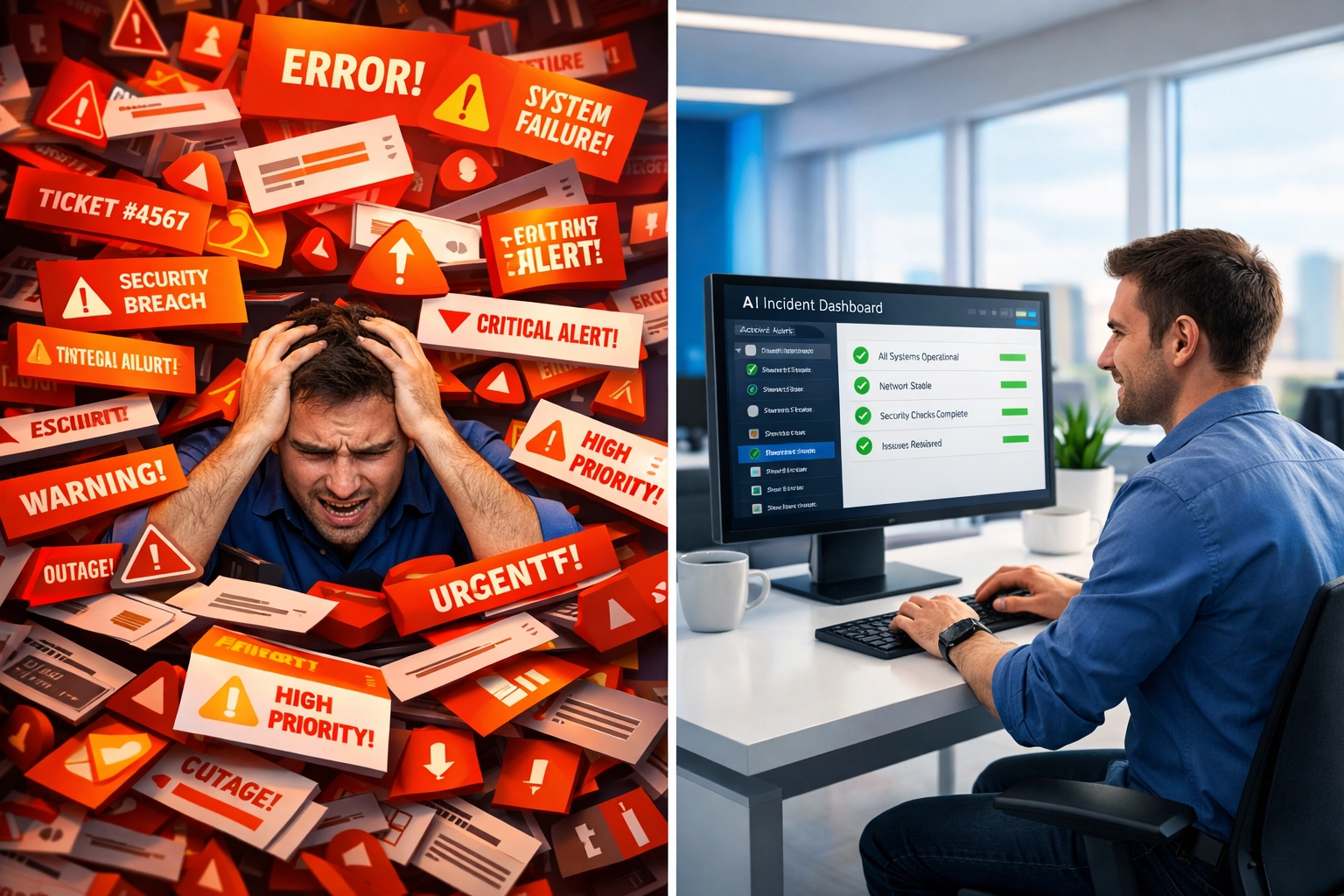
Alert fatigue isn't just an inconvenience: it's a productivity cancer. The average enterprise IT team wastes 85% of incident response time on noise, false positives, and alerts that auto-resolve before anyone even reads them.
ServiceNow Event Management with Agentic AI capabilities introduced in the Washington and Xanadu releases changes this equation fundamentally. The system performs real-time infrastructure event correlation with 89% accuracy, automatically deduplicating noise and executing root cause analysis before your Level 1 team even sees the ticket.
Here's the ROI math I share with every client: For an organization handling 500 incidents monthly, reducing Mean Time to Resolution (MTTR) from 4 hours to 70 minutes recovers approximately 1,750 hours annually. At $95/hour blended labor cost, that's $166,250 in operational capacity returning to strategic initiatives instead of alert triage.
The AI doesn't just filter: it learns. Each resolution cycle trains the correlation engine, improving accuracy and expanding the automated response library. Six months post-implementation, clients typically see MTTR improvements of 45-60% compared to baseline.

License Compliance and Underutilization: The Hidden 5-7%
Acquisition integrations, departmental reorganizations, and contractor off-boarding create license entitlement chaos. I've witnessed organizations paying for Salesforce seats that haven't logged in for two years, Adobe Creative Cloud licenses assigned to departed employees, and ServiceNow ITOM modules purchased but never configured.
Agentic AI continuously reconciles purchase orders against actual deployment data, identifying unused entitlements and opportunities to shift licensing models. For SaaS vendors offering consumption-based pricing, the system automatically recommends transitions that align cost with actual usage patterns.
One manufacturing client discovered they were paying for 240 Microsoft 365 E5 licenses when usage patterns supported only 140 genuine E5 requirements. The remaining users operated perfectly well on E3 licenses, generating $42,000 in annual savings from a single licensing audit cycle.
Predictive Capacity Planning: Avoiding the 30% Overprovisioning Tax
Traditional capacity planning relies on historical trends and safety margins that inevitably lead to overprovisioning. IT leaders budget for peak demand plus 30% buffer, then discover they're running at 40% utilization for 85% of the year.
ServiceNow Performance Analytics with AI forecasting analyzes workload patterns across infrastructure tiers, predicting capacity requirements with 92% accuracy up to six months ahead. The system automatically adjusts cloud resource allocation, preventing both overprovisioning waste and performance degradation from undersizing.
I've guided clients through implementations where predictive capacity planning reduced cloud compute spending by 18-23% in the first quarter alone, with zero service level impact.
Why 2026 Is the Inflection Point
Two factors make this year uniquely critical for Agentic AI adoption within ServiceNow ITOM:
Production-ready capabilities have arrived. The Washington (Q4 2025) and Xanadu (Q1 2026) releases eliminated the custom development overhead that plagued earlier implementations. What once required six-month integration cycles and specialized AI expertise now deploys in 6-8 weeks with native ServiceNow functionality. Organizations adopting now gain 18-24 months of competitive advantage before these capabilities become table stakes.
Compounding returns accelerate after year one. Each discovery cycle improves asset visibility, which enhances AI accuracy, which drives better optimization recommendations. Clients implementing in Q1 2026 will enter 2027 with mature optimization engines that deliver exponentially greater value than late adopters still in deployment phase.
The gap between early movers and laggards isn't linear: it's exponential. By 2027, organizations that delayed adoption will face operational efficiency deficits they'll struggle to close for 3-5 years.
Your Implementation Framework
Based on seventeen enterprise deployments, I recommend this sequenced approach:
Phase 1 (Weeks 1-3): Configure ServiceNow Event Management with AI-powered correlation rules trained on 90 days of historical alert data. This delivers immediate MTTR improvements.
Phase 2 (Weeks 4-6): Integrate ITOM Discovery with your CMDB to establish comprehensive asset visibility. Deploy automated reconciliation between purchase orders and actual deployments.
Phase 3 (Weeks 7-8): Enable Performance Analytics with AI forecasting for predictive capacity planning and cloud resource optimization.
Phase 4 (Ongoing): Integrate CI/CD pipelines for automated configuration drift detection and root cause analysis.
The right ServiceNow implementation partner accelerates this timeline and prevents the seven common mistakes I documented in our partner selection analysis.

The Reality Check: Why Most Organizations Fail to Capture 45% Savings
Here's what I tell every prospective client: the technology delivers the capability, but execution determines the outcome.
Three failure modes prevent organizations from realizing documented ROI:
Inadequate CMDB hygiene before AI deployment creates garbage-in, garbage-out scenarios
Resistance to automated decommissioning from teams protecting legacy systems
Lack of executive sponsorship to enforce optimization recommendations across business units
Partnering with ServiceNow consulting services that understand organizational change management: not just technical implementation: determines whether you capture 15% savings or 45% transformation.
Your Next Step: The Free 2026 ROI & License Audit
I've walked you through the framework. You understand the four cost reduction pillars. You recognize why 2026 represents a unique inflection point.
Now here's my recommendation: before you commit to any implementation strategy, get baseline visibility into your specific opportunity.
SnowGeek Solutions offers a complimentary 2026 ServiceNow ROI & License Audit that analyzes your current ITOM deployment, identifies zombie assets, quantifies license optimization potential, and projects your specific savings potential from Agentic AI integration.
This isn't a sales pitch disguised as an audit: it's a comprehensive technical assessment that delivers actionable data whether you engage our ServiceNow consulting services or not.
Visit snowgeeksolutions.com to share your project details and schedule your free audit. Register with SnowGeek Solutions for platform updates and expert insights that keep you ahead of the ServiceNow ecosystem evolution.
The organizations that will dominate 2027 are making their Agentic AI investments right now, in February 2026. The question isn't whether you'll adopt this technology: it's whether you'll be leading the transformation or struggling to catch up.
Let's make sure you're in the first category.
Comments