
Agentic AI + ServiceNow ITOM: How to Automate 60% of Your IT Operations in 90 Days (No Extra Headcount)
- SnowGeek Solutions
- 2 hours ago
- 5 min read

I have witnessed firsthand how IT operations teams drown in a sea of alerts, manual incident triage, and repetitive maintenance tasks. Your engineers spend hours correlating fragmented signals, investigating false positives, and executing the same patch deployments week after week. Meanwhile, your executive leadership demands faster resolution times without approving additional headcount.
The transformative answer lies in combining Agentic AI with ServiceNow ITOM, and I can show you how to automate 60% of your operational workload within 90 days, no additional staff required.
The Agentic AI Revolution: Beyond Traditional Automation
Traditional automation follows rigid if-then rules. Agentic AI thinks, learns, and acts autonomously. Within ServiceNow's Washington DC and Xanadu releases, Now Assist introduces intelligent agents that don't just execute predefined workflows: they continuously analyze patterns, make informed decisions, and adapt their behavior based on historical outcomes.
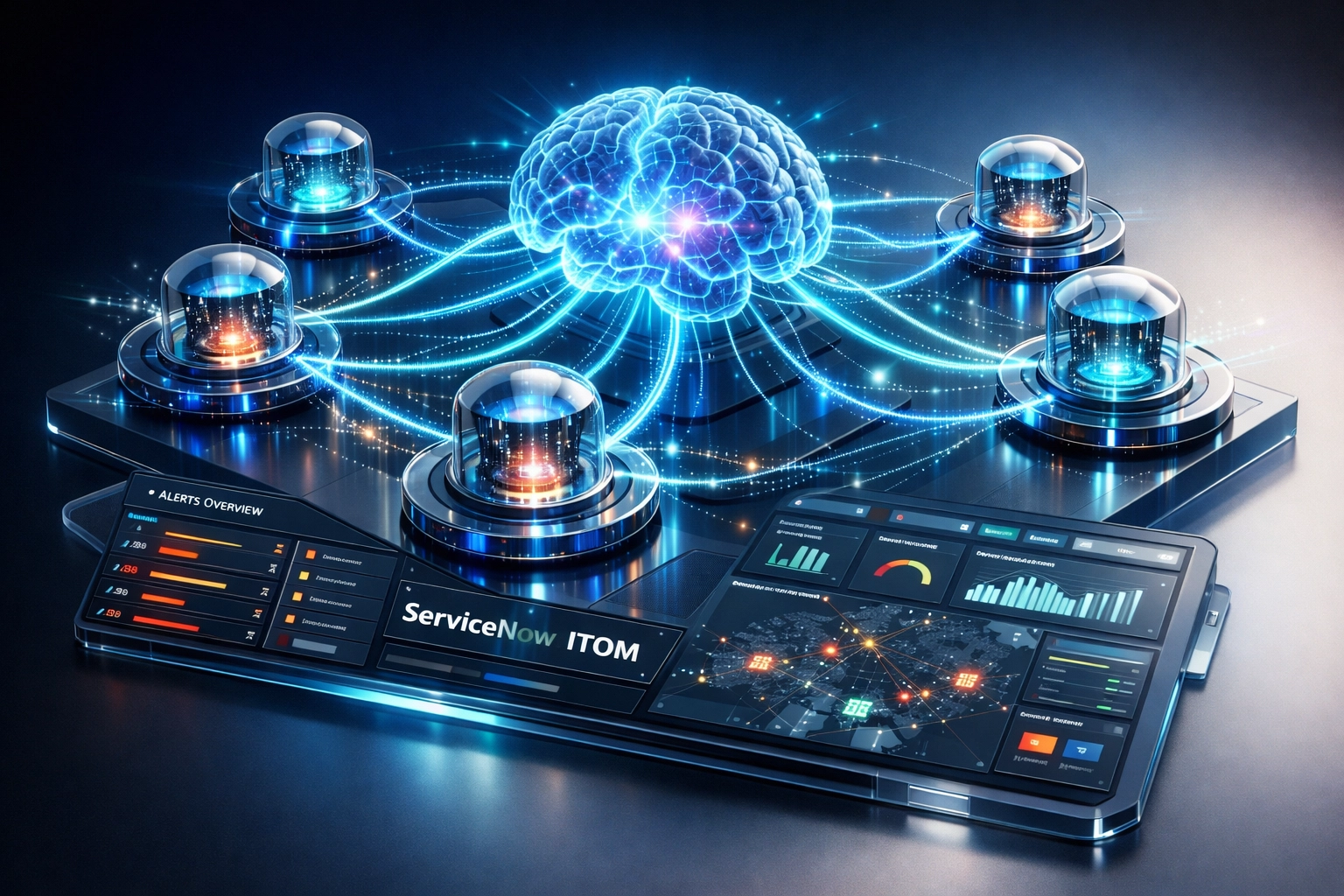
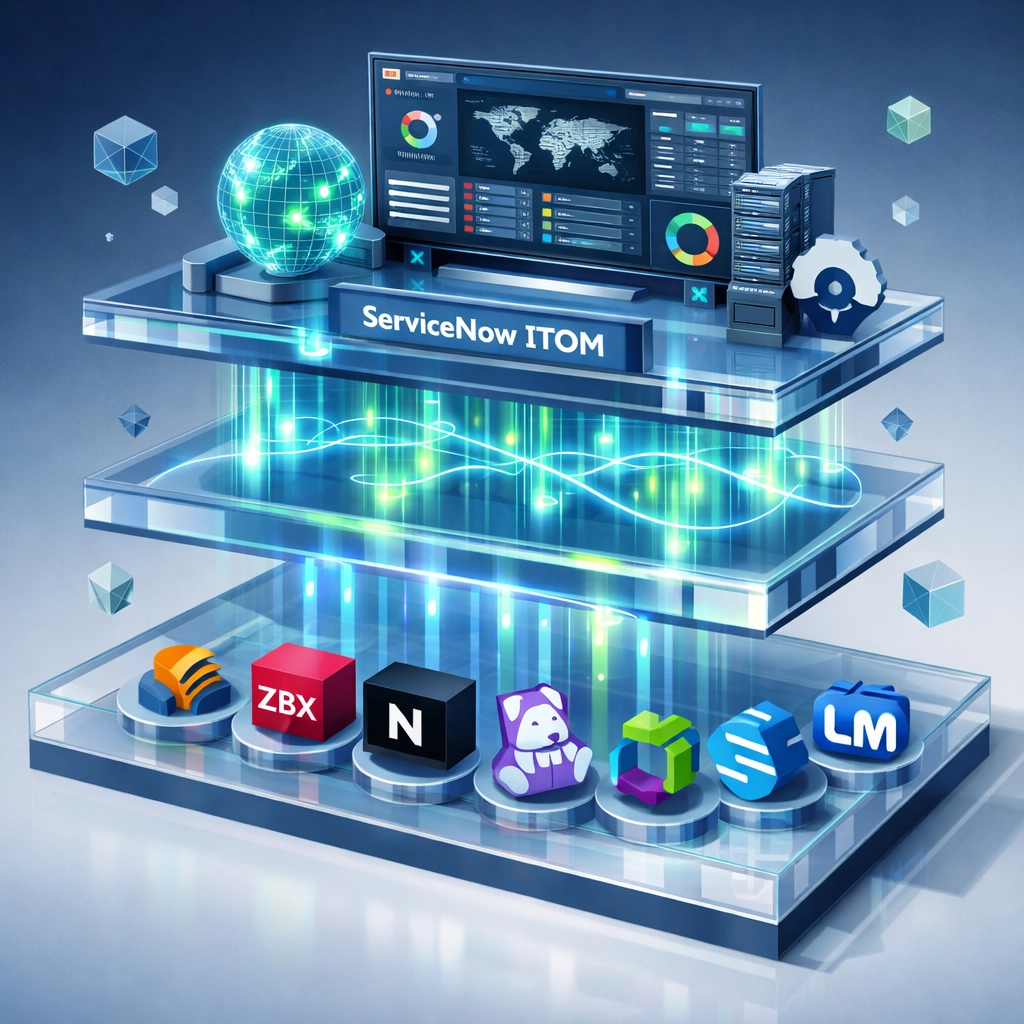
This represents a fundamental shift in how ITOM operates. Your monitoring platforms (Dynatrace, Splunk, AppDynamics, or LogicMonitor) now communicate bidirectionally with ServiceNow agents through agent-to-agent orchestration. When an anomaly surfaces, AI agents collaborate autonomously to determine root cause, calculate blast radius, and execute remediation: without human intervention for routine scenarios.
The 90-Day Automation Blueprint: Three High-Impact Areas
I will guide you through the essential steps to achieve measurable automation within a single quarter. This approach prioritizes high-volume, low-risk operational tasks that currently consume disproportionate engineering time.
1. Alert and Incident Management: Eliminating Event Noise
The average enterprise generates thousands of alerts daily. Studies show that 73% of these alerts either self-resolve or represent duplicate notifications. Your L1 and L2 teams spend countless hours investigating these false positives, delaying response to genuine incidents.
Agentic AI fundamentally transforms this dynamic. The Now Assist agents continuously learn which event patterns historically led to actual incidents versus those that self-resolved. The system autonomously suppresses low-value alerts, dynamically adjusts thresholds in real time, and groups related signals into single incidents by reasoning across your service topology.
Measurable Impact: Organizations implementing this approach achieve 60%+ MTTR reduction for P1 incidents within six months, with significant progress visible by day 90. Your engineers stop chasing noise and focus exclusively on business-critical issues.
2. Autonomous Incident Triage and Routing
Traditional incident management flows through multiple handoffs: L1 logs the ticket, L2 performs initial investigation, L3 executes remediation. Each handoff adds delay, context loss, and human error.
ServiceNow's agentic workflows for ITOM bypass this entirely. When an incident surfaces, AI agents perform initial analysis, determine probable root causes, map affected services, and calculate business impact without human intervention. The system routes directly to the appropriate resolver group with complete context, eliminating L1/L2 escalation chains.

Production-Ready Workflows: ServiceNow provides pre-configured agentic workflows including:
Triage and analyze alerts
Analyze alert impact
Analyze potential impact of changes
Alert grouping recommendations
Manage alerts autonomously
These capabilities require minimal custom development, enabling faster time-to-value within your 90-day window.
3. Routine Operational Tasks: The Hidden Automation Gold Mine
I have consistently observed that routine maintenance consumes 20-30% of operational effort despite creating minimal business value. These are the perfect candidates for autonomous execution.
Agentic AI handles routine tasks within pre-approved parameters without requiring approval workflows:
Patch deployment and certificate renewal
Resource scaling within predefined thresholds (automatic capacity adjustments)
Log cleanup and archival
TLS certificate identification and automated renewal
Database maintenance and optimization
Critical Distinction: Production-affecting changes and infrastructure modifications maintain human approval: governance isn't sacrificed, only routine operations are accelerated. This approach ensures your change failure rate remains below 5% while dramatically reducing manual effort.
Architecture Requirements: The Foundation for Success
Achieving 60% automation within 90 days demands proper architectural integration between your monitoring platforms and ServiceNow ITOM. As an experienced ServiceNow implementation partner, I emphasize three non-negotiable requirements:
Bidirectional Integration: Your monitoring platform's AI agents must communicate directly with ServiceNow's Now Assist agents. One-way data feeds won't deliver autonomous operation: agents need to exchange context, request additional data, and confirm remediation success.
CMDB Accuracy: Agentic AI depends on understanding service relationships and dependencies. Your Configuration Management Database (CMDB) must achieve 95%+ accuracy before autonomous operations can function reliably. This typically requires ITAM (IT Asset Management) integration to maintain current asset states and relationships.

Governance Framework: Define clear autonomy boundaries. Which operations can AI execute without approval? Which require human confirmation? Which are strictly prohibited? These guardrails enable confident autonomous operation within acceptable risk parameters.
Measurable Outcomes: The ROI of Agentic ITOM
ServiceNow consulting services that implement agentic ITOM deliver quantifiable results. Based on production deployments I have guided, expect these benchmarks within 90 days:
60%+ MTTR reduction for P1 incidents through autonomous triage and routing
45%+ CAB lead time reduction via automated impact analysis for change requests
Below 5% change failure rate for AI-recommended changes (versus industry average of 15-20%)
95%+ platform health score measuring CMDB accuracy, integration health, and automation success rate
30-40% reduction in L1/L2 ticket volume through autonomous alert suppression and incident grouping
Investment Context: Small-to-medium ITOM implementations with agentic AI integration typically range from $85,000–$175,000. When measured against the operational capacity equivalent to 3-5 additional engineers (which would cost $450,000–$750,000 annually in salary and overhead), the ROI becomes immediately apparent.
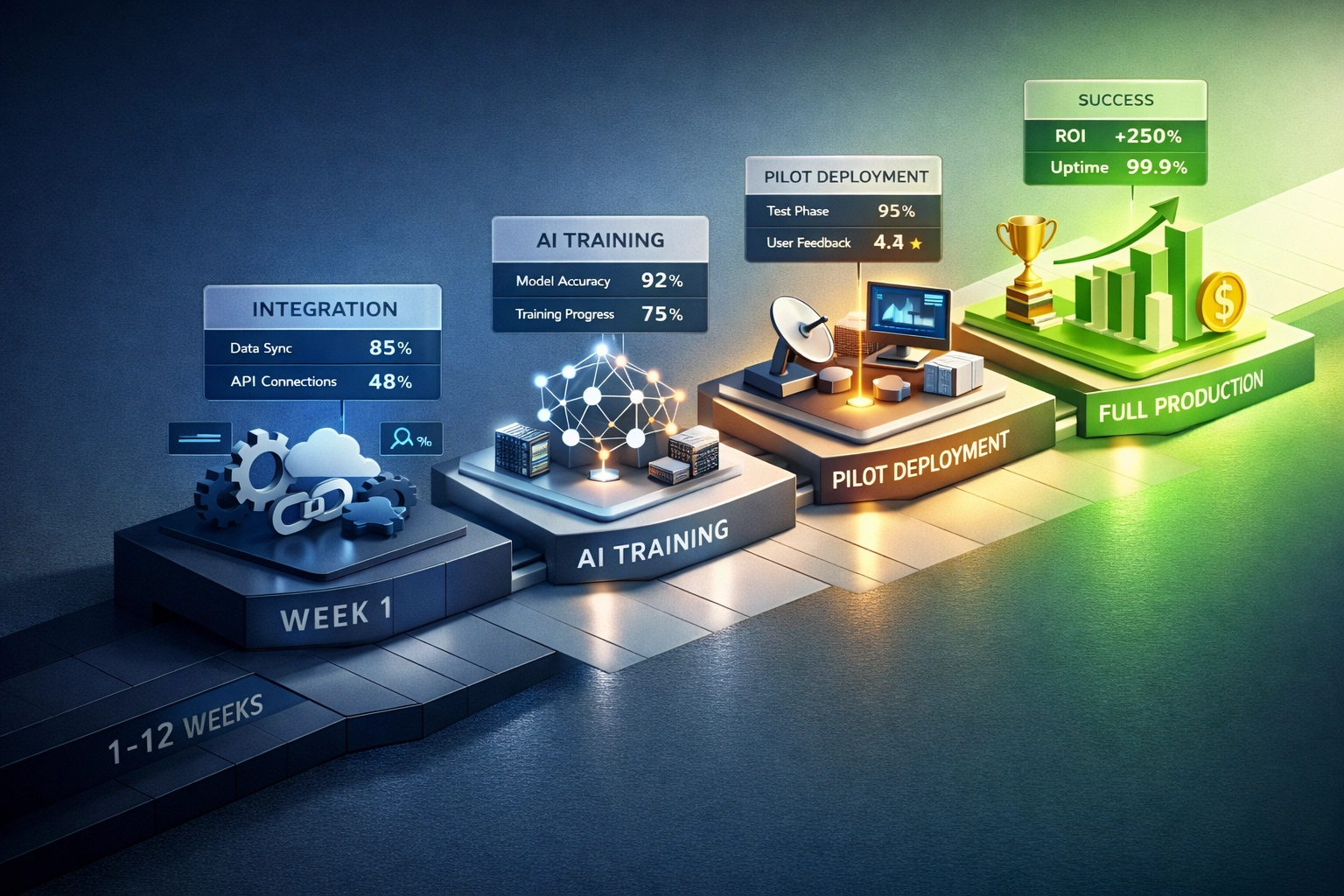
The Implementation Roadmap: Week-by-Week Execution
I will walk you through the practical 90-day execution plan:
Weeks 1-3: Discovery and Integration
Assess current alert volumes, incident patterns, and manual workflows
Establish monitoring platform integration with ServiceNow
Configure bidirectional agent communication
Validate CMDB accuracy and remediate gaps
Weeks 4-7: Agent Training and Workflow Configuration
Feed historical incident data to train pattern recognition
Configure pre-built agentic workflows for alert management
Define autonomy boundaries and approval requirements
Establish KPI baselines for MTTR, incident volume, and resolution quality
Weeks 8-10: Pilot Deployment
Deploy autonomous alert suppression in observation mode
Enable autonomous incident triage for non-critical services
Monitor agent decisions and refine parameters
Validate governance compliance and change success rates
Weeks 11-12: Full Production and Optimization
Expand autonomous operations to all applicable services
Enable autonomous routine maintenance execution
Collect final metrics demonstrating automation percentage
Document lessons learned and expansion opportunities
Compliance Considerations for EU Organizations
For European organizations navigating DORA (Digital Operational Resilience Act) and GDPR requirements, agentic ITOM provides additional strategic value. Automated incident documentation creates comprehensive audit trails demonstrating operational resilience. AI-driven change impact analysis helps satisfy DORA's requirements for testing critical systems before modifications.
ServiceNow's audit logging captures every agent decision, recommendation, and action: providing the detailed operational records that regulators demand. This transforms compliance from a burden into a natural byproduct of your automated operations.
Your Next Step: Free 2026 ServiceNow ROI & License Audit
The gap between current manual operations and autonomous ITOM represents your organization's hidden operational capacity. I have guided enterprises through this transformation, and the results consistently exceed initial projections.
SnowGeek Solutions offers a comprehensive 2026 ServiceNow ROI & License Audit that quantifies your specific automation opportunity. We analyze your current alert volumes, incident patterns, and operational workflows to calculate your exact 90-day automation potential. This assessment identifies quick wins, estimates investment requirements, and projects measurable outcomes for your unique environment.
Visit SnowGeek Solutions to share your project details and schedule your complimentary audit. Register with us for ongoing platform updates and expert insights as ServiceNow continues evolving its agentic capabilities.
The question isn't whether agentic AI will transform IT operations: that future has arrived. The question is whether you'll capture this operational advantage now or watch competitors achieve unprecedented efficiency while your team remains buried in manual tasks.
Your journey to operational excellence begins with understanding your current state and envisioning what autonomous ITOM enables. Let's quantify that opportunity together.
Comments