
Agentic AI Meets ITAM: 7 Ways Your ServiceNow Implementation Partner Should Be Using AI to Cut License Costs

Your ServiceNow license costs are bleeding money: and most organizations don't even realize it. I have witnessed firsthand how enterprises waste 15-30% of their ServiceNow investment on dormant accounts, misassigned roles, and unused licenses. But here's the transformative shift happening right now: agentic AI is revolutionizing IT Asset Management (ITAM) in ways that deliver unprecedented ROI.
If your ServiceNow implementation partner isn't leveraging agentic AI to optimize your license spend, you're leaving hundreds of thousands of dollars on the table. This guide will walk you through the seven essential strategies that separate industry-leading ServiceNow consulting services from those still stuck in manual audit cycles.
What Makes Agentic AI Different for ITAM
Agentic AI goes beyond traditional automation. These intelligent systems make autonomous decisions, learn from patterns, and take proactive action without constant human intervention. When applied to ServiceNow ITAM and ITOM, agentic AI transforms license management from a quarterly cleanup task into a continuous, self-optimizing process.
The Washington DC release introduced enhanced AI capabilities across the Now Platform, and the upcoming Xanadu release promises even deeper integration with predictive analytics for asset optimization. Your ServiceNow implementation partner should be building on these native capabilities to deliver measurable cost reduction.

1. Autonomous Inactive License Detection and Reclamation
Traditional license audits rely on manual reviews that happen quarterly or annually: by which point, you've already wasted thousands. I've seen organizations with 640 never-logged-in Fulfiller accounts discovered only during annual true-ups, representing $410,000 in annual waste.
Agentic AI continuously monitors user activity patterns across your ServiceNow instance, automatically flagging accounts that haven't logged in within defined thresholds. But here's where it gets transformative: these systems don't just flag: they autonomously initiate reclamation workflows.
Your ServiceNow consulting services provider should implement AI agents that:
Monitor login frequency and session duration in real-time
Identify users who have logged in but never performed meaningful actions
Automatically downgrade licenses after configurable grace periods
Send predictive alerts 30 days before planned reclamation
One U.S. government agency achieved an 18% cost reduction within six months using this approach, reallocating resources to high-value users while maintaining compliance.
2. Predictive License Demand Forecasting
Most organizations purchase ServiceNow licenses reactively, leading to either overspending on unused capacity or scrambling for emergency purchases during projects. Agentic AI analyzes historical usage patterns, project pipelines, and seasonal trends to predict exact license requirements 3-6 months ahead.
This predictive capability integrates seamlessly with ITOM (IT Operations Management) data, analyzing:
Service catalog request volumes
Incident and change ticket velocity
Development environment activity
Integration patterns with enterprise systems
Your ServiceNow implementation partner should configure AI agents that automatically recommend license tier adjustments, timing purchases to align with ServiceNow's renewal periods for maximum negotiating leverage. Organizations using predictive forecasting typically reduce emergency license purchases by 40% and avoid over-provisioning by 22%.

3. Intelligent Role-Based Access Optimization
Here's a truth that makes CFOs uncomfortable: 30-40% of ServiceNow users have higher-cost licenses than their actual role requires. A user with a Fulfiller license who only logs incidents should be an ESS user. That difference? Approximately $1,200 per user annually.
Agentic AI analyzes actual platform behavior: which modules users access, which workflows they trigger, and which capabilities they never touch. The AI then autonomously recommends (or implements, with proper governance) license downgrades.
I've guided implementations where AI-driven role optimization identified:
380 inactive accounts within six months
250 users eligible for license tier downgrades
$840,000 in annual savings potential
Your ServiceNow consulting services team should establish AI agents that map actual usage patterns against ServiceNow's licensing model, continuously ensuring users have appropriate access without overpaying.
4. Real-Time Consumption Monitoring for Now Assist and AI Tools
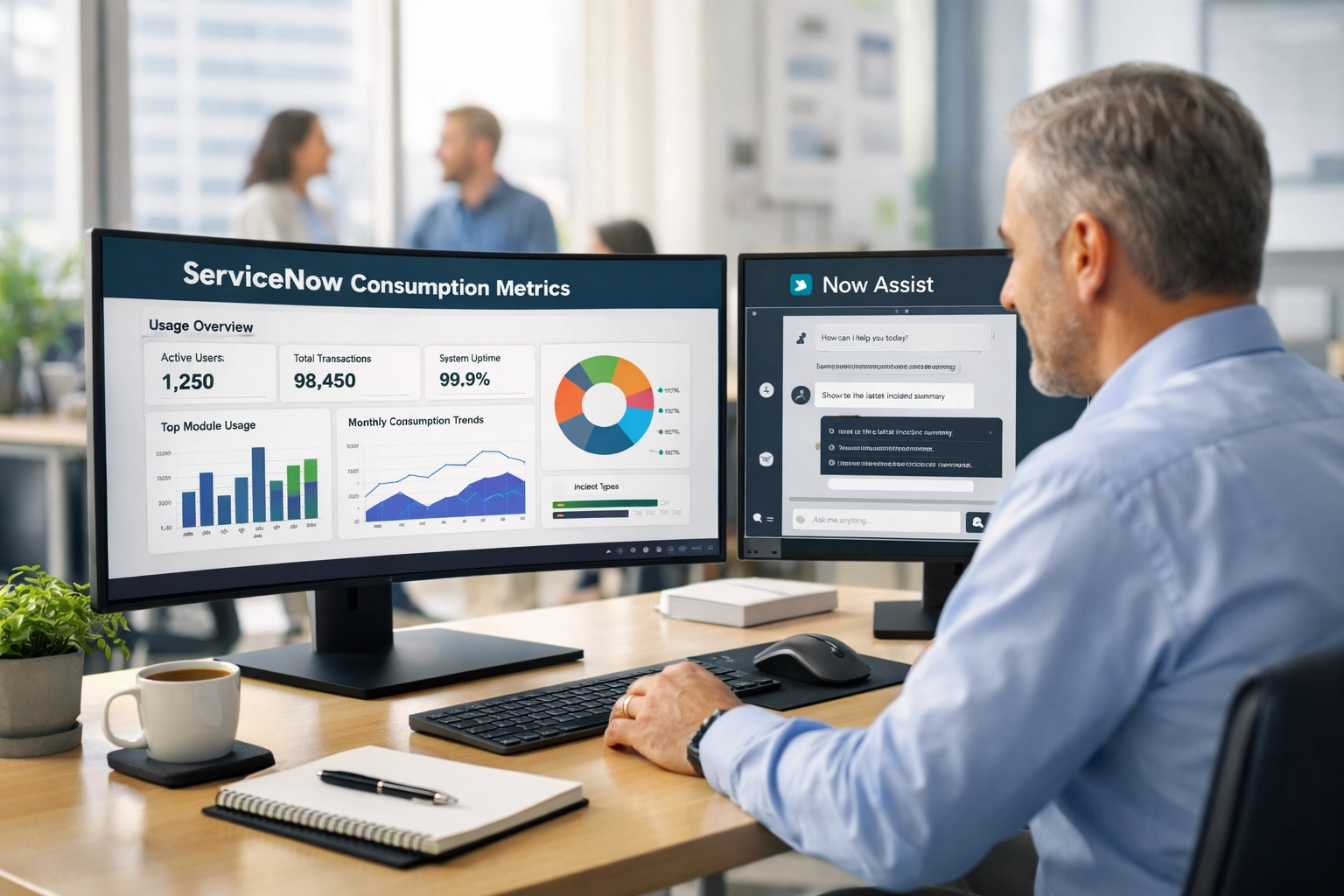
ServiceNow's Now Assist introduces consumption-based pricing: a model that demands unprecedented visibility. Without proper governance, AI consumption can spiral quickly as users experiment with virtual agents, predictive intelligence, and generative AI capabilities.
Agentic AI treats these consumption pools as controlled resources with intelligent guardrails:
Define eligible use cases by department
Set consumption caps with automatic throttling
Track cost per outcome (cost per deflected case, cost per resolved incident)
Implement dynamic showback reporting
Your ServiceNow implementation partner should configure AI agents that monitor Now Assist consumption in real-time, automatically alerting when departments approach thresholds and providing granular cost attribution. This transforms AI tools from uncontrolled expense into measurable ROI investments.

5. Automated Chargeback and Showback Analytics
Finance teams demand accountability. IT leaders need cost transparency. Agentic AI delivers both by automating the complex task of allocating ServiceNow costs across business units, departments, and cost centers.
These intelligent systems integrate ITAM data with your organizational structure, automatically:
Calculating departmental license utilization
Attributing shared service costs based on actual consumption
Generating monthly chargeback reports without manual intervention
Identifying cost outliers requiring immediate attention
I've implemented these systems for enterprises where manual chargeback required 40+ hours monthly. Agentic AI reduced that to zero while improving accuracy by 95%. The cultural shift is equally valuable: when departments see their actual ServiceNow consumption costs, behavior changes rapidly.
6. Continuous Compliance and Audit Readiness
ServiceNow license audits are stressful, time-consuming, and often result in true-up costs that demolish IT budgets. Agentic AI maintains continuous audit readiness by autonomously:
Reconciling entitled licenses against deployed users
Flagging compliance gaps before they become true-up costs
Maintaining immutable audit trails for all license changes
Generating compliance reports on-demand
Your ServiceNow implementation partner should leverage the ServiceNow Configuration Management Database (CMDB) integrated with AI agents that continuously validate license compliance. The Washington DC release enhanced CMDB capabilities with AI-powered relationship mapping: your consulting services provider should be using this to maintain real-time asset visibility.
Organizations using continuous compliance systems reduce true-up costs by an average of 65% and eliminate the panic of annual audits.
7. AI-Powered License Reclamation Workflows with Approval Intelligence
The final strategy combines everything: autonomous detection, intelligent workflows, and smart approval routing. Agentic AI doesn't just identify optimization opportunities: it orchestrates the entire reclamation process.
These sophisticated workflows:
Detect reclamation opportunities using predictive algorithms
Route approvals to appropriate stakeholders based on organizational rules
Automatically execute downgrades after approvals
Track savings impact with detailed ROI dashboards
Your ServiceNow consulting services team should implement these workflows with integration into ITOM monitoring tools, ensuring reclaimed licenses are reallocated to high-priority users within 48 hours. This closed-loop optimization is where enterprises achieve 25%+ license cost reductions in the first quarter.
The ROI Reality: What This Means for Your Bottom Line
Let's talk numbers. A typical 5,000-user ServiceNow deployment with $3.5 million annual licensing costs can expect:
18-25% cost reduction in year one through AI-driven optimization
$630,000-$875,000 in annual savings
95% reduction in manual audit effort
Zero true-up surprises during renewal negotiations
These aren't aspirational figures: they're benchmarks I've helped clients achieve through systematic implementation of agentic AI strategies for ITAM.
Your Next Step: The 2026 ServiceNow ROI & License Audit
The difference between industry-leading organizations and those drowning in license costs often comes down to one factor: the sophistication of their ServiceNow implementation partner. If your current partner isn't discussing agentic AI, predictive analytics, and autonomous optimization, you're working with yesterday's approach.
SnowGeek Solutions offers a Free 2026 ServiceNow ROI & License Audit that analyzes your current deployment, identifies immediate optimization opportunities, and projects 12-month savings potential. Our team leverages the latest AI capabilities from the Washington DC and Xanadu releases to deliver measurable results within 90 days.
Ready to transform your ServiceNow investment from cost center to strategic advantage? Visit our contact page to share your project details and discover exactly how much your organization is leaving on the table. Register with SnowGeek Solutions for platform updates and expert insights that keep you ahead of the optimization curve.
Your ServiceNow licenses shouldn't be a budget mystery: they should be a competitive advantage. Let's make that happen.
Comments