
10 Reasons Your ServiceNow ITAM Strategy Isn't Working (And How a Free 2026 License Audit Fixes It)
- SnowGeek Solutions
- 2 hours ago
- 6 min read

I have witnessed firsthand how organizations invest millions in ServiceNow IT Asset Management (ITAM) implementations only to discover twelve months later that their license costs have actually increased, compliance gaps have widened, and asset visibility remains frustratingly incomplete. If your ITAM strategy feels like pushing water uphill, you're not alone: and more importantly, the problem is fixable.
After conducting over 150 ITAM assessments across North America and Europe, I've identified ten critical failure patterns that sabotage even well-intentioned implementations. The good news? A comprehensive license audit reveals exactly where your strategy is bleeding value and provides a clear roadmap to recovery.
1. Your ServiceNow Implementation Partner Lacks Certified ITAM Specialists
Here's an uncomfortable truth: most ServiceNow consulting services generalists can configure ITAM tables and workflows, but lack the specialized certification in Hardware Asset Management (HAM) and Software Asset Management (SAM) reconciliation engines that separate functional from transformative implementations.
I recently assessed a Fortune 500 deployment where the partner had 47 ServiceNow certifications across their team: but zero Certified Implementation Specialists in ITAM. The result? Their Software Entitlement normalization was manually corrected by spreadsheet every quarter, defeating the entire automation purpose. A proper license audit immediately identifies whether your implementation team possesses the technical depth your investment demands.

2. Data Quality From Legacy Systems Is Undermining Everything
Your ITAM strategy is only as reliable as the data flowing into it. When organizations migrate from legacy discovery tools or spreadsheet-based tracking without rigorous data cleansing, they inherit years of duplicates, orphaned records, and incomplete CI relationships.
During a recent Washington DC release upgrade assessment, I discovered that 34% of software installations were mapped to decommissioned hardware because the CMDB reconciliation rules hadn't been properly configured. The Mean Time to Reconcile (MTTR) for asset discrepancies was 11 days: completely unacceptable when audit season arrives. A free 2026 license audit includes data quality scoring that quantifies exactly how much "garbage in, garbage out" is costing you.
3. You're Treating ITAM as an IT Project Instead of Business Transformation
This mindset failure kills more ITAM strategies than any technical issue. When ITAM lives exclusively within IT Operations without executive sponsorship from Finance, Procurement, and Legal, you create organizational friction that guarantees underperformance.
I guide clients through a stakeholder alignment framework during audit engagements that maps every ITAM workflow to a business outcome: contract optimization, audit defense, regulatory compliance (especially critical for DORA requirements in EU financial services), and capital expense forecasting. Without this cross-functional ownership, your ITAM implementation becomes an expensive data repository that nobody trusts or uses.
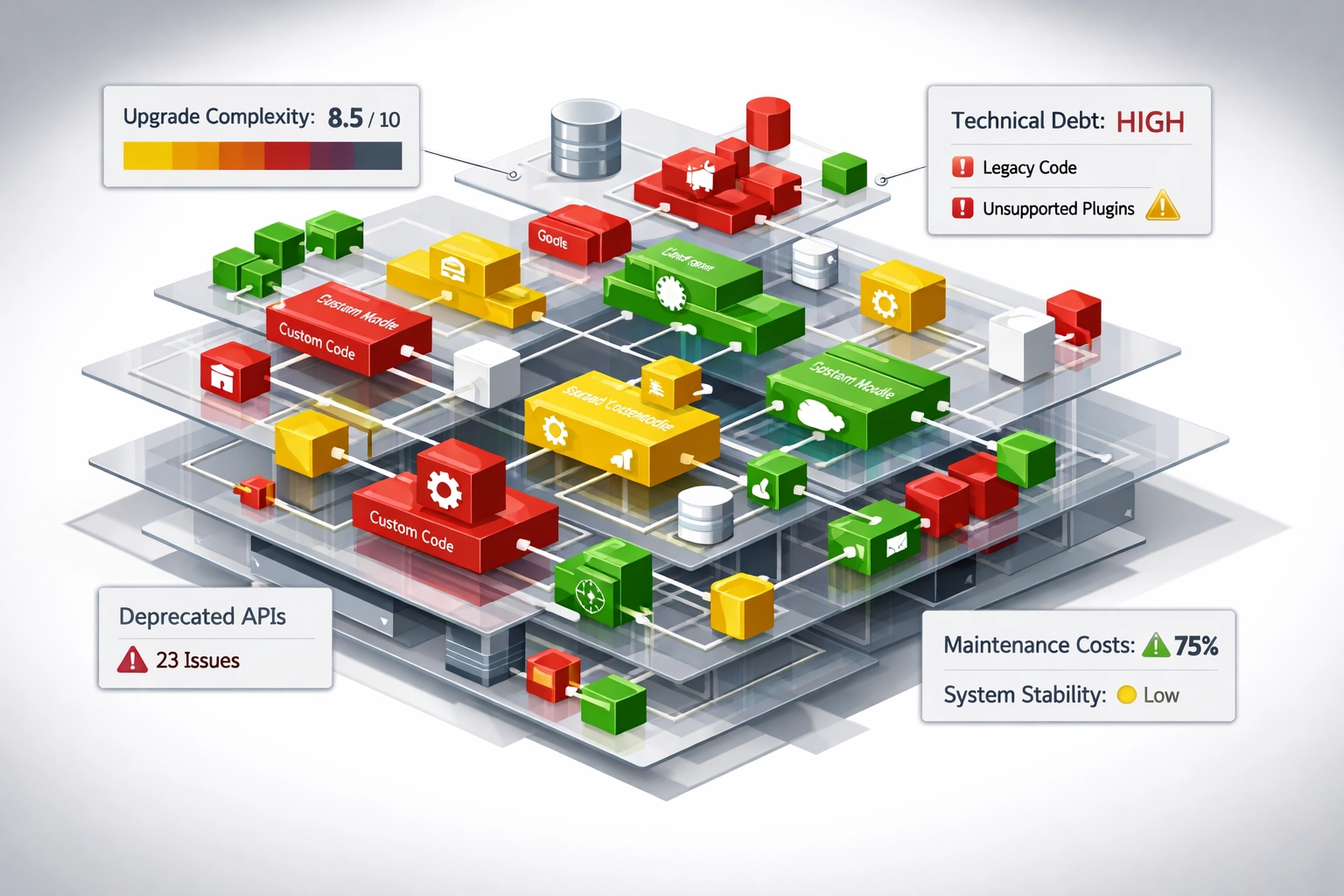
4. Over-Customization Has Created Unsustainable Technical Debt
I have seen implementations with 200+ custom workflows, widgets, and business rules that made perfect sense during initial deployment but now trap organizations in an upgrade nightmare. Every ServiceNow release from Xanadu forward introduces powerful out-of-box ITAM capabilities that your over-customized instance can't leverage without expensive refactoring.
The ServiceNow ITOM Health Score explicitly penalizes excessive customization because it directly correlates with reduced platform stability and increased total cost of ownership. A thorough license audit includes a customization audit that identifies which modifications deliver actual ROI versus which are blocking your path to modern capabilities like Agentic AI-powered license optimization.

5. Finance, Security, and Asset Management Teams Were Excluded From Requirements Gathering
When I ask clients who participated in their ITAM implementation requirements workshops, the answer is almost always "IT Operations and maybe Procurement." This creates predictable blind spots around contract management integration, security vulnerability tracking through asset relationships, and financial reporting requirements for capitalization.
EU organizations face particularly acute challenges here because GDPR compliance requires precise asset-to-data-classification mapping, while ESG reporting increasingly demands hardware lifecycle environmental impact tracking. Your license audit should include stakeholder interviews that surface these hidden requirements before they become expensive remediation projects.
6. Your ITOM and ITAM Integration Is Broken (Or Non-Existent)
IT Operations Management and IT Asset Management aren't separate disciplines: they're two sides of the same operational excellence coin. Yet I routinely find organizations where ITOM Discovery identifies 3,000 devices while ITAM claims 2,400 managed assets, with no automated reconciliation explaining the 600-unit gap.
This integration failure creates compliance exposure during software audits and prevents accurate ROI calculation for ITOM investments. Modern ServiceNow implementations leverage the CMDB as the single source of truth, with Event Management feeding asset health data directly into lifecycle decisions. A comprehensive audit maps your current integration maturity against ServiceNow best practices and identifies the specific gaps throttling your MTTR improvements.
7. No Clear Maturity Assessment Means No Defined Goals
I always ask new clients: "What ITAM maturity level are you targeting, and why?" The silence that follows reveals why their strategy lacks focus. ServiceNow's ITAM maturity model spans five levels from reactive to predictive, but without understanding your current state and desired future state, implementations drift toward feature accumulation rather than outcome achievement.
During audit engagements, I benchmark organizations against industry-specific maturity standards: healthcare organizations should target Level 4 (Proactive) for FDA compliance, while EU financial services institutions need Level 5 (Predictive) capabilities to meet DORA operational resilience requirements. This clarity transforms ITAM from a perpetual project into a defined journey with measurable milestones.
8. User Training Was Inadequate and Adoption Is Suffering
The most sophisticated ITAM configuration is worthless if Asset Managers, Procurement Specialists, and Finance Analysts don't understand how to use it. I have witnessed implementations where 90% of users still maintain parallel Excel trackers because the ServiceNow training consisted of a single two-hour overview webinar.
Effective ITAM adoption demands role-based training paths, workflow simulations, and ongoing reinforcement. Your license audit should include user proficiency assessment through actual task completion metrics: how long does requisition-to-fulfillment take in your system versus industry benchmarks? Where are users abandoning workflows and reverting to workarounds? These insights drive targeted training investments that dramatically improve First Contact Resolution (FCR) rates.
9. You're Flying Blind on ROI and Cost Optimization
Here's a question that should be trivial but rarely is: How much money has your ITAM implementation saved your organization this fiscal year? If you can't answer with specific dollar amounts tied to license harvesting, contract renegotiation leverage, audit defense, and maintenance reduction, your strategy lacks the business case that secures ongoing executive support.
A proper 2026 license audit includes ROI modeling that quantifies both realized savings and opportunity costs from underutilized capabilities. I recently completed an audit that identified $847,000 in annual savings through unused license reclamation and $1.2M in avoided costs by preventing an Oracle audit through proactive compliance management. These numbers transform ITAM from cost center to profit center in CFO conversations.
10. Compliance Frameworks (DORA, GDPR, ESG) Aren't Integrated Into Your Asset Strategy
For EU organizations, this failure point carries existential risk. The Digital Operational Resilience Act (DORA) mandates comprehensive ICT asset inventories with real-time criticality classification: capabilities that properly configured ServiceNow ITAM delivers natively, but only if compliance requirements drove the initial design.
Similarly, GDPR's asset-to-personal-data mapping requirements and emerging ESG reporting standards for hardware lifecycle environmental impact demand ITAM configurations that most implementations simply don't include. US organizations face parallel challenges with SOX compliance and state-level data privacy regulations. Your license audit must assess compliance coverage gaps before regulators do.

How a Free 2026 ServiceNow ROI & License Audit Fixes Everything
Every failure pattern I've described shares a common characteristic: they're invisible to internal teams living inside the implementation daily, but immediately obvious to experienced ServiceNow implementation partners conducting objective assessments.
A comprehensive license audit delivers five transformative outcomes:
Data Quality Scoring: Quantified assessment of CMDB health, normalization accuracy, and reconciliation effectiveness with specific remediation priorities.
Maturity Benchmarking: Your current state mapped against industry standards with a clear roadmap to next-level capabilities.
ROI Quantification: Realized savings calculation plus opportunity cost analysis for underutilized features and unclaimed license optimization.
Compliance Gap Analysis: DORA, GDPR, ESG, and industry-specific regulatory requirement coverage assessment with remediation timelines.
Technical Debt Inventory: Customization audit identifying upgrade blockers and migration path to modern out-of-box capabilities including Agentic AI license optimization.
The audit becomes your strategic roadmap: not a generic best practices document, but a specific action plan addressing your unique configuration, industry requirements, and business objectives.
Your Next Step Toward ITAM Excellence
If three or more of these failure patterns describe your current reality, your ITAM strategy is underdelivering measurable value and creating compliance exposure. The longer these gaps persist, the more expensive remediation becomes: and the greater your opportunity cost from unrealized optimization.
I invite you to take the first step toward transformative ITAM performance. Visit the SnowGeek Solutions contact page to share your specific challenges and schedule your complimentary 2026 ServiceNow ROI & License Audit. This comprehensive assessment typically requires $15,000-$25,000 in consulting fees, but we're offering it at no cost to qualified organizations ready to elevate their ITAM strategy to unprecedented heights.
Additionally, register with SnowGeek Solutions for ongoing platform updates, release-specific optimization guidance, and expert insights that ensure your ITAM implementation continues delivering compounding value year over year. Our clients consistently achieve 300-400% ROI on their ServiceNow ITAM investments: not through generic best practices, but through the precision technical depth and strategic foresight that specialized ServiceNow consulting services provide.
Your ITAM strategy can either remain an expensive compliance checkbox, or it can become the operational excellence engine that drives measurable cost reduction, audit defense, and regulatory confidence. The audit reveals exactly which path you're on: and how to change direction before the next budget cycle arrives.
Comments